
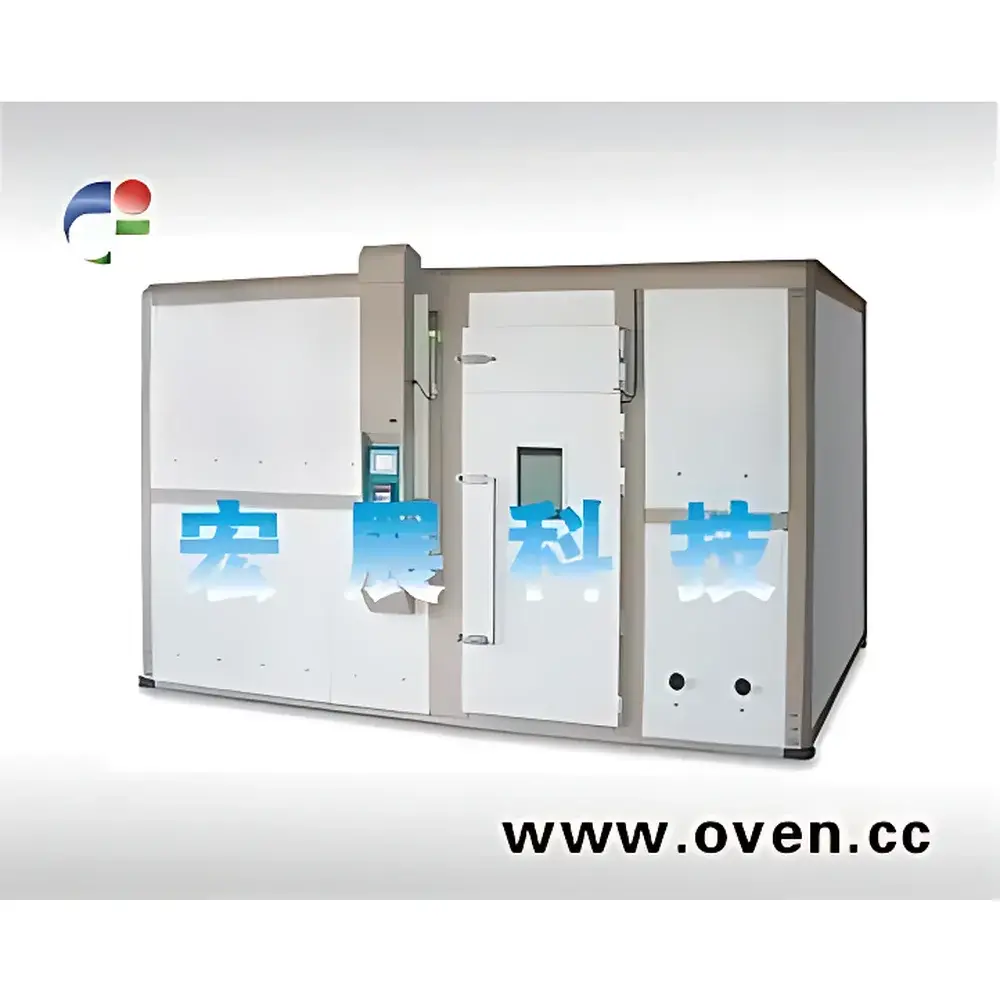
LabCompanion HH-235 Walk-in Environmental Test Chamber (High-Temperature Forced-Air Oven)
| Brand | LabCompanion |
|---|---|
| Origin | Guangdong, China |
| Manufacturer Type | Direct Manufacturer |
| Model | HH-235 |
| Chamber Interior Dimensions (H×W×D) | 750 × 600 × 500 mm |
| External Dimensions (H×W×D) | ≈1230 × 1100 × 680 mm |
| Power Supply | 220 V, 50 Hz |
| Heating Power | 4.0 kW |
| Operating Temperature Range | Ambient +10 °C to 250 °C |
| Temperature Uniformity | ±1.6% of setpoint |
| Air Circulation | Dual horizontal forced-air duct system |
| Cabinet Material | Cold-rolled steel with light-gray epoxy coating |
| Interior & Duct Material | Stainless steel (SUS304) |
| Heater Type | Stainless steel tubular heating elements |
| Heater Location | Bottom-mounted |
| Insulation | 80 mm thick glass wool |
| Blower Motor | 40 W |
| Temperature Controller | Digital PID controller with LED display, keypad input, auto-hold function |
| Sensor | Pt100 platinum resistance thermometer |
| Timer Range | 0.01–99.99 h with audible alarm and automatic heater cutoff |
| Safety Protections | Short-circuit, overload, motor thermal overload, and phase-loss protection |
| Standard Accessories | 2 stainless steel wire mesh shelves |
Overview
The LabCompanion HH-235 is a walk-in environmental test chamber engineered for precise, repeatable high-temperature thermal processing in industrial, pharmaceutical, and research laboratory environments. Designed as a forced-air convection oven, it operates on the principle of uniform horizontal air circulation across dual ducts—ensuring consistent heat distribution throughout the entire 225 L working volume (750 × 600 × 500 mm). Its maximum operating temperature of 250 °C supports critical applications including drying, baking, thermal aging, sterilization validation, and pre-conditioning of polymeric, ceramic, and composite materials. The chamber’s robust architecture integrates bottom-mounted stainless steel tubular heaters, a high-efficiency 40 W blower motor, and 80 mm thick glass wool insulation—achieving stable thermal performance while minimizing external surface temperature rise and energy consumption. All internal surfaces—including the chamber walls, floor, ceiling, and airflow ducts—are fabricated from SUS304 stainless steel, ensuring corrosion resistance, ease of cleaning, and compliance with ISO 14644 cleanroom-compatible material standards.
Key Features
- Stainless steel (SUS304) interior and dual horizontal air duct system for optimal thermal homogeneity and long-term durability
- Digital PID temperature controller with LED display, real-time setpoint adjustment, and auto-hold functionality
- Pt100 platinum resistance thermometer for accurate, traceable temperature sensing with ≤0.1 °C repeatability
- Programmable timer (0.01–99.99 hours) with audible alarm and automatic heater deactivation upon completion
- Comprehensive electrical safety suite: short-circuit, overload, motor thermal overload, and three-phase loss protection
- Cold-rolled steel outer cabinet with electrostatically applied light-gray epoxy finish for mechanical resilience and chemical resistance
- Bottom-mounted heating configuration enabling rapid thermal ramp-up and reduced thermal stratification
Sample Compatibility & Compliance
The HH-235 accommodates large-format samples—including full-size PCB assemblies, automotive component subassemblies, medical device packaging trays, and bulk pharmaceutical intermediates—without spatial constraint. Its open-chamber design supports custom fixture integration and direct access for in-situ monitoring or periodic sampling. The unit complies with IEC 61000-6-3 (EMC emissions), IEC 61000-6-2 (immunity), and meets general requirements for laboratory equipment under ISO/IEC 17025:2017 clause 6.4. While not certified to UL or CE for standalone safety listing, its construction adheres to widely adopted engineering practices referenced in ASTM E145–22 (Standard Specification for Gravity-Convection and Forced-Ventilation Ovens) and supports user-defined qualification protocols aligned with FDA 21 CFR Part 11 data integrity expectations when paired with validated logging software.
Software & Data Management
The HH-235 operates as a standalone instrument with embedded PID logic; no proprietary software is required for basic operation. However, its analog voltage output (0–10 V DC) and RS485 Modbus RTU interface enable seamless integration into facility-wide SCADA or LIMS platforms. When connected to compliant third-party data acquisition systems, the unit supports time-stamped temperature logging, audit trail generation, and electronic signature capability—facilitating adherence to GLP and GMP documentation requirements. All temperature setpoints, actual readings, timer status, and alarm events are retained in non-volatile memory for post-run review, satisfying minimum record retention mandates outlined in ISO 9001:2015 clause 7.5.3.
Applications
- Thermal stability testing of active pharmaceutical ingredients (APIs) and excipients per ICH Q1A(R2)
- Drying kinetics studies of hygroscopic powders and granules in formulation development
- Accelerated aging of polymer-based medical devices per ISO 11607–2
- Pre-bake conditioning of semiconductor wafers and printed circuit boards prior to coating or lamination
- Residual solvent removal from lithium-ion battery electrode slurries
- Validation of autoclave pre-drying cycles in sterile manufacturing environments
- Calibration reference chamber for secondary temperature sensors in metrology labs
FAQ
What is the maximum continuous operating temperature of the HH-235?
The chamber is rated for continuous operation up to 250 °C, with thermal cut-off protection activated at 270 °C.
Does the HH-235 support programmable ramp-soak profiles?
No—this model features single-setpoint PID control only. For multi-step thermal profiling, consider the LabCompanion TH-235 series with programmable controller upgrade.
Is the interior lighting compatible with UV-sensitive materials?
The standard chamber includes an incandescent viewing lamp; optional LED lighting with <400 nm cutoff filter is available upon request.
Can the unit be configured for inert atmosphere operation?
Yes—custom nitrogen purge ports and gas-tight door gaskets can be factory-installed; consult technical sales for ASME BPVC Section VIII Div. 1 pressure rating options.
What maintenance intervals are recommended for the blower motor and heating elements?
Visual inspection every 6 months; bearing lubrication and resistance verification annually; heater continuity check during quarterly preventive maintenance.



