
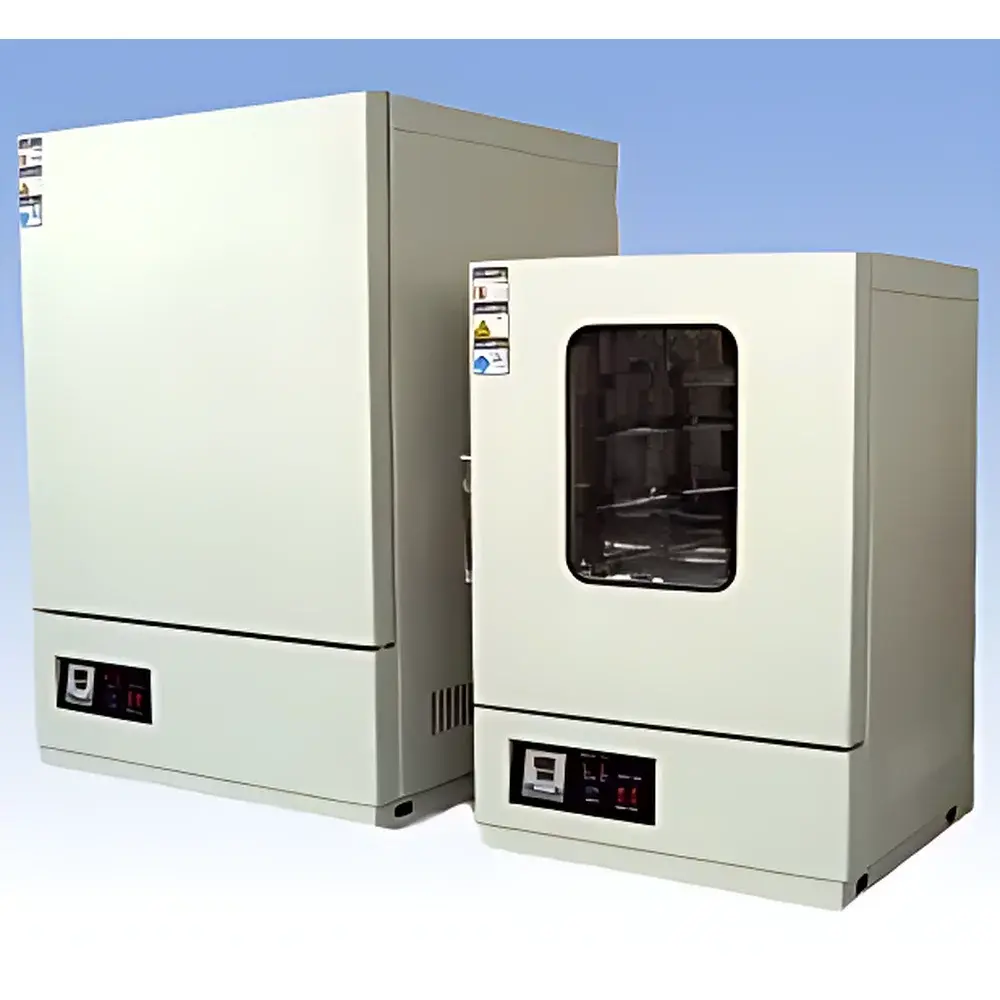
LabCompanion CS101-E LED Digital Display Forced-Air Drying Oven
| Brand | LabCompanion |
|---|---|
| Origin | Guangdong, China |
| Manufacturer Type | Direct Manufacturer |
| Country of Origin | China |
| Model | CS101-E |
| Pricing | Upon Request |
| Temperature Range | R.T.+10°C to 300°C |
| Temperature Uniformity | ±2.5% |
| Temperature Fluctuation | ±0.5°C |
| Heating Rate (to 200°C) | ≤70 min |
| Control System | PID with LED Digital Display |
| Sensor | Industrial PT100 Platinum Resistance Thermometer |
| Heating Element | Nickel-Chromium Alloy |
| Air Circulation | Forced Convection via Centrifugal Blower |
| Interior Material | SUS304 Mirror-Finish Stainless Steel (BN variant) or Pre-treated Cold-Rolled Steel (EN variant) |
| Insulation | Ultra-Fine Glass Fiber |
| Door Seal | Eco-Friendly Silicone Rubber |
| Viewing Window | Double-Layer High-Temperature Tempered Glass |
| Power Supply | AC 220 V, 50 Hz |
| Rated Power | 1.5 kW |
| Internal Dimensions (W×D×H) | 450×400×400 mm |
| External Dimensions (W×D×H) | 610×575×905 mm |
| Net Volume | 72 L |
| Safety Features | Independent Over-Temperature Protection, Thermal Cut-Out Circuit Breaker |
| Compliance | JB/T 5520–1991 “Technical Specifications for Drying Ovens” |
Overview
The LabCompanion CS101-E LED Digital Display Forced-Air Drying Oven is an engineered solution for precision thermal processing in research laboratories, quality control environments, and industrial manufacturing settings. Designed around a robust forced-convection architecture, it maintains stable, uniform temperature distribution across the working chamber through a high-efficiency centrifugal blower and optimized airflow ducting. The oven operates on the principle of convective heat transfer, where heated air is continuously recirculated—ensuring rapid thermal equilibration and minimal spatial gradient. Its core application domain includes drying, baking, sterilization, curing, and aging of non-flammable, non-explosive samples—particularly critical in semiconductor packaging, optoelectronics (e.g., LED/LCD module conditioning), passive component manufacturing (capacitors, resistors, quartz crystals), pharmaceutical stability testing, and polymer post-curing. The unit complies fully with JB/T 5520–1991, the Chinese national standard governing performance, safety, and metrological requirements for laboratory drying ovens.
Key Features
- High-precision PID temperature controller with digital LED display for simultaneous readout of setpoint and actual chamber temperature
- Industrial-grade PT100 platinum resistance sensor mounted at the chamber center for traceable, repeatable measurement (±0.1°C intrinsic accuracy)
- Double-layer high-temperature tempered glass observation window enabling real-time visual monitoring without thermal disturbance
- Energy-efficient nickel-chromium heating elements controlled via zero-crossing thyristor switching—minimizing electrical noise and extending component life
- Two standard stainless-steel adjustable shelves included; optional additional shelves available for multi-tier sample loading
- Front-accessible exhaust port (Φ45 mm) with manual damper for controlled vapor removal during moisture-sensitive processes
- Independent mechanical over-temperature safety cutoff—electrically isolated from main control circuitry for fail-safe operation
- Electrostatically coated cold-rolled steel exterior and mirror-finish SUS304 stainless steel interior (BN version) ensuring corrosion resistance and ease of decontamination
Sample Compatibility & Compliance
The CS101-E accommodates a broad range of sample formats—including Petri dishes, crucibles, trays, PCBs, wafers, and component carriers—within its 72 L working volume. Its non-explosive classification permits use with aqueous solutions, solvent-free polymers, metal oxides, ceramic precursors, and biological matrices under validated drying protocols. The oven meets structural and functional requirements outlined in JB/T 5520–1991, including temperature uniformity verification (±2.5% deviation across load zone), fluctuation limits (±0.5°C at steady state), and recovery time specifications. While not certified to ISO/IEC 17025 or ASTM E145, its design principles align with GLP-compliant thermal validation practices. For regulated environments, optional RS485 interface supports integration into centralized monitoring systems compliant with FDA 21 CFR Part 11 when paired with validated data acquisition software.
Software & Data Management
The CS101-E operates as a standalone instrument with embedded microcontroller-based logic—no external PC required for basic operation. All parameters (setpoint, timer, alarm thresholds) are configured locally via intuitive up/down keypad navigation. The LED display provides real-time feedback with 0.1°C resolution and auto-zero calibration upon power-up. Optional accessories include a programmable temperature controller (enabling multi-step ramp-hold profiles) and an RS485 serial interface for remote parameter readback, event logging, and alarm notification via Modbus RTU protocol. When integrated into a validated networked environment, audit trails—including operator ID, timestamped setpoint changes, and thermal excursion alerts—can be archived in accordance with GMP Annex 11 and EU GMP Chapter 4 documentation requirements.
Applications
- LED phosphor layer drying and encapsulant curing under tightly controlled thermal profiles
- Aging tests for electrolytic capacitors and thin-film resistors per IEC 60384-1 and JIS C 5101 standards
- Residual solvent removal from coated optical filters and LCD alignment layers
- Moisture content determination in pharmaceutical excipients (USP <921> compliant when validated)
- Pre-conditioning of reference standards prior to gravimetric analysis
- Thermal stabilization of calibration weights and gauge blocks in metrology labs
- Curing of epoxy-based adhesives used in MEMS packaging and hybrid circuit assembly
FAQ
What is the maximum operating temperature and how is thermal stability verified?
The CS101-E achieves a maximum operating temperature of 300°C. Stability is confirmed by measuring temperature fluctuation at the chamber center over 30 minutes at setpoints of 100°C, 150°C, and 200°C—results must remain within ±0.5°C per JB/T 5520–1991.
Can this oven be used for sterilization of medical devices?
No. It lacks the validation-grade temperature mapping, HEPA filtration, and steam generation capability required for microbiological sterilization (e.g., ISO 17665). It is suitable only for dry-heat depyrogenation of glassware and metal tools under user-defined SOPs.
Is the internal chamber volume calibrated and traceable to national standards?
Volume is calculated geometrically from nominal internal dimensions (450 × 400 × 400 mm). Calibration certificates for temperature uniformity and fluctuation are available upon request and performed using NIST-traceable PT100 probes.
Does the oven support continuous operation for extended aging cycles?
Yes. Designed for unattended 24/7 operation, it incorporates thermal cut-out redundancy, fan failure detection, and automatic restart suppression after power interruption.
How does the forced-air system minimize thermal stratification?
A rear-mounted centrifugal blower directs heated air upward through perforated ducts along the chamber walls, creating a vertical laminar flow pattern that suppresses convection-driven layering—verified by nine-point uniformity mapping per JB/T 5520–1991 Annex B.
Related Products



