
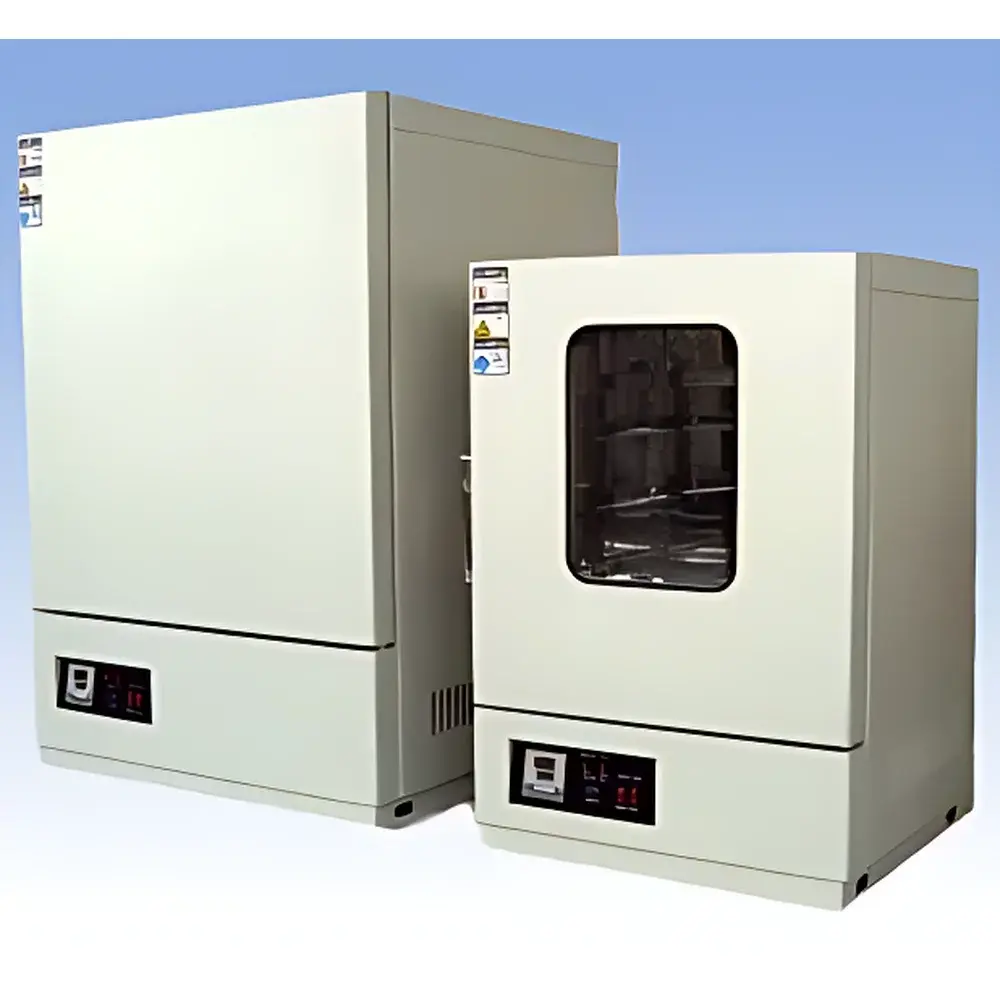
LabCompanion CS101-E Forced-Air Drying Oven
| Brand | LabCompanion |
|---|---|
| Model | CS101-E |
| Type | Forced-Convection Benchtop Drying Oven |
| Temperature Range | RT+10°C to 300°C |
| Temperature Uniformity | ±2.5% |
| Temperature Fluctuation | ±0.5°C |
| Heating Rate (to 300°C) | ≤70 min |
| Control System | Microprocessor-Based PID with Auto-Tuning |
| Temperature Sensor | Industrial PT100 Platinum Resistance Thermometer |
| Chamber Material | SUS304 Mirror-Finish Stainless Steel (BN variant) or Pre-Painted Cold-Rolled Steel (EN variant) |
| Insulation | High-Density Ultra-Fine Glass Fiber |
| Viewing Window | Double-Layer Tempered Heat-Resistant Glass |
| Safety Features | Independent Over-Temperature Cut-Off, Over-Current Circuit Breaker |
| Power Supply | AC 220 V, 50 Hz |
| Rated Power | 1.5 kW |
| Internal Volume | 72 L |
| Interior Dimensions (W×D×H) | 450 × 400 × 400 mm |
| External Dimensions (W×D×H) | 610 × 575 × 905 mm |
| Standard Accessories | 2 Stainless Steel Shelves, 4 Shelf Supports, User Manual |
Overview
The LabCompanion CS101-E is a microprocessor-controlled, forced-convection benchtop drying oven engineered for precision thermal processing in R&D laboratories and production QC environments. It operates on the principle of uniform air circulation via a centrifugal blower system, ensuring consistent heat distribution across the chamber volume—critical for repeatable drying, baking, sterilization, and aging protocols. Designed to meet the structural and performance requirements outlined in JB/T 5520–1991 (Technical Specifications for Drying Ovens), the CS101-E delivers stable thermal control within a working range of ambient +10°C to 300°C. Its compact vertical architecture optimizes floor space without compromising internal volume (72 L), making it suitable for integration into constrained lab benches or cleanroom support zones. The unit is not rated for flammable, explosive, or volatile organic solvent applications; it complies strictly with IEC 61010-1 safety standards for laboratory electrical equipment.
Key Features
- Microprocessor-based PID temperature controller with auto-tuning capability, enabling adaptive response to load variations and ambient fluctuations
- Dual-display LED interface showing both setpoint and real-time chamber temperature simultaneously
- Independent mechanical over-temperature protection circuit—functionally isolated from the main controller for fail-safe operation
- Temperature compensation function to correct systematic offset between sensor reading and actual sample-zone temperature
- High-efficiency insulation using ultra-fine glass fiber (thermal conductivity < 0.04 W/m·K at 200°C), minimizing energy consumption and external surface temperature rise
- Double-layer tempered observation window with low-emissivity coating, maintaining structural integrity up to 300°C while reducing radiant heat loss
- Sealed door gasket made from food-grade silicone rubber (operational range: –60°C to +250°C), ensuring long-term compression set resistance and leak-tight sealing
- Modular internal construction allowing rapid field replacement of heating elements, fan assemblies, and sensor modules
Sample Compatibility & Compliance
The CS101-E is validated for non-hazardous, non-volatile solid and semi-solid samples—including electronic components (LEDs, LCD drivers, quartz crystals, passive SMDs), polymer films, pharmaceutical excipients, ceramic precursors, and metal oxide coatings. It supports standardized thermal treatment procedures referenced in ASTM D2857 (moisture content in plastics), ISO 293 (compression molding of thermoplastics), and USP (dry-heat sterilization validation). While not intrinsically compliant with FDA 21 CFR Part 11 out-of-the-box, the optional RS485 interface enables integration with validated LIMS or SCADA systems supporting audit-trail-enabled data logging. All electrical design conforms to EN 61000-6-3 (EMC emission limits) and EN 61000-6-2 (immunity requirements).
Software & Data Management
The base configuration includes local parameter storage for up to 10 user-defined programs, each with segment-based ramp/soak profiles and timer-triggered shutdown. When equipped with the optional programmable controller (sold separately), the unit supports full cycle logging at 1-second intervals, exportable via USB or RS485 to CSV-compatible platforms. Data integrity safeguards include password-protected parameter modification, event timestamping (power-on, alarm activation, door opening), and non-volatile memory retention during mains interruption. For GLP/GMP-aligned workflows, third-party software solutions (e.g., WinQSB, LabVIEW DAQ modules) may be deployed to enforce electronic signatures, version-controlled protocol execution, and automated report generation per Annex 11 guidelines.
Applications
- Pre-conditioning of moisture-sensitive electronic assemblies prior to solder reflow or conformal coating
- Accelerated thermal aging of encapsulants, adhesives, and dielectric layers per JEDEC JESD22-A108
- Drying of filter papers, gravimetric crucibles, and volumetric glassware in analytical chemistry labs
- Baking of thin-film transistor substrates in display manufacturing pilot lines
- Residual solvent removal from coated optical lenses and photomask blanks
- Stabilization annealing of ferrite cores and magnetic shielding components
- Validation of shelf-life stability for desiccant-based packaging systems
FAQ
What is the maximum recommended operating temperature for continuous use?
The CS101-E is rated for sustained operation at 300°C; however, prolonged exposure above 250°C may accelerate degradation of the silicone door seal and reduce long-term calibration stability.
Can the unit be used for sterilization of surgical instruments?
No—this model lacks the pressure vessel certification, steam generation capability, and biological indicator validation required for medical device sterilization per ISO 17665.
Is the PT100 sensor calibrated traceable to NIST standards?
Factory calibration is performed against a reference standard certified to ISO/IEC 17025; NIST-traceable calibration certificates are available as an add-on service with documented uncertainty budgets.
Does the oven support ramp-and-soak programming in standard configuration?
No—segmented thermal profiling requires the optional programmable controller module; the base unit supports only single-setpoint timed operation.
What maintenance intervals are recommended for optimal performance?
Blower motor lubrication every 12 months, door gasket inspection every 6 months, and annual verification of temperature uniformity per ASTM E2203 using a 9-point sensor array.



