
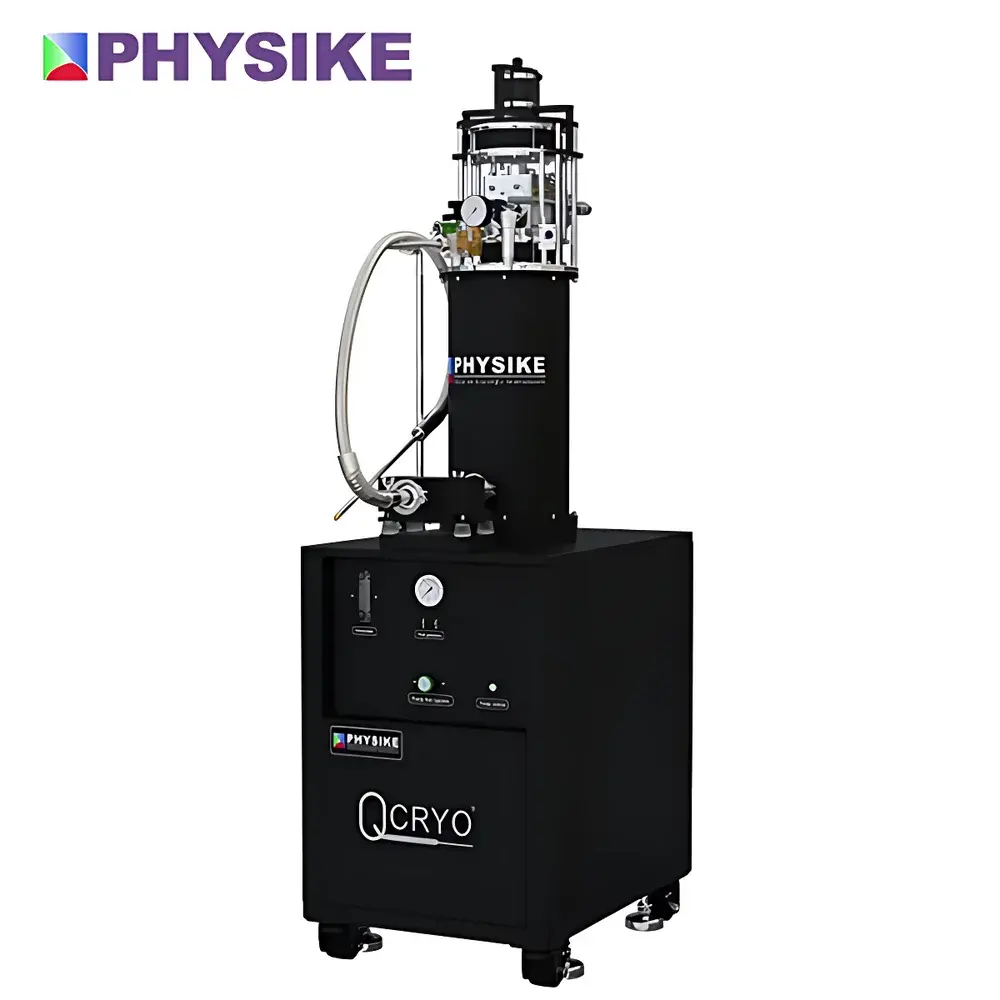
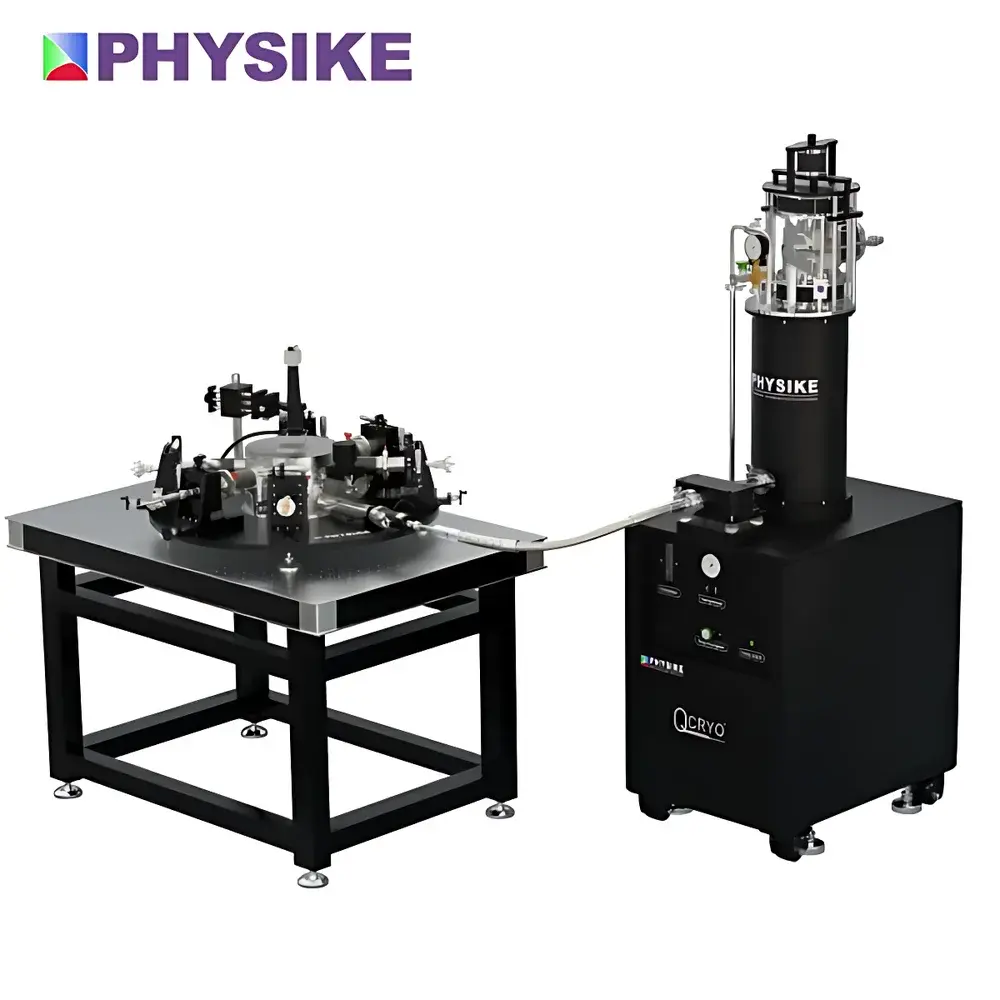
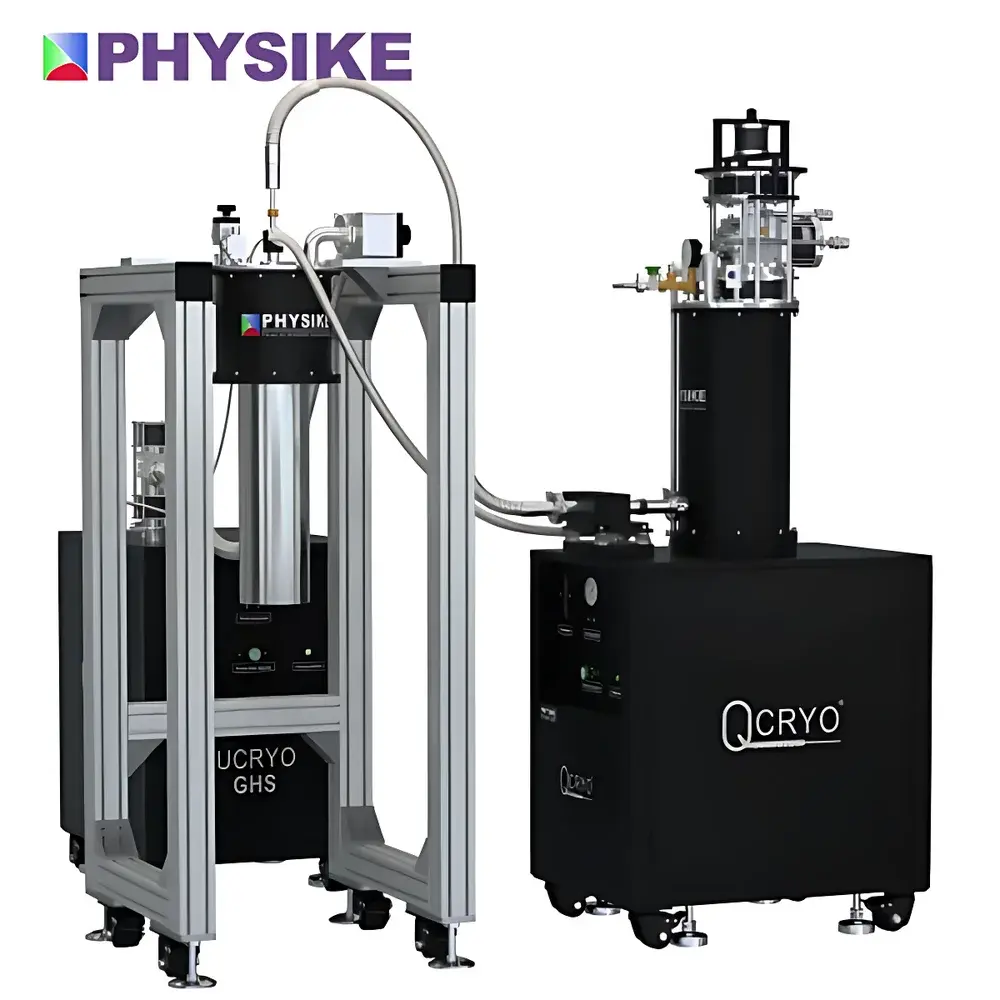
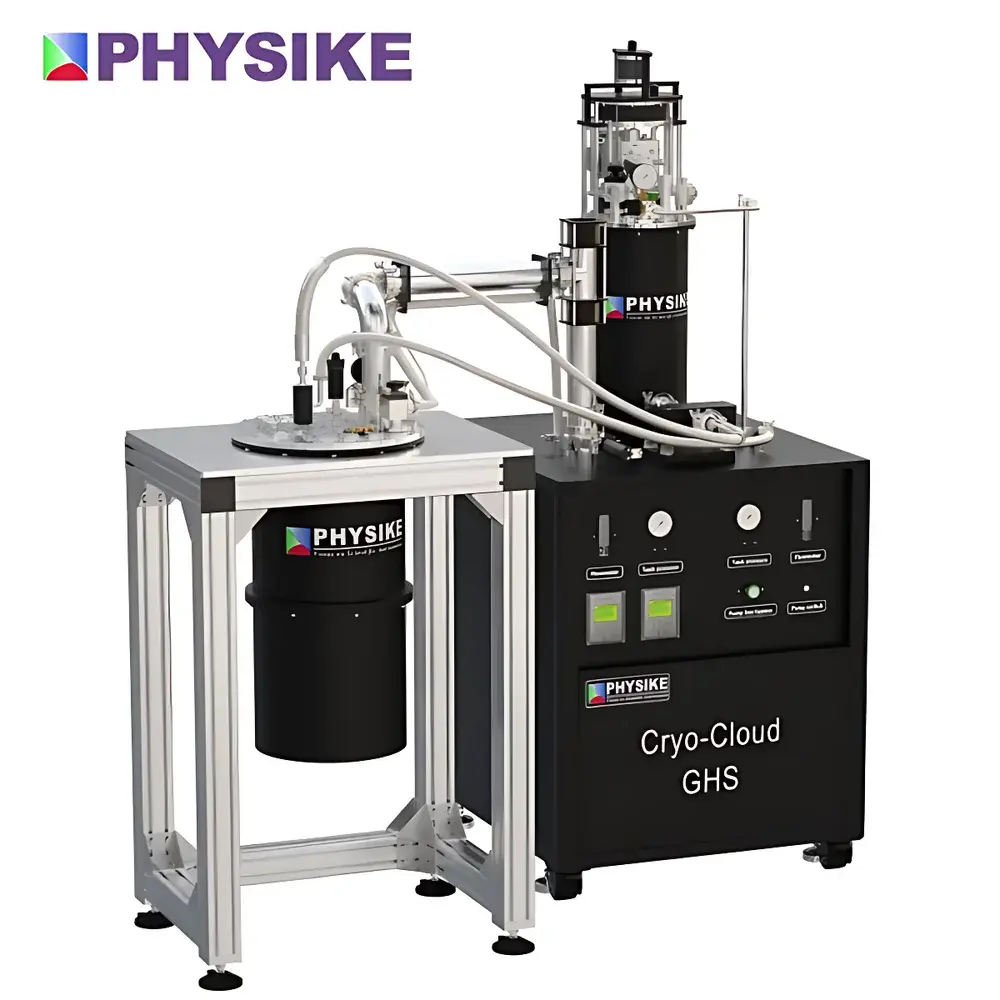
PHYSIKE Qcryo Helium-Closed-Cycle Cryogenic System
| Brand | PHYSIKE |
|---|---|
| Origin | Beijing, China |
| Manufacturer Type | Original Equipment Manufacturer (OEM) |
| Country of Origin | China |
| Model | Qcryo |
| Pricing | Upon Request |
Overview
The PHYSIKE Qcryo Helium-Closed-Cycle Cryogenic System is an engineered cryogenic infrastructure platform designed to convert standard commercial 4 K pulse-tube or Gifford-McMahon (GM) cryocoolers into ultra-low-vibration, sub-2.5 K cold sources without liquid helium consumption. Operating on a closed-cycle helium gas recirculation principle, the Qcryo integrates a high-efficiency gas handling unit—including multi-stage precooling, pressure-regulated feedback control, and ultra-low-vibration helium transfer lines—with externally mounted continuous-flow, sub-Kelvin, or He-3 cryostats. Its core thermodynamic architecture enables stable thermal anchoring at temperatures as low as <2.5 K (standard), <1.8 K (optional), <1.3 K (optional), <800 mK (with sub-K cryostat), <350 mK (continuous-flow He-3 cryostat), and <280 mK (single-shot He-3 cryostat). Unlike conventional dry cryocoolers, the Qcryo suppresses mechanical vibration transmission via proprietary decoupling design and active helium mass flow stabilization—critical for scanning probe microscopy, quantum sensing, and high-resolution optical spectroscopy where picometer-scale stability is required.
Key Features
- Sub-2.5 K base temperature (standard); optional configurations support <1.8 K and <1.3 K operation
- Ultra-low mechanical vibration: RMS displacement <5 nm below 10 Hz; validated for STM, AFM, and TEM-compatible cryogenic stages
- Closed-cycle helium recirculation: zero liquid helium consumption; no helium gas replenishment required during operation
- High thermal stability: ±1 mK temperature fluctuation over 10 minutes at base temperature, enabled by constant-pressure feedback regulation and triple-stage precooling
- Modular compatibility: interfaces with commercial continuous-flow cryostats, sub-K cryostats, He-3 cryostats (continuous and single-shot), cryogenic probe stations, and bolometric detectors
- Continuous operation capability: sample exchange possible without system warm-up or cooldown cycles
- Configurable cryocooler integration: supports multiple GM and pulse-tube cryocoolers (e.g., Sumitomo RDK-101D, Cryomech PT415, Bluefors LD series)
- Low operational cost: eliminates recurring liquid helium procurement, storage, and handling logistics
Sample Compatibility & Compliance
The Qcryo system is compatible with a broad range of commercially available cryogenic platforms, including but not limited to: Janis ST-500/ST-1000 continuous-flow cryostats, Bluefors BF-LD250/BF-UC250 sub-K systems, Attocube ANS300/ANS310 He-3 inserts, Montana Instruments Cryostation series, and custom UHV-compatible cryogenic inserts. All Qcryo configurations meet ISO 14001 environmental management standards for energy-efficient operation and comply with IEC 61000-6-2/6-4 electromagnetic compatibility requirements. For regulated laboratory environments, the integrated gas handling controller supports audit-trail logging and user-access-level configuration management—facilitating GLP/GMP alignment and FDA 21 CFR Part 11 readiness when paired with compliant data acquisition software.
Software & Data Management
The Qcryo system is controlled via PHYSIKE’s proprietary CryoControl Suite—a Windows-based application offering real-time monitoring of helium pressure, mass flow rate, cold-head temperature, second-stage temperature, and cryostat cold-finger temperature. The software provides programmable temperature ramps, setpoint hold functions, and automated cooldown/warm-up sequences. All operational parameters are logged in HDF5 format with timestamps synchronized to UTC via NTP. Export options include CSV and MATLAB-compatible .mat files. Remote access is supported via secure TLS-encrypted Ethernet connection. Optional integration with LabVIEW™, Python (via PyVISA), and EPICS IOC enables full automation within synchrotron beamline or quantum computing testbed environments.
Applications
- Scanning tunneling microscopy (STM) and atomic force microscopy (AFM) requiring picometer-scale thermal-mechanical stability
- Quantum device characterization: superconducting qubits, spin qubits, topological insulators, and 2D materials under magnetic fields
- Low-temperature optical spectroscopy: micro-PL, Raman, magneto-optical Kerr effect (MOKE), nano-ARPES, and time-resolved fluorescence lifetime imaging
- Single-photon detection and quantum optics experiments using SNSPDs or transition-edge sensors (TES)
- Electron spin resonance (ESR/EPR) and nuclear magnetic resonance (NMR) with enhanced signal-to-noise ratio at sub-2 K
- UHV-compatible surface science: molecular beam epitaxy (MBE) post-growth analysis, ion trapping, and cold atom lattice loading
- Bolometric infrared detector testing and calibration across 2.5–350 K temperature ranges
- High-energy physics instrumentation: cryogenic particle detector readout and radiation-hardened sensor validation
FAQ
What is the lowest achievable base temperature with the Qcryo system?
The standard Qcryo configuration achieves <2.5 K when coupled with a commercial continuous-flow cryostat. With optional sub-K or He-3 cryostats, base temperatures of <800 mK (sub-K), <350 mK (continuous-flow He-3), and <280 mK (single-shot He-3) are attainable.
Does the Qcryo require periodic helium refilling?
No. The system operates as a fully sealed, closed-cycle helium recirculation platform. No helium gas or liquid helium replenishment is required under normal operation.
Can the Qcryo be integrated with existing liquid-helium cryostats?
Yes. The Qcryo is designed to retrofit most commercially available liquid-helium-based cryostats—including Janis, Oxford Instruments, and Advanced Research Systems models—converting them into helium-conserving dry systems.
Is the Qcryo compatible with ultra-high vacuum (UHV) environments?
Yes. Models such as Qcryo-S-200 and Qcryo-S-400 are UHV-rated (≤1×10⁻¹⁰ mbar) and feature all-metal seals, bakeable components, and non-magnetic construction suitable for STM, quantum diamond NV-center AFM, and surface science applications.
How is temperature stability maintained at sub-Kelvin regimes?
Stability is achieved through a combination of constant-pressure helium mass flow regulation, multi-stage passive precooling (50 K → 4 K → 1.5 K), and active thermal anchoring of the cryostat cold stage—enabling ±1 mK stability over 10-minute intervals at base temperature.



