
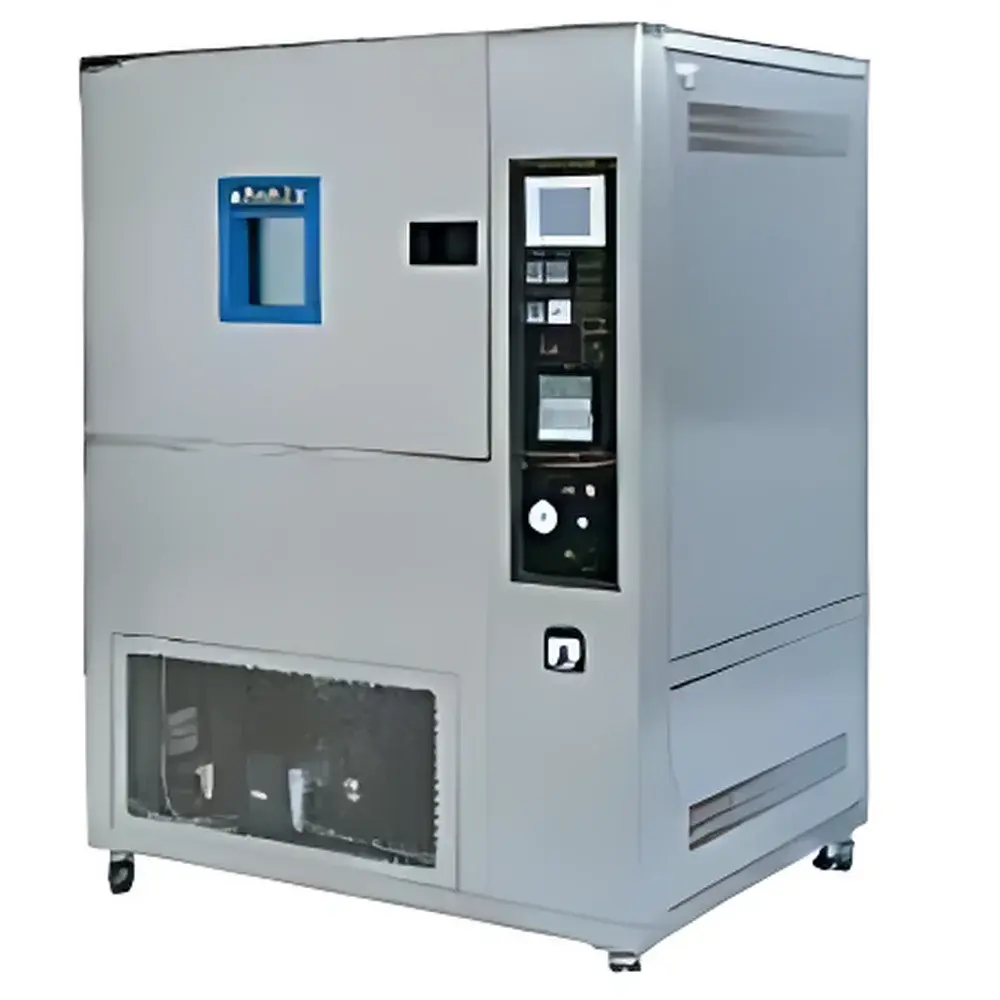
LabCompanion SH+TH Series Combined Salt Spray, Dry & Humid Corrosion Test Chamber
| Brand | LabCompanion |
|---|---|
| Model | SH+TH Series |
| Construction Material | SUS#316L inner chamber (1.0 mm), SUS#304 outer casing & saturation tank |
| Internal Dimensions (W×H×D) | 960 × 860 × 620 mm |
| Operating Temperature Range | –20 °C to +80 °C |
| Humidity Range | 25 %RH to 98 %RH |
| Temperature Control Accuracy | ±1 °C |
| Humidity Control Accuracy | ±2 %RH |
| Ramp Rate | 1 °C/min |
| Salt Fog Collection Rate | 1–2 mL/80 cm²/h |
| Control System | Japanese-made digital temperature/humidity programmable controller with LCD interface, integrated saturation tank controller (0–99.9 °C), timer (0–9999.9 hr), high-pressure recirculating pump |
| Program Capacity | Up to 99 steps per cycle, 99 cycles repeatable, individual step duration: 1 min to 99 h 59 min |
| Safety Protection | Comprehensive interlock system including over-temperature, over-pressure, low-water-level, and leakage detection |
| De-fogging System | Pneumatic air-pressure assisted fog exhaust |
| Compliance | Designed to meet ASTM B117, ISO 9227, JIS Z2371, and GB/T 2423.17 test method requirements |
Overview
The LabCompanion SH+TH Series Combined Salt Spray, Dry & Humid Corrosion Test Chamber is an engineered environmental simulation system designed for accelerated multi-phase corrosion testing of metallic components, coatings, and protective finishes. Unlike conventional single-mode salt spray chambers, this instrument integrates three distinct environmental stressors—neutral salt fog, controlled drying, and regulated humid conditioning—within a single, tightly sealed test volume. Its operation follows the fundamental principles of electrochemical corrosion acceleration: chloride ion penetration under elevated humidity initiates anodic dissolution, while cyclic drying promotes crystallization-induced coating delamination and hygroscopic salt reactivation upon rehumidification. This sequential stress profile replicates real-world exposure conditions encountered in marine, coastal, automotive under-hood, and industrial atmospheric environments. The chamber’s architecture supports standardized test protocols defined by ASTM B117 (salt fog), ASTM D2247 (humidity), ASTM D4585 (condensing humidity), and ISO 9227 (corrosion testing in artificial atmospheres), enabling reproducible, auditable data generation for QC release, R&D validation, and regulatory submissions.
Key Features
- Triple-function environmental cycling: programmable sequence of salt spray → dry → humid phases, each independently controllable for temperature, duration, and relative humidity
- Corrosion-resistant internal construction using 1.0 mm thick SUS#316L stainless steel—optimized for resistance to chloride-induced pitting and crevice corrosion during prolonged exposure
- Integrated pneumatic de-fogging system that actively evacuates residual salt mist post-spray phase, preventing cross-contamination between test stages and ensuring operator safety and optical clarity through the observation window
- High-precision Japanese digital temperature/humidity programmable controller with full-cycle logging capability, supporting up to 99 programmable steps per test sequence and 99 repeat cycles with audit-trail-ready timestamping
- Saturation air tower fabricated from SUS#304 stainless steel rated for sustained operation at 47 °C ±1 °C and pressures exceeding 1.2 bar—ensuring consistent fog droplet size distribution and stable pH (6.5–7.2) of collected solution
- Modular fluid management: concealed reagent reservoir with integrated level sensor, calibrated salt solution delivery pump, and non-drip nozzle array with adjustable spray angle and uniformity verification per ISO 9227 Annex A
Sample Compatibility & Compliance
The SH+TH chamber accommodates standard test specimens up to 600 mm in height and 450 mm in width, with full compatibility for ASTM G85 Annex A2 (acidified salt fog), Annex A5 (cyclic acidified salt fog), and ISO 14993 (cyclic corrosion testing). All wetted surfaces—including nozzles, saturator, and collection funnels—are constructed from chloride-resistant alloys to prevent metal ion leaching that could skew corrosion morphology. The system meets mechanical and electrical safety requirements per IEC 61000-6-2 (immunity) and IEC 61000-6-4 (emissions), and its control firmware supports GLP-compliant data integrity features including user access levels, electronic signature prompts, and immutable event logs. Optional validation packages include IQ/OQ documentation aligned with ISO/IEC 17025 and FDA 21 CFR Part 11 readiness for regulated industries.
Software & Data Management
LabCompanion’s proprietary WinControl-Corrosion software (Windows-based, USB/Ethernet interface) enables remote monitoring, real-time parameter visualization, and automated report generation in PDF or CSV format. The software enforces ALCOA+ data principles—attributable, legible, contemporaneous, original, accurate, complete, consistent, enduring, and available—with built-in calibration traceability to NIST-traceable references. All temperature, humidity, and timing events are recorded at 1-second intervals and stored redundantly on internal flash memory and external host PC. Audit trails capture operator ID, parameter changes, alarm acknowledgments, and program starts/stops—fully compliant with ISO 17025 Clause 7.7 and EU Annex 11 requirements for computerized systems in testing laboratories.
Applications
- Automotive OEMs and Tier-1 suppliers validating paint systems, galvanized steel, aluminum die-cast housings, and fastener coatings against GMW14872, Ford CETP, and VW PV1210 specifications
- Aerospace component manufacturers performing qualification per SAE AMS 2700 and ASTM F1110 for landing gear hardware and engine bay enclosures
- Electronics enclosure producers assessing IP-rated housing integrity under combined thermal-hygric-saline stress per IEC 60068-2-52
- Marine equipment fabricators verifying cathodic protection performance and coating adhesion on offshore structural steel per NORSOK M-501
- Academic corrosion research groups conducting mechanistic studies on localized attack initiation, rust creepage measurement, and inhibitor efficacy screening
FAQ
What standards does the SH+TH series support out-of-the-box?
The chamber is pre-configured for ASTM B117, ISO 9227, JIS Z2371, and GB/T 2423.17; optional firmware modules enable compliance with ASTM D6899 (cyclic corrosion), ISO 14993, and VDA 621-415.
Can the salt solution concentration be adjusted during a test cycle?
No—the system uses fixed-concentration NaCl solution (5.0 ± 0.1 % w/w) per ISO 9227; however, dual-reservoir configurations (optional) allow switching between neutral and acidified solutions via programmable valve sequencing.
Is calibration certification included with shipment?
Yes—a factory-issued calibration certificate (traceable to national standards) covering temperature, humidity, and spray rate is provided; on-site IQ/OQ services are available upon request.
What maintenance intervals are recommended for long-term reliability?
Daily: visual inspection of nozzles and water level; weekly: cleaning of saturator and drain lines; quarterly: verification of temperature/humidity sensor drift and pressure regulator function; annually: full system performance validation.
Does the controller support Modbus TCP for integration into central MES/LIMS platforms?
Yes—standard Ethernet port supports Modbus TCP/IP protocol (function codes 03h/04h/10h) for bidirectional data exchange with SCADA, LIMS, or ERP systems.
Related Products



