
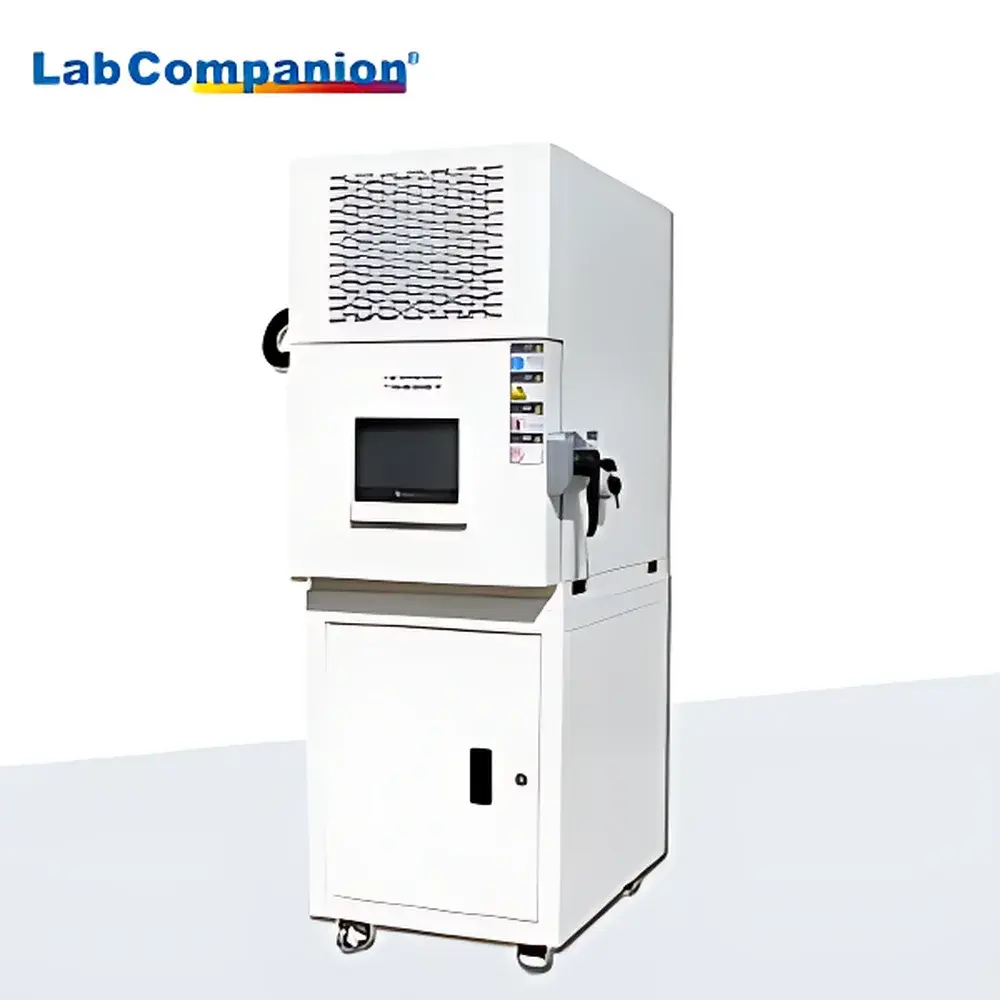
LabCompanion PL20 Desktop High-Low Temperature Test Chamber
| Brand | LabCompanion |
|---|---|
| Origin | Guangdong, China |
| Manufacturer Type | Direct Manufacturer |
| Country of Origin | China |
| Model | PL20 |
| Temperature Range | -40 °C to +150 °C |
| Cooling Method | Compressor-based Refrigeration |
| Explosion-Proof | Standard (Non-Explosion-Proof) |
| Temperature Fluctuation | ±0.5 °C |
| Temperature Uniformity | ±2.0 °C |
| Temperature Deviation | ±2.0 °C |
| Heating Rate (20 °C to +150 °C, no-load, non-linear) | 3.0 °C/min |
| Cooling Rate (20 °C to -40 °C, no-load, non-linear) | 1.2 °C/min |
| Internal Chamber Dimensions (W×D×H) | 300 mm × 300 mm × 200 mm |
| Internal Volume | 18 L |
Overview
The LabCompanion PL20 Desktop High-Low Temperature Test Chamber is an engineered environmental simulation system designed for precise thermal stress evaluation of photonic components, optical modules, fiber connectors, and miniature optoelectronic assemblies. Operating on a dual-stage compressor refrigeration cycle with PID-controlled forced-air convection, the chamber delivers stable, repeatable thermal profiles across a wide operational range of –40 °C to +150 °C. Its compact desktop footprint (300 × 300 × 200 mm internal dimensions) makes it ideal for integration into optical lab benches, QC stations, and R&D workcells where space efficiency and thermal fidelity are critical. Unlike walk-in or floor-standing chambers, the PL20 employs optimized airflow ducting and high-density insulation to minimize thermal lag and reduce boundary-layer effects—ensuring accurate representation of real-world thermal cycling conditions experienced by light-emitting diodes (LEDs), laser diodes (LDs), photodetectors, and passive optical devices during field deployment.
Key Features
- Compact desktop form factor with 18 L internal volume—optimized for single-device or small-batch photonic component testing
- Compressor-based dual-stage refrigeration system enabling reliable operation down to –40 °C without liquid nitrogen or cryogenic assist
- PID-driven temperature control with ±0.5 °C fluctuation and ±2.0 °C uniformity across the working zone (per IEC 60068-3-5)
- Verified heating rate of 3.0 °C/min (20 °C → +150 °C, no-load, non-linear) and cooling rate of 1.2 °C/min (20 °C → –40 °C, no-load, non-linear)
- Stainless-steel interior chamber with electrostatically painted exterior housing for corrosion resistance and ESD-safe handling
- Integrated over-temperature, over-pressure, and compressor overload protection per UL 61010-1 and EN 61010-1 safety standards
- Front-access transparent door with double-layer low-emissivity glass for real-time visual monitoring without thermal interruption
Sample Compatibility & Compliance
The PL20 accommodates standard photonic test fixtures—including TO-can sockets, butterfly-mount holders, fiber alignment stages, and PCB-mounted device carriers—within its 300 mm × 300 mm × 200 mm workspace. It supports thermal cycling protocols required by Telcordia GR-468-CORE (reliability of optoelectronic devices), IEC 61347-1 (LED driver thermal endurance), and MIL-STD-810H Method 501.7/502.7 (temperature storage and operating). While the base PL20 model is configured for dry thermal testing only, optional humidity modules (PL20-H) extend capability to 20–98% RH for combined thermal-hygroscopic stress assessment. All configurations comply with electromagnetic compatibility (EMC) requirements under EN 61326-1 and meet essential safety clauses for laboratory equipment per ISO/IEC 17025-accredited environments.
Software & Data Management
The chamber integrates with LabCompanion’s TC-Link™ Control Suite (v4.2+), a Windows-based application supporting programmable multi-step thermal profiles, real-time data logging at 1 Hz resolution, and CSV export for traceable analysis. The software enables user-defined alarm thresholds, automatic pass/fail flagging against preset thermal soak durations, and audit-ready event logs—including setpoint changes, door openings, and safety interlock triggers. For regulated laboratories, optional 21 CFR Part 11 compliance packages provide electronic signature authentication, role-based access control, and immutable audit trails—fully aligned with GLP and GMP documentation requirements for optical component qualification reports.
Applications
- Thermal cycling validation of VCSEL arrays and silicon photonics transceivers per IEEE 802.3bs specifications
- High-temperature life testing of optical isolators and wavelength division multiplexers (WDMs)
- Low-temperature functional verification of fiber Bragg grating (FBG) sensors and planar lightwave circuit (PLC) splitters
- Pre-screening of epoxy-cured optical adhesives and UV-curable lens mounts under accelerated thermal aging
- Environmental stress screening (ESS) of QSFP-DD and OSFP modules prior to burn-in and final QA release
- Supporting failure analysis (FA) workflows in conjunction with optical time-domain reflectometers (OTDRs) and spectral analyzers
FAQ
What is the maximum sample weight the PL20 chamber can accommodate without compromising thermal uniformity?
The chamber is rated for static loads up to 5 kg distributed evenly on the chamber floor; exceeding this may impede airflow and degrade uniformity beyond ±2.0 °C.
Can the PL20 be integrated into an automated test system via digital I/O or Ethernet?
Yes—standard RS-485 Modbus RTU and optional Ethernet/IP interfaces support bidirectional communication with ATE platforms and SCADA systems.
Is calibration certification included with shipment?
A factory-issued NIST-traceable temperature calibration report (at three points: –40 °C, 25 °C, +150 °C) is provided; ISO/IEC 17025-accredited field calibration services are available upon request.
Does the PL20 support ramp-soak-ramp (RSR) profiles with dwell times under 1 minute?
Yes—the controller supports minimum dwell times of 60 seconds and linear ramp rates adjustable in 0.1 °C/min increments.
Are replacement consumables—such as air filters or desiccant cartridges—required for routine maintenance?
The unit contains a washable aluminum pre-filter; no desiccant or consumable media is used in the standard dry-thermal configuration.



