
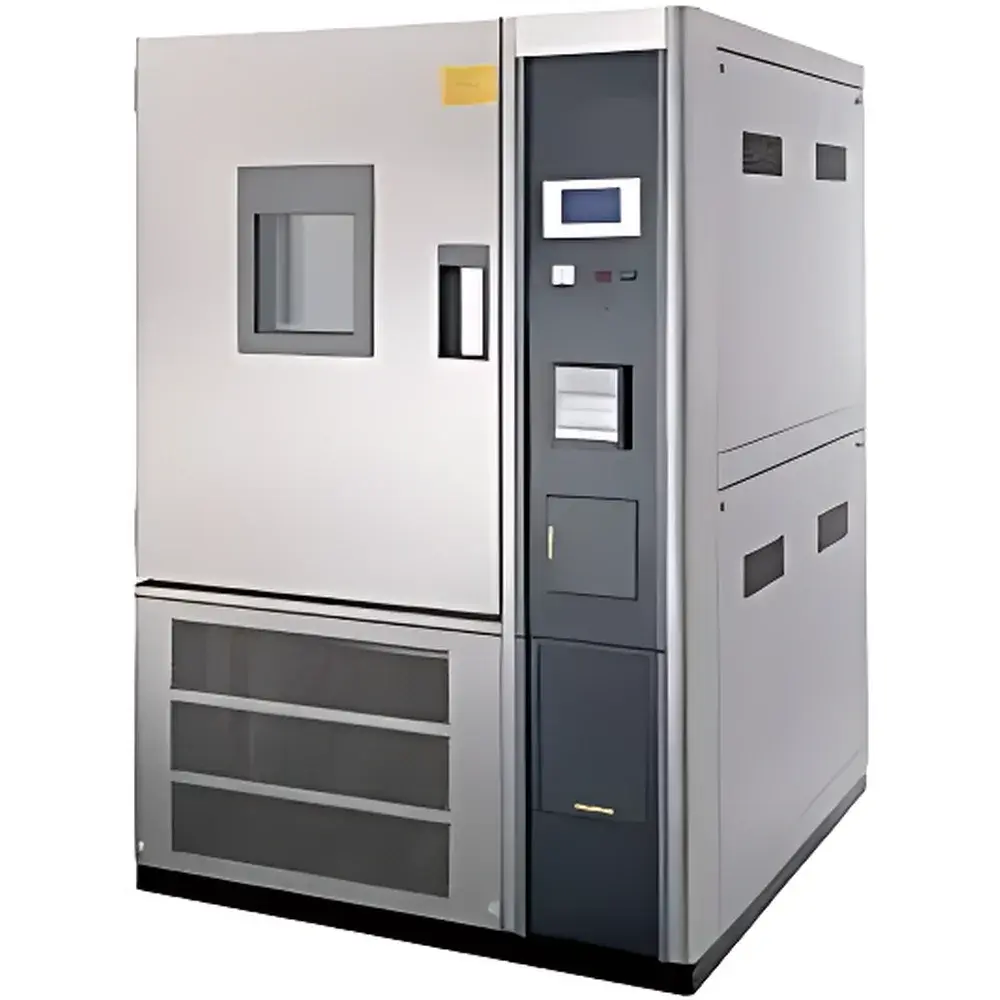
LabCompanion UC-80S High-Low Temperature Alternating Environmental Test Chamber
| Brand | LabCompanion |
|---|---|
| Model | UC-80S |
| Temperature Range (Standard Configuration) | -40 °C to +150 °C |
| Temperature Uniformity | ±0.5 °C |
| Temperature Accuracy | ±0.3 °C |
| Internal Dimensions (W×D×H) | 400 mm × 500 mm × 400 mm |
| External Dimensions (W×D×H) | 880 mm × 1650 mm × 920 mm |
| Construction | Interior – SUS304 stainless steel mirror finish |
| Insulation | Rigid polyurethane foam (glass wool used for high-temp operation up to 150 °C) |
| Refrigeration System | Hermetic compressor-based dual-stage cascade system (for -40 °C capability) |
| Control System | Korean-made PID controller with LCD interface, English-language firmware, LAN port optional |
| Compliance | GB/T 10589–2008, GB/T 2423.22–2012, IEC 60068-2-14 |
Overview
The LabCompanion UC-80S High-Low Temperature Alternating Environmental Test Chamber is an engineered solution for accelerated environmental stress testing of electronic components, automotive modules, packaging materials, and industrial assemblies under rigorously controlled thermal cycling conditions. Based on forced-air convection and a dual-stage cascade refrigeration architecture, the chamber delivers precise, repeatable temperature transitions between -40 °C and +150 °C—enabling compliance-driven qualification per JEDEC JESD22-A104, MIL-STD-810H Method 502.7, and IEC 60068-2-14. Its thermally optimized chamber geometry, high-efficiency insulation, and responsive PID-controlled heating/cooling subsystems ensure stable setpoint maintenance and minimal thermal gradient across the test volume. Designed for laboratory and production QA environments, the UC-80S supports both steady-state (constant temperature) and dynamic (programmed ramp-and-soak) operational modes, with real-time monitoring and traceable data logging capabilities.
Key Features
- Stainless steel interior (SUS304 mirror-finish) and corrosion-resistant exterior (brushed stainless or epoxy-powder-coated steel) for long-term durability and cleanroom-compatible operation.
- Dual-stage cascade refrigeration system with hermetic compressors, enabling reliable sub-zero performance down to -40 °C without liquid nitrogen dependency.
- Precision temperature control via imported Korean PID controller with 0.1 °C resolution, PT100 platinum resistance sensors, and auto-tuning functionality.
- Integrated observation window with double-layer low-E tempered glass, internal LED lighting, and Ø50 mm sealed test port for external signal routing or sensor feedthrough.
- Two adjustable stainless steel shelves with load capacity up to 15 kg each, facilitating flexible sample arrangement and airflow optimization.
- Comprehensive safety and reliability systems: over-temperature cut-off, compressor high-pressure protection, phase failure detection, and power-loss recovery with resume-on-power restoration.
Sample Compatibility & Compliance
The UC-80S accommodates a broad range of sample types—including PCBAs, LED modules, lithium-ion battery cells, medical device housings, and polymer-based enclosures—within its 80 L internal volume (400 × 500 × 400 mm). Its uniformity specification of ±0.5 °C (measured per IEC 60068-3-5) ensures representative thermal exposure across the entire working zone. The chamber meets national and international standards including GB/T 10589–2008 (Cold and Heat Test Chambers), GB/T 2423.22–2012 (Environmental Testing – Part 2: Tests – Test N: Change of Temperature), and aligns with technical requirements of ISO 16750-4 (Road vehicles – Environmental conditions and testing for electrical and electronic equipment) and AEC-Q200 stress test profiles. Optional LAN connectivity enables integration into centralized lab management systems compliant with FDA 21 CFR Part 11 for audit-trail-enabled validation protocols.
Software & Data Management
While the base UC-80S operates via standalone controller firmware, the optional LAN interface supports remote monitoring and command execution via TCP/IP using standard Modbus RTU or custom HTTP API endpoints. Real-time temperature curves, alarm logs, and program execution history are stored internally and exportable as CSV files via USB flash drive. All recorded data include timestamp, setpoint, actual chamber temperature, and event flags (e.g., door open, compressor cycle status). The controller firmware incorporates GLP/GMP-aligned features: user-level access control (administrator/operator tiers), electronic signature prompts for critical parameter changes, and immutable audit trails with tamper-proof time stamps—facilitating IQ/OQ/PQ documentation in regulated manufacturing environments.
Applications
- Thermal cycling qualification of LED lighting systems per IES LM-80 and ENERGY STAR SSL requirements.
- Pre-conditioning and life-cycle stress screening of automotive ECUs prior to functional testing.
- Material compatibility verification for adhesives, conformal coatings, and encapsulants exposed to extreme thermal gradients.
- Reliability assessment of consumer electronics during design validation (DV) and production validation (PV) phases.
- Accelerated aging studies of lithium-based batteries under controlled charge/discharge thermal boundary conditions.
- Calibration support for temperature-sensitive metrology tools requiring stable ambient reference environments.
FAQ
What is the standard temperature range for the UC-80S model?
The UC-80S is configured for -40 °C to +150 °C operation. Other variants (e.g., UC-150S, UC-225S) extend to -70 °C or higher upper limits.
Does the chamber support programmable thermal profiles?
Yes—it supports up to 99 segments in a single program, with independent ramp rate, soak duration, and cycle count settings.
Is the controller firmware validated for regulated industries?
The base firmware includes audit trail, user authentication, and electronic signature functions; full 21 CFR Part 11 compliance requires configuration review and documented validation by the end user.
Can external sensors be integrated for multi-point monitoring?
The Ø50 mm test port allows feedthrough of thermocouples or RTDs; additional channel inputs are not natively supported but may be added via third-party DAQ systems connected via LAN.
What maintenance intervals are recommended for the refrigeration system?
Compressor oil and filter-drier replacement is advised every 24 months under continuous operation; annual inspection of condenser coils and refrigerant charge integrity is required.



