
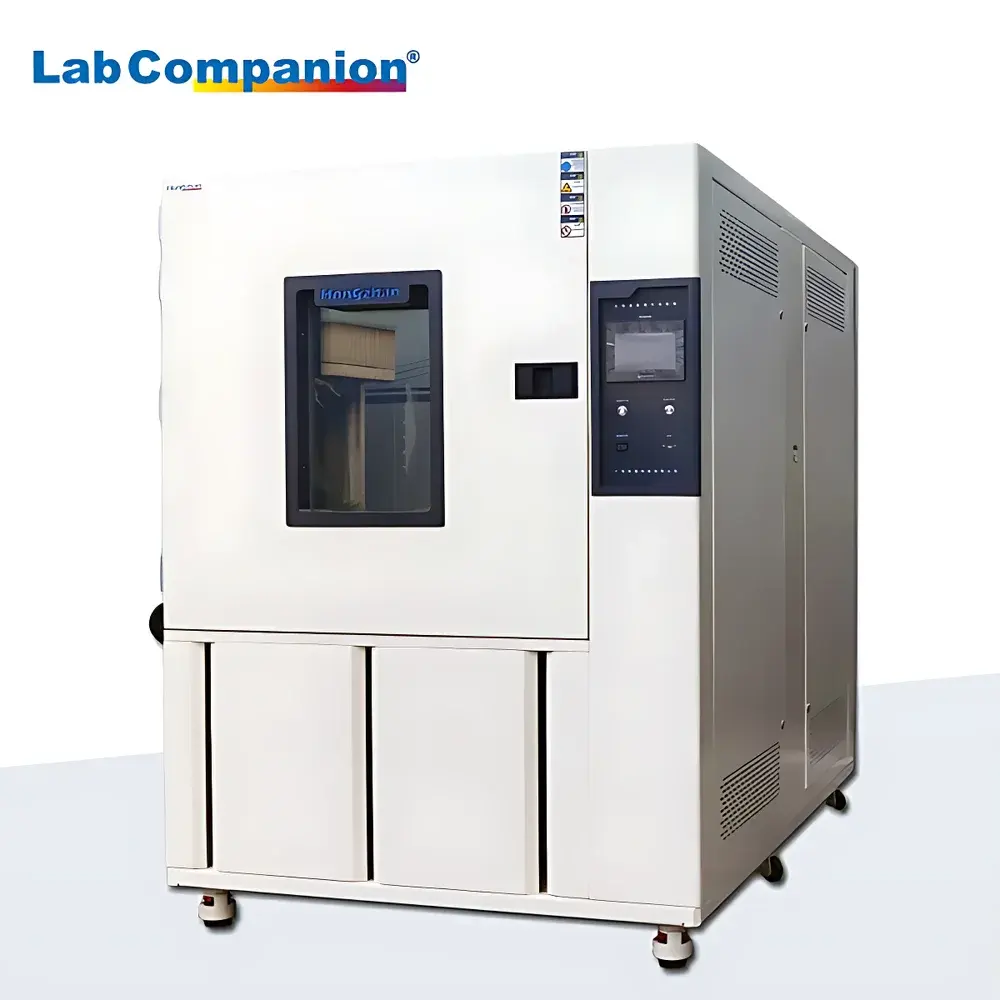
LabCompanion Solar PV Environmental Test Chamber – Combined Thermal Cycling / Damp Heat / Freeze-Thaw Chamber
| Brand | LabCompanion |
|---|---|
| Origin | Guangdong, China |
| Manufacturer Type | OEM/ODM Manufacturer |
| Country of Origin | China |
| Model | Solar PV Series (PHP & PL Series) |
| Temperature Range | -40 °C to +100 °C |
| Humidity Range | 30–98 % RH |
| Temperature Uniformity | ≤ ±2 °C |
| Temperature Fluctuation | ±0.5 °C |
| Humidity Deviation | +2 % RH / −3 % RH (≥75 % RH), ±5 % RH (<75 % RH) |
| Internal Dimensions (D×W×H) | 1400×750×2350 mm to 1400×2550×2350 mm |
| Sample Capacity | 3–12 standard PV modules (up to 1000×50×2000 mm) |
| Controller | TEMI300 (Korean) or Japanese touchscreen PID controller |
| Refrigerant | R404A/R23 |
| Cooling Method | Water-cooled |
| Power Supply | 380 V, 50 Hz, 3-phase 5-wire |
| Compliance | IEC 61215:2005, IEC 61646:2008, GB/T 2423.3–2016, GB/T 10586–2018, GB/T 10592–2008 |
Overview
The LabCompanion Solar PV Environmental Test Chamber is an engineered environmental simulation system designed specifically for accelerated reliability validation of photovoltaic (PV) modules and related materials in accordance with international photovoltaic qualification standards. It integrates three critical stress profiles—thermal cycling (TC), damp heat (DH), and freeze-thaw (FT)—within a single robust chamber architecture, enabling sequential or standalone execution of IEC 61215-2 and IEC 61646 test sequences. The chamber operates on a dual-mode thermal management principle: precise PID-controlled resistive heating combined with a cascade refrigeration system utilizing R404A/R23 refrigerants and water-cooled condensation. This ensures stable, reproducible temperature ramping rates (e.g., 100 °C/min typical ramp-to-ramp transition under defined load conditions) and high-fidelity humidity control across the full operational envelope (−40 °C to +100 °C / 30–98 % RH). Its structural design emphasizes long-term thermal stability, low thermal inertia, and minimal condensation risk—critical for maintaining measurement integrity during extended DH tests (1000 h at 85 °C / 85 % RH) or multi-cycle TC protocols (200 cycles between −40 °C and +85 °C).
Key Features
- Modular chamber platform supporting both combined and independent operation of thermal cycling, damp heat, and freeze-thaw test modes per IEC-defined sequences
- High-precision TEMI300 or Japanese touchscreen PID controller with 7-inch color display, real-time data logging, and RS232 interface for external software integration
- Custom-engineered PV module sample rack: electrically insulated, height-adjustable, with spring-loaded clamping mechanism accommodating modules up to 1000 × 50 × 2000 mm (D×W×H)
- Multi-layer heated observation window using low-emissivity coated, multi-pane electro-heated glass to eliminate fogging during high-humidity operation
- Dual-wall construction: SUS304 brushed stainless steel inner chamber and Baosteel cold-rolled steel outer shell with electrostatic powder coating
- Insulation system combining rigid polyurethane foam (for PL series) and ultra-fine glass wool (for PHP series) to minimize thermal leakage and ensure uniform internal gradients
- Redundant safety architecture including overtemperature cut-off, phase sequence monitoring, compressor high-pressure/overcurrent protection, fan motor overload detection, and earth leakage circuit interruption
Sample Compatibility & Compliance
The chamber accommodates crystalline silicon (c-Si), thin-film (CIGS, CdTe, a-Si), and emerging perovskite-based PV modules, as well as encapsulant materials (EVA, POE), backsheets, and junction boxes. All models are validated against the thermal and humidity profile tolerances specified in IEC 61215-2:2016 (Clause 10: Damp Heat; Clause 11: Thermal Cycling; Annex A: Freeze-Thaw) and IEC 61646:2008 (Thin-Film Modules). Compliance documentation includes traceable calibration certificates for PT100 platinum resistance temperature sensors and capacitive humidity transducers, aligned with ISO/IEC 17025 requirements. The system supports GLP-compliant test execution through optional audit-trail-enabled data acquisition modules and configurable pass/fail criteria per test step.
Software & Data Management
Standard configuration includes native controller firmware with programmable test profiles, cycle counting, alarm history, and real-time parameter visualization. Optional PC-based software enables remote monitoring, automated report generation (PDF/CSV), and export of time-stamped environmental logs synchronized with external IV curve tracers or electroluminescence imaging systems. Data integrity meets FDA 21 CFR Part 11 requirements when paired with user authentication, electronic signatures, and immutable audit trails. Raw sensor outputs (temperature, humidity, ramp rate, dwell time) are recorded at user-selectable intervals (1 s to 60 s), ensuring full traceability for third-party certification bodies such as TÜV Rheinland, UL, or CSA.
Applications
- Qualification testing of new PV module designs prior to IEC certification submission
- Failure mode analysis (FMA) of delamination, solder bond fatigue, moisture ingress, and potential-induced degradation (PID)
- Material screening of encapsulants, adhesives, and front/backsheet polymers under accelerated aging conditions
- In-house pre-compliance verification for manufacturers targeting UL 1703, IEC 61730, or JIS C 8990 certification
- Research-grade environmental stress testing in university and national laboratory settings (e.g., NREL, Fraunhofer ISE)
FAQ
Can this chamber perform IEC 61215 thermal cycling and damp heat tests simultaneously?
No. While the chamber supports all three test types (TC, DH, FT), each must be executed sequentially per IEC-defined procedures. Simultaneous application of thermal cycling and damp heat is not physically permissible and violates test standard requirements.
What is the maximum allowable sample weight per shelf?
Each adjustable rack supports up to 30 kg per module position. Total chamber loading must remain within 80 % of rated thermal capacity to maintain specified uniformity and deviation limits.
Is water cooling mandatory for the PL-series chambers?
Yes. The PL-series utilizes a water-cooled cascade refrigeration system; closed-loop chilled water supply (10–30 °C inlet, ≥1.5 L/min flow rate) is required for stable operation below −20 °C.
Does the controller support custom test profiles beyond IEC defaults?
Yes. Users may define multi-step profiles with variable ramp rates, dwell times, humidity setpoints, and conditional branching (e.g., “hold until dew point reaches −10 °C before initiating freeze phase”).
Are calibration certificates included with shipment?
Factory calibration certificates for temperature and humidity sensors are provided. On-site ISO/IEC 17025-accredited calibration is available as an optional service.



