
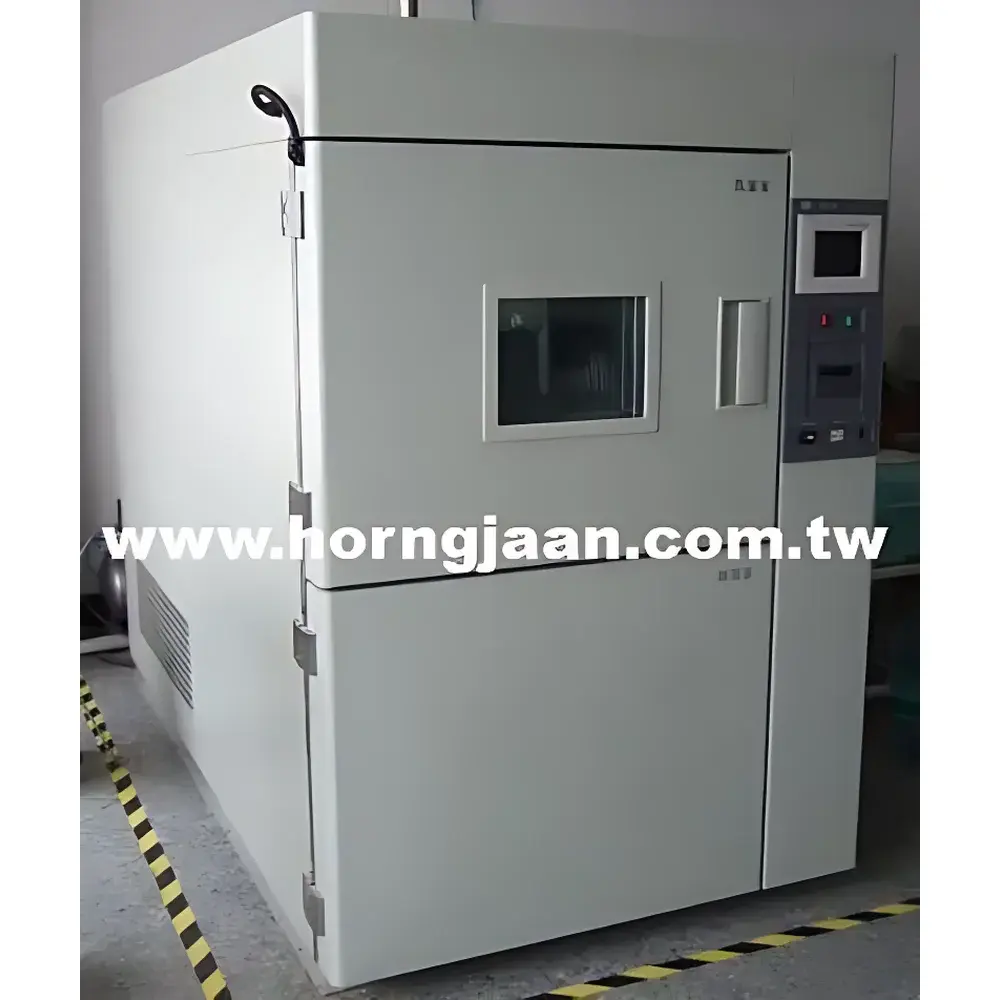
LabCompanion LTS-80-2P Two-Chamber Moving-Test-Specimen Thermal Shock Test Chamber
| Brand | LabCompanion |
|---|---|
| Origin | Guangdong, China |
| Manufacturer Type | Direct Manufacturer |
| Model | LTS-80-2P (Two-Chamber Moving Specimen Type) |
| Temperature Range | −40 °C to +100 °C (optional +150 °C) |
| Low-Temp Chamber | −70 °C to −10 °C |
| High-Temp Chamber | +60 °C to +200 °C |
| Specimen Weight Capacity | 2.5 kg |
| Specimen Transfer Time | ≤10 s |
| Temp. Rise Time (−40 °C → +100 °C) | 40 min |
| Temp. Fall Time (+100 °C → −40 °C) | 70 min |
| Test Chamber Dimensions (W×H×D) | 200×130×200 mm |
| Low-Temp Chamber Dimensions | 400×500×400 mm |
| High-Temp Chamber Dimensions | 400×400×400 mm |
| Control System | Microprocessor-based PID + SSR |
| Refrigerant | HFC-series eco-friendly refrigerant |
| Internal Material | SUS304 stainless steel |
| External Material | Galvanized steel with high-grade resin enamel coating |
| Safety Protections | Overheat protection, compressor overload protection, control system overload protection, high/low pressure cut-off switches |
| Optional Interfaces | RS-232 serial communication port |
Overview
The LabCompanion LTS-80-2P is a two-chamber, specimen-moving thermal shock test chamber engineered for precise, repeatable evaluation of material integrity under rapid, extreme temperature transitions. Unlike single-chamber air-based systems, this unit employs physically isolated high-temperature and low-temperature chambers—each independently conditioned—while the test specimen is mechanically transferred between them via pneumatically actuated positioning. This architecture eliminates thermal cross-contamination and ensures strict adherence to defined dwell times, transition rates, and temperature stability per cycle. The system complies with core thermal shock testing standards including ASTM D5229/D5229M (for composites), IEC 60068-2-14 (Environmental Testing – Part 2-14: Tests – Test N: Change of Temperature), and JIS Z 8701-2-14. It is designed for laboratories requiring deterministic, traceable thermal stress profiles in reliability qualification, failure mode analysis, and accelerated life testing of electronic components, automotive sensors, polymer encapsulants, PCB assemblies, and ceramic substrates.
Key Features
- Independent dual-chamber design with dedicated heating (up to +200 °C) and cooling (down to −70 °C) zones, enabling high-fidelity simulation of real-world thermal cycling environments.
- Pneumatically driven specimen transfer mechanism achieving full chamber-to-chamber movement in ≤10 seconds—critical for meeting stringent transition time requirements in MIL-STD-810H Method 503.5 and JEDEC JESD22-A104F.
- Microprocessor-based controller with PID algorithm and solid-state relay (SSR) output ensures stable temperature maintenance (±0.5 °C typical) and programmable ramp/dwell sequences across up to 999 cycles.
- Integrated 3.5″ 1.44 MB floppy disk drive for local backup of test programs and real-time temperature/time curve logging—data exportable for post-test analysis using standard PC-based charting software.
- Thermal fluid recovery system minimizes coolant consumption and operational cost; optional RS-232 interface supports remote monitoring, script-based test automation, and integration into centralized lab data management platforms.
- Full-spectrum safety architecture includes dual-stage overheat protection, compressor high/low-pressure cut-offs, SSR fault detection, and fail-safe door interlocks compliant with IEC 61000-6-2/6-4 EMC requirements.
Sample Compatibility & Compliance
The LTS-80-2P accommodates specimens up to 200 × 130 × 200 mm (W×H×D) and 2.5 kg mass, making it suitable for IC packages (QFP, BGA, CSP), automotive ECUs, MEMS devices, optical lenses, and molded plastic housings. Its stainless-steel interior (SUS304) resists corrosion from condensate and thermal degradation byproducts. All operational parameters—including dwell time, transition speed, and temperature extremes—are fully configurable to align with industry-specific protocols such as AEC-Q200 for passive components, IPC-9701 for solder joint reliability, and ISO 16750-4 for road vehicle environmental conditions. The system’s mechanical and thermal repeatability supports GLP-compliant validation documentation and audit-ready calibration records.
Software & Data Management
While the embedded controller provides standalone operation, the RS-232 interface enables bidirectional communication with external PCs running custom or third-party test sequencing software (e.g., LabVIEW, Python-based PySerial scripts). Logged thermal profiles are stored in ASCII CSV format for direct import into statistical process control (SPC) tools or MATLAB for derivative analysis (e.g., dT/dt calculation, dwell deviation mapping). Audit trails—including operator ID, start/stop timestamps, parameter modifications, and alarm events—are retained locally and can be exported for FDA 21 CFR Part 11–aligned review when paired with validated user access controls on host systems.
Applications
This chamber is routinely deployed in QC labs for pre-shipment qualification of consumer electronics, aerospace avionics modules, and medical device PCBAs. It validates resistance to interfacial delamination in multilayer ceramic capacitors (MLCCs), solder joint fatigue in automotive radar units, coefficient-of-thermal-expansion (CTE) mismatch effects in chip-scale packaging, and moisture-induced popcorning in plastic-encapsulated microcircuits (PEMs). In R&D settings, it supports DOE-driven studies correlating shock profile parameters (e.g., dwell ratio, ΔT magnitude) with failure onset thresholds—feeding predictive models used in HALT/HASS protocols.
FAQ
What is the maximum allowable specimen weight and dimensional envelope?
The test basket accepts loads up to 2.5 kg within a volume of 200 × 130 × 200 mm (W×H×D). Exceeding either limit compromises thermal uniformity and transfer repeatability.
Does the system support automated test sequencing and report generation?
Yes—via RS-232, users can trigger cycles, read real-time chamber status, and retrieve logged data. Report formatting must be implemented externally using compatible software; no built-in PDF/export engine is included.
Is calibration certification provided with shipment?
A factory calibration certificate (traceable to NIM, China) is supplied. For ISO/IEC 17025 compliance, third-party on-site calibration with uncertainty budgeting is recommended annually.
Can the high-temperature chamber reach +200 °C while maintaining −70 °C in the low-temperature chamber simultaneously?
Yes—the chambers operate independently; their temperature setpoints are decoupled, enabling concurrent extreme conditions without thermal bleed.
What refrigerant is used, and does it comply with global environmental regulations?
The system uses HFC-134a or HFC-404A (model-dependent), both zero-ozone-depletion-potential (ODP) refrigerants compliant with EU F-Gas Regulation (EU) No 517/2014 and EPA SNAP program requirements.



