
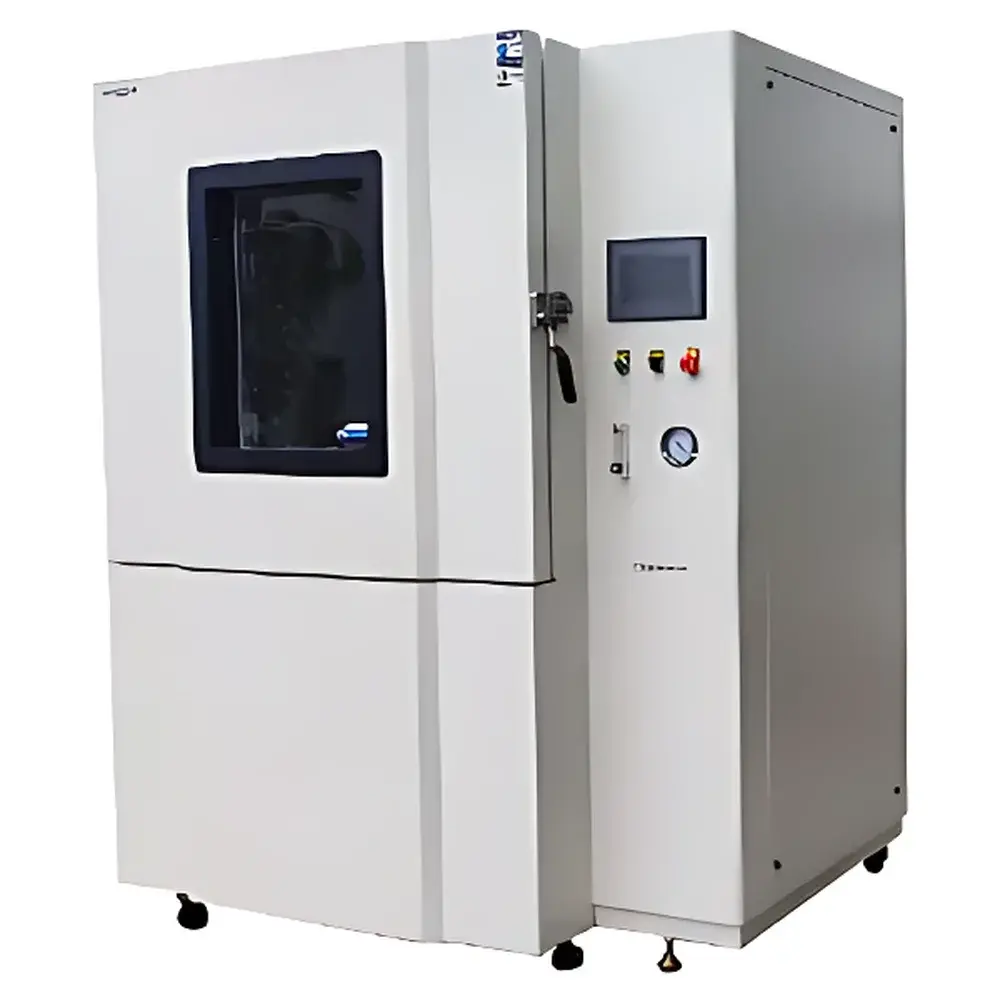
LabCompanion SC-1000 Sand and Dust Test Chamber
| Brand | LabCompanion |
|---|---|
| Origin | Guangdong, China |
| Manufacturer Type | OEM Manufacturer |
| Model | SC-1000 |
| Sand Composition | 97–99% SiO₂ (silicon dioxide) |
| Sand Blowing Concentration | 1.1 g/m³ ±0.25 g/m³ to 2.2 g/m³ ±0.5 g/m³ |
| Sand Blowing Velocity | Adjustable from 1–10 m/s |
| Dust Concentration Control | 0.1–10.6 g/m³ ±7% with real-time monitoring and automatic dust replenishment |
| Internal Chamber Dimensions | 1000 × 1000 × 1000 mm (W×H×D) |
| External Dimensions | 1550 × 1800 × 1400 mm (W×H×D) |
| Power Supply | AC 380 V ±10%, 50 Hz |
| Total Power Consumption | 5 kW |
| Operating Ambient Temperature | −15 °C to +50 °C |
| Relative Humidity Range | 10–80% RH (at 20 °C) |
| Altitude Limit | Up to 3000 m |
| Compliance Standards | IEC 60529:2001, IEC 60068-2-68 (Test La2), GB 2423.37–2006, GB 4208–2008, DIN 40050-9, JIS D 0207, ISO 20653, SAE J575e, GB 10485 |
| IP Rating Validation | IP5X and IP6X |
| Dust Sieve Specifications | Wire diameter 50 µm, nominal mesh spacing 75 µm |
| Talcum Powder Loading | 2–4 kg/m³ |
| Test Duration Range | 0–99 h 59 min (programmable) |
| Data Logging | Battery-backed RAM storage ≥120 days (2-min sampling interval) |
| Interface | USB port for data export (CSV/Excel-compatible), PC software for test programming, curve visualization, and audit-trail-enabled reporting |
| Safety Features | Door interlock, over-temperature cut-off, phase-loss protection, leakage current protection, motor overload protection, vacuum system pressure monitoring, audible/visual fault alerts |
Overview
The LabCompanion SC-1000 Sand and Dust Test Chamber is an engineered environmental simulation system designed to evaluate the ingress protection (IP) performance of enclosures under controlled airborne particulate exposure. It operates in strict accordance with internationally recognized standards—including IEC 60529:2001, IEC 60068-2-68 (Test La2), GB 4208–2008, and ISO 20653—for verification of IP5X and IP6X ratings. The chamber utilizes a closed-loop air circulation architecture integrated with precision-controlled pneumatic dispersion, enabling reproducible simulation of desert sandstorms, industrial dust environments, and low-velocity particulate deposition scenarios. Its core function is to assess the integrity of mechanical seals, gaskets, housing joints, and ventilation apertures against abrasive, non-conductive particulates—primarily standardized talcum powder (particle size <75 µm) and high-purity silica sand (97–99% SiO₂). Unlike thermal or humidity chambers, the SC-1000 emphasizes dynamic aerodynamic fidelity: variable wind velocity (1–10 m/s), programmable blow/stop cycles, directional airflow modulation, and real-time concentration feedback control ensure metrologically traceable test conditions across diverse product classes.
Key Features
- Programmable dual-mode operation: independent control of sand-blowing and dust-suspension cycles, each configurable from 1 second to 99 hours 59 minutes
- Real-time particulate concentration monitoring (0.1–10.6 g/m³ ±7%) with closed-loop automatic dust replenishment via calibrated dosing mechanism
- Adjustable airflow velocity (1–10 m/s) maintained by low-noise centrifugal blower with multi-vane impeller and integrated flow regulation
- Automated directional switching of dust jet orientation to replicate multi-angle particle impact on test specimens
- 7-inch full-color touch-screen controller with 0.1 °C temperature resolution and 0.1-minute timing precision
- Battery-backed RAM data logger storing setpoints, measured values, and timestamps for ≥120 days (2-minute sampling interval)
- USB interface supporting direct export of time-stamped test logs to USB flash drive in CSV, Excel (.xlsx), or Access (.accdb) formats
- PC-based configuration software enabling offline test program development, graphical curve analysis, and tamper-evident report generation compliant with GLP/GMP documentation requirements
- Integrated vacuum subsystem with SMC filtration cups, pressure gauge, and regulated air supply for IP6X suction-phase testing
- Comprehensive safety architecture including door interlock, over-temperature cutoff, phase-failure detection, leakage current protection, and motor overload relays
Sample Compatibility & Compliance
The SC-1000 accommodates specimens up to 1000 mm × 1000 mm × 1000 mm within its stainless-steel-lined working chamber. It supports static and dynamic testing of electrical enclosures, automotive ECUs, outdoor lighting fixtures, aerospace connectors, marine instrumentation housings, and industrial control panels. All operational parameters align with the mandatory test conditions specified in IEC 60529 Annex B for IP5X (limited dust ingress) and IP6X (dust-tight), as well as the extended durability protocols in ISO 20653 for road vehicles. The chamber’s dust delivery system employs a certified 75-µm nominal mesh sieve (wire diameter 50 µm) conforming to ASTM E11 and ISO 3310-1, ensuring consistent particle size distribution. Sliding sample racks, dual Ø50 mm cable ports, and internal LED illumination facilitate secure mounting and visual inspection during exposure. Calibration certificates for airflow sensors, concentration monitors, and timer modules are provided at factory acceptance, supporting ISO/IEC 17025-compliant laboratory accreditation.
Software & Data Management
The embedded microcontroller runs deterministic real-time firmware supporting ISO/IEC 17025-aligned data integrity protocols. All test configurations—including wind speed profiles, dust concentration targets, cycle durations, and vacuum hold times—are stored with cryptographic timestamping and user authentication. The included Windows-compatible software suite enables full test lifecycle management: remote parameter upload/download, graphical overlay of multiple test runs, statistical summary reports (min/max/mean/stdev), and export of raw datasets with embedded metadata (operator ID, calibration status, environmental ambient log). Audit trails record every configuration change, start/stop event, and alarm condition—meeting FDA 21 CFR Part 11 requirements for electronic records and signatures when deployed in regulated manufacturing environments. Data exports include digital watermarking to prevent unauthorized modification, satisfying GLP documentation traceability mandates.
Applications
The SC-1000 serves critical validation roles across multiple sectors requiring robustness against particulate contamination. In automotive R&D, it verifies ingress resistance of battery management systems (BMS), ADAS sensor housings, and powertrain control units per SAE J575e and ISO 20653. For energy infrastructure, it certifies NEMA 4X and IP66-rated switchgear, solar inverters, and substation controllers against desert sand infiltration. Consumer electronics manufacturers use it to validate smartphone, tablet, and wearable device enclosures prior to IEC 60529 certification. Aerospace suppliers apply it to avionics cooling ducts and cockpit display bezels subjected to runway dust ingestion. Additionally, it supports military standard MIL-STD-810H Method 510.6 (sand and dust) qualification testing, where long-duration cyclic exposure under variable wind loading simulates operational deployment in arid theater environments.
FAQ
What standards does the SC-1000 comply with for IP rating verification?
It fully implements IEC 60529:2001, GB 4208–2008, ISO 20653, and IEC 60068-2-68 (Test La2) for IP5X and IP6X validation.
Can the chamber perform both sand-blowing and dust-suspension tests simultaneously?
No—it executes sequential or alternating modes; sand and dust cycles are independently programmable but not concurrent due to distinct particle density and dispersion physics.
Is the talcum powder supplied with the system certified for particle size distribution?
Yes—the included 10 kg batch is pre-sieved to ≤75 µm and accompanied by a certificate of analysis referencing ISO 13320 laser diffraction validation.
Does the data logging system support regulatory audit requirements?
Yes—battery-backed RAM retains immutable records for ≥120 days, and PC software generates 21 CFR Part 11-compliant reports with digital signatures and revision history.
What maintenance intervals are recommended for the airflow and filtration subsystems?
SMC filter cups require replacement every 200 operational hours; the 75-µm mesh screen should be inspected and cleaned after each test series, with full replacement recommended every 500 hours.



