
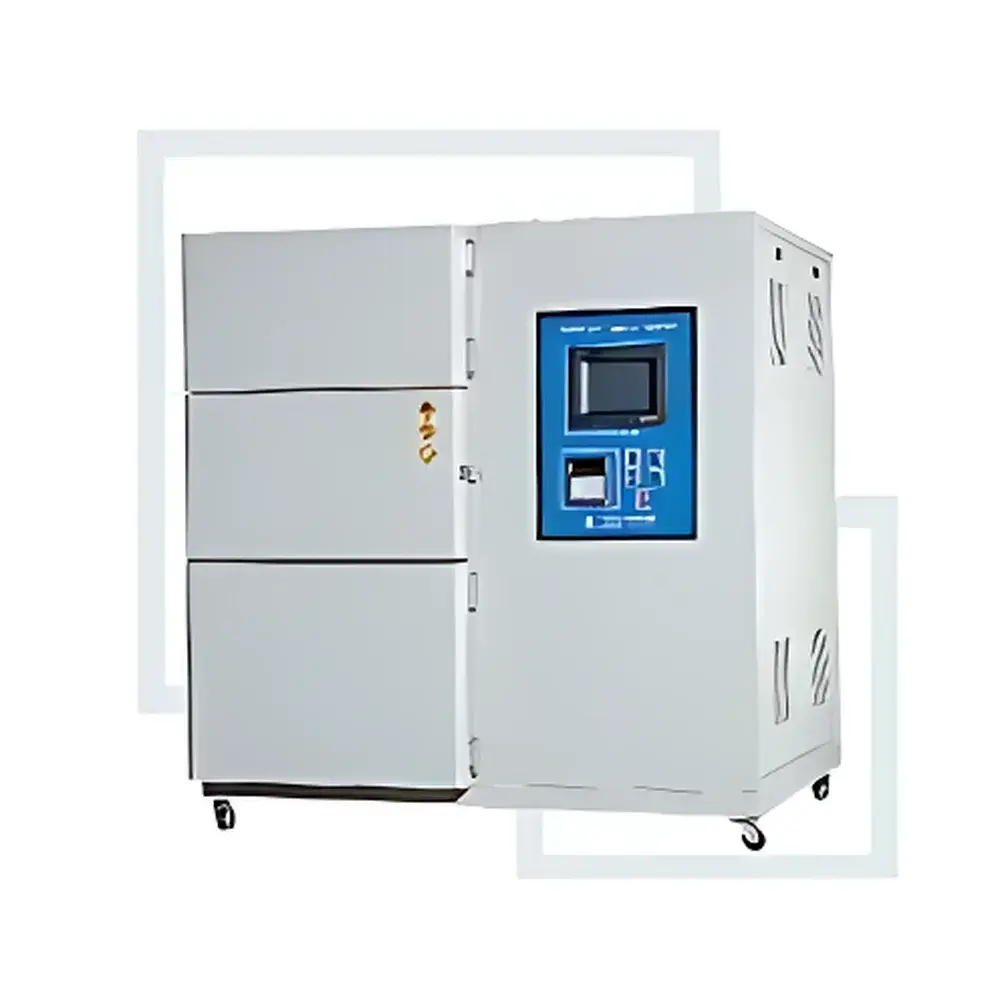
LabCompanion LTS-80-3PA Three-Zone Thermal Shock Test Chamber
| Brand | LabCompanion |
|---|---|
| Model | LTS-80-3PA |
| Chamber Type | Three-Zone Static Specimen Configuration |
| Temperature Range (High Zone) | 80–150 °C |
| Temperature Range (Low Zone) | 0 to –65 °C |
| Preconditioning Range | 80–200 °C / 0 to –70 °C |
| Soak Time (High/Low) | 25 min (adjustable) |
| Transfer Time (Recovery) | ≤5 min (configurable) |
| Temperature Stability | ±2 °C |
| Internal Dimensions (W×D×H) | 600×450×400 mm |
| Max. Specimen Weight | 10 kg |
| Power Supply | AC 3-phase, 220/380 V, 50/60 Hz |
| Origin | Guangdong, China |
| Manufacturer | LabCompanion (Guangdong Hongzhan Instrument Co., Ltd.) |
Overview
The LabCompanion LTS-80-3PA is a three-zone thermal shock test chamber engineered for high-reliability evaluation of electronic components, automotive modules, aerospace subsystems, and advanced materials under rapid, repetitive temperature transitions. Unlike single- or dual-chamber configurations that rely on mechanical specimen transfer, this system maintains the test specimen in a static position within a central test zone—while thermally isolating and independently conditioning two adjacent chambers: one at elevated temperature (up to 150 °C), the other at cryogenic temperature (down to –65 °C). Thermal shock exposure is achieved by pneumatically actuating insulated dampers to expose the stationary sample alternately to extreme hot and cold environments. This architecture eliminates mechanical stress from shuttle motion, improves repeatability, and enables precise control over dwell time, transition rate, and thermal gradient exposure—critical parameters defined in standards such as MIL-STD-810H Method 503.7, IEC 60068-2-14, and JESD22-A104.
Key Features
- Static specimen configuration: Eliminates shuttle-induced vibration or positional drift during thermal cycling—ensuring measurement integrity for precision assemblies and wafer-level packages.
- Triple-chamber architecture: Independent high-temperature (80–200 °C preconditioning), low-temperature (0 to –70 °C preconditioning), and central test zones with rapid damper-based air transfer (≤5 min recovery).
- Stable thermal performance: ±2 °C temperature uniformity across the 600×450×400 mm test volume, validated per IEC 60068-3-5 and ASTM E2298.
- Configurable thermal profiles: Adjustable soak duration (standard 25 min per extreme, user-definable), programmable cycle count (up to 9999), and ramp-rate monitoring via integrated Pt100 sensors.
- Robust construction: Stainless steel interior, double-wall insulation with vacuum-sealed polyurethane foam, and corrosion-resistant exterior cladding compliant with ISO 9001-certified manufacturing processes.
- Integrated safety systems: Over-temperature cutoff, refrigerant pressure monitoring, door interlock, and real-time alarm logging with event timestamping.
Sample Compatibility & Compliance
The LTS-80-3PA accommodates specimens up to 10 kg and 600×450×400 mm in dimension—suitable for PCBAs, ECUs, MEMS sensors, battery modules, optical housings, and encapsulated semiconductor devices. Its static-test design supports non-intrusive integration with external metrology (e.g., in situ resistance monitoring, thermography, or acoustic emission detection). The chamber meets essential regulatory and industry requirements including IEC 60068-2-14 (change of temperature), MIL-STD-810H Method 503.7 (temperature shock), AEC-Q200 stress validation protocols, and supports GLP/GMP audit readiness through configurable access control, calibration traceability (NIST-traceable sensors), and optional 21 CFR Part 11-compliant software packages.
Software & Data Management
Controlled via LabCompanion’s TC-Studio v4.2 software suite, the system delivers intuitive profile programming, real-time multi-channel temperature visualization, and automated report generation (PDF/CSV). Data logging records all critical parameters—including zone temperatures, damper status, power consumption, and alarm events—at user-selectable intervals (100 ms to 10 s resolution). Audit trails are retained for ≥18 months with immutable timestamps; optional firmware modules support electronic signatures, role-based user permissions, and secure data export for LIMS integration. Calibration certificates include uncertainty budgets per ISO/IEC 17025 guidelines.
Applications
- Qualification testing of solder joint reliability in automotive ADAS modules per IPC-9701A.
- Accelerated life assessment of conformal-coated circuit boards exposed to thermal fatigue.
- Validation of hermetic seal integrity in medical implant electronics under repeated thermal excursions.
- Material compatibility screening for adhesives, potting compounds, and thermal interface materials (TIMs).
- Pre-conditioning step prior to HALT/HASS protocols in reliability engineering workflows.
- Conformance verification for JEDEC J-STD-020 moisture sensitivity level (MSL) reflow simulation sequences.
FAQ
What distinguishes a three-zone thermal shock chamber from a two-zone shuttle-type system?
The LTS-80-3PA eliminates mechanical specimen movement—reducing risk of misalignment, micro-fracture induction, or connector disengagement. It achieves faster, more repeatable transitions via controlled airflow routing rather than physical transport.
Can the LTS-80-3PA be configured for extended low-temperature operation below –65 °C?
Standard configuration supports down to –65 °C in the low zone; custom variants with cascade refrigeration are available upon request for operation to –80 °C (lead time and qualification apply).
Is remote monitoring and control supported?
Yes—via Ethernet-connected TC-Studio with HTTPS-enabled web interface, SNMP alerting, and Modbus TCP integration for factory-wide SCADA systems.
Does the system comply with environmental regulations regarding refrigerants?
It utilizes R-513A (GWP = 631), an ASHRAE-approved low-GWP alternative to R-404A, fully compliant with EU F-Gas Regulation No. 517/2014 and EPA SNAP Program requirements.
What documentation is provided for IQ/OQ/PQ validation?
Factory-applied qualification packages include Installation Qualification (IQ) checklists, Operational Qualification (OQ) test protocols with pass/fail criteria, and Performance Qualification (PQ) templates aligned with ASTM E2500 and Annex 15 of the EU GMP Guide.



