
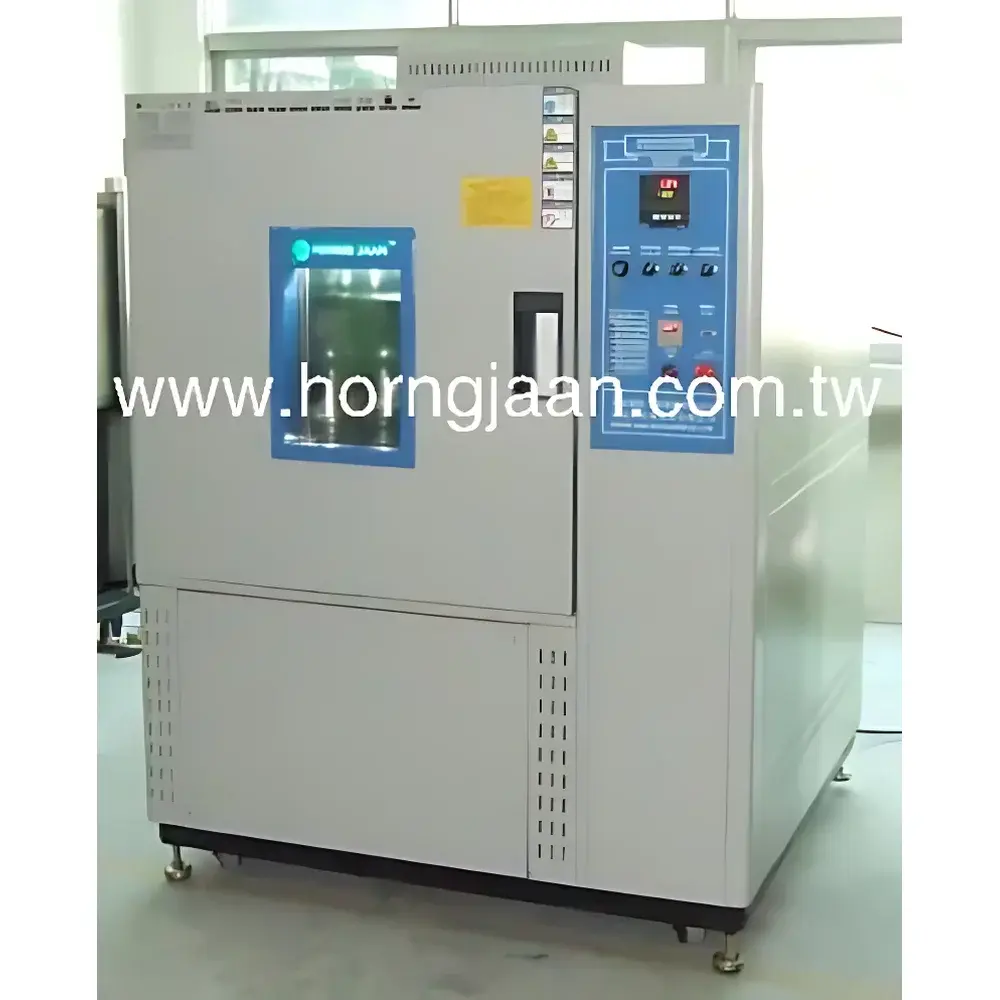
LabCompanion SP-120U Programmable Temperature and Humidity Controlled Chamber
| Brand | LabCompanion |
|---|---|
| Origin | Guangdong, China |
| Manufacturer Type | Direct Manufacturer |
| Model | SP-120U |
| Internal Volume | 120 L |
| Internal Dimensions (W×H×D) | 500 × 600 × 400 mm |
| Temperature Range | −70 °C to +150 °C |
| Humidity Range | 10 %RH to 98 %RH (with optional dehumidification module) |
| Temperature Uniformity | ±0.5 °C |
| Temperature Deviation | ≤ ±2.0 °C |
| Humidity Deviation | ±2.5 %RH |
| Heating Rate | −70 °C → +150 °C in ≤60 min (~3 °C/min) |
| Cooling Rate | +20 °C → −70 °C in ≤90 min (~1.2 °C/min) |
| Control System | ETAC820 Touchscreen PLC-based Controller (50 programs / 2500 segments) |
| Refrigerant | R507 (HFC, ozone-friendly) |
| Construction | SUS304 stainless steel interior & exterior with powder-coated cold-rolled steel option |
| Insulation | High-density polyurethane foam + glass fiber |
| Safety Protections | Dry-heater cutoff, independent over-temperature cutoff, low-water detection, compressor overload/overcurrent, high-pressure refrigerant switch, earth-leakage protection |
| Power Supply | AC220±10% V / 50±0.5 Hz (single-phase) or AC380±10% V / 50±0.5 Hz (three-phase) |
Overview
The LabCompanion SP-120U is a precision-engineered programmable temperature and humidity controlled chamber designed for rigorous environmental stress testing of electronic components, optical devices, PCB assemblies, lithium-ion batteries, and other mission-critical hardware. Operating on the fundamental principles of thermodynamic equilibrium and vapor-phase mass transfer, the SP-120U delivers tightly regulated thermal and hygroscopic conditions across an exceptionally wide operational envelope—from −70 °C to +150 °C and 10 %RH to 98 %RH—enabling accelerated reliability assessment under real-world climatic extremes. Its dual-stage mechanical refrigeration system (single-stage for standard operation; cascade configuration for sub-zero performance), combined with steam-generation humidification and BTHC (Balanced Temperature & Humidity Control) modulation logic, ensures stable setpoint adherence and minimized spatial gradients. The chamber meets the physical and metrological requirements of international environmental test standards including IEC 60068-2, MIL-STD-810G, and GB/T 2423 series, making it suitable for qualification testing in R&D labs, QC/QA departments, and third-party certification facilities operating under GLP or ISO/IEC 17025 frameworks.
Key Features
- Wide-range environmental simulation: −70 °C to +150 °C and 10–98 %RH (with optional desiccant-assisted dehumidification module)
- BTHC (Balanced Temperature & Humidity Control) algorithm enabling independent, simultaneous regulation of heating, cooling, humidification, and dehumidification
- ETAC820 touchscreen controller with integrated PLC architecture: supports up to 50 user-defined programs, each containing up to 2500 programmable steps; resolution of ±0.1 °C and ±1 %RH
- Dual-mode refrigeration system: single-stage air-cooled compression for standard operation; optional cascade configuration for enhanced low-temperature performance below −40 °C
- SUS304 stainless steel interior and structural frame with electrostatically applied exterior coating—resistant to corrosion, condensation ingress, and long-term exposure to aggressive test atmospheres
- High-efficiency steam humidifier with UL-shaped stainless steel heater and auto-refill water reservoir (15 L capacity); dry-run protection prevents heater damage
- LAN-enabled remote monitoring and control via IPC/SCADA architecture—supports centralized management of up to 200+ units without additional field wiring
- USB data logging interface supporting real-time export of time-stamped temperature/humidity profiles, alarm logs, and system diagnostics
- Comprehensive safety suite: independent over-temperature cutoff, refrigerant high-pressure interlock, phase-loss detection, earth-leakage circuit breaker, and compressor current monitoring
- Energy-optimized design using R507 zero-ozone-depletion-potential (ODP) refrigerant—reduces power consumption by up to 30% versus legacy systems
Sample Compatibility & Compliance
The SP-120U accommodates a broad spectrum of test specimens—including bare dies, SMT-assembled PCBs, optoelectronic modules (e.g., LCD panels, fiber-optic transceivers), coin-cell and pouch-format Li-ion batteries, and automotive ECUs—within its 120 L working volume (500 × 600 × 400 mm internal dimensions). Standard features include two adjustable stainless steel shelves, a Φ50 mm cable port with removable cap, and front-access water fill. All materials contacting test environments comply with RoHS Directive 2011/65/EU. The chamber satisfies the technical specifications outlined in GB/T 10586–2014 (damp heat), GB/T 10589–2008 (low temperature), GB/T 10592–2008 (climatic testing), and MIL-STD-810G Method 507.5 (temperature-humidity cycling). It is routinely deployed in laboratories conducting tests per IEC 60068-2-30 (cyclic damp heat), USP (pharmaceutical packaging stability), and AEC-Q200 (automotive passive component qualification).
Software & Data Management
The embedded ETAC820 controller provides native support for audit-trail-compliant data acquisition in accordance with FDA 21 CFR Part 11 requirements when paired with validated remote software (optional). All operational parameters—including setpoints, actual readings, alarm events, program execution status, and system faults—are timestamped and stored internally with non-volatile memory retention. USB export enables direct transfer of CSV-formatted datasets for post-processing in MATLAB, Python (Pandas), or statistical analysis platforms such as JMP or Minitab. Optional LAN integration permits SCADA-level visualization through industry-standard protocols (Modbus TCP, OPC UA), allowing traceability across enterprise MES or LIMS environments. The controller retains full program state during power interruption and resumes testing automatically upon restoration—critical for multi-day reliability cycles requiring unattended operation.
Applications
- Accelerated life testing (ALT) and highly accelerated life testing (HALT) of semiconductor packages and wafer-level components
- Thermal cycling and humidity bias testing per JEDEC JESD22-A104 and A110
- Moisture sensitivity level (MSL) classification and floor-life validation for surface-mount devices
- Environmental stress screening (ESS) of aerospace avionics and defense electronics per MIL-STD-883 Method 1010
- Stability evaluation of battery electrolytes and solid-state separator membranes under variable RH conditions
- Qualification of display modules (OLED, TFT-LCD) for outdoor deployment in tropical or arid climates
- Material compatibility testing of conformal coatings, potting compounds, and encapsulants
- Pre-conditioning of samples prior to mechanical shock, vibration, or ESD testing
FAQ
What is the minimum achievable humidity level with the SP-120U?
With the optional desiccant-based dehumidification module installed, the chamber achieves and maintains humidity levels down to 10 %RH at ambient temperatures above 20 °C.
Does the SP-120U support compliance with FDA 21 CFR Part 11?
Yes—when used with the validated LabCompanion Remote Monitoring Suite and configured with electronic signatures, audit trails, and role-based access control, the system meets core Part 11 requirements for electronic records and signatures.
Can the controller store and replay complex multi-step profiles?
Yes—the ETAC820 supports up to 50 distinct programs, each containing up to 2500 individual steps, with flexible looping, segment branching, and real-time parameter override during execution.
Is the refrigeration system serviceable in the field?
All major refrigeration components—including the imported hermetic compressors, expansion valves, and heat exchangers—are modular and accessible via standardized service panels; full maintenance documentation and OEM spare parts are available under LabCompanion’s global support agreement.
How is temperature and humidity uniformity verified?
Uniformity is validated per IEC 60068-3-5 using nine calibrated PT100 sensors placed at prescribed locations within the working volume; typical results show spatial deviation ≤ ±0.5 °C and ≤ ±2.5 %RH across the entire load zone.



