
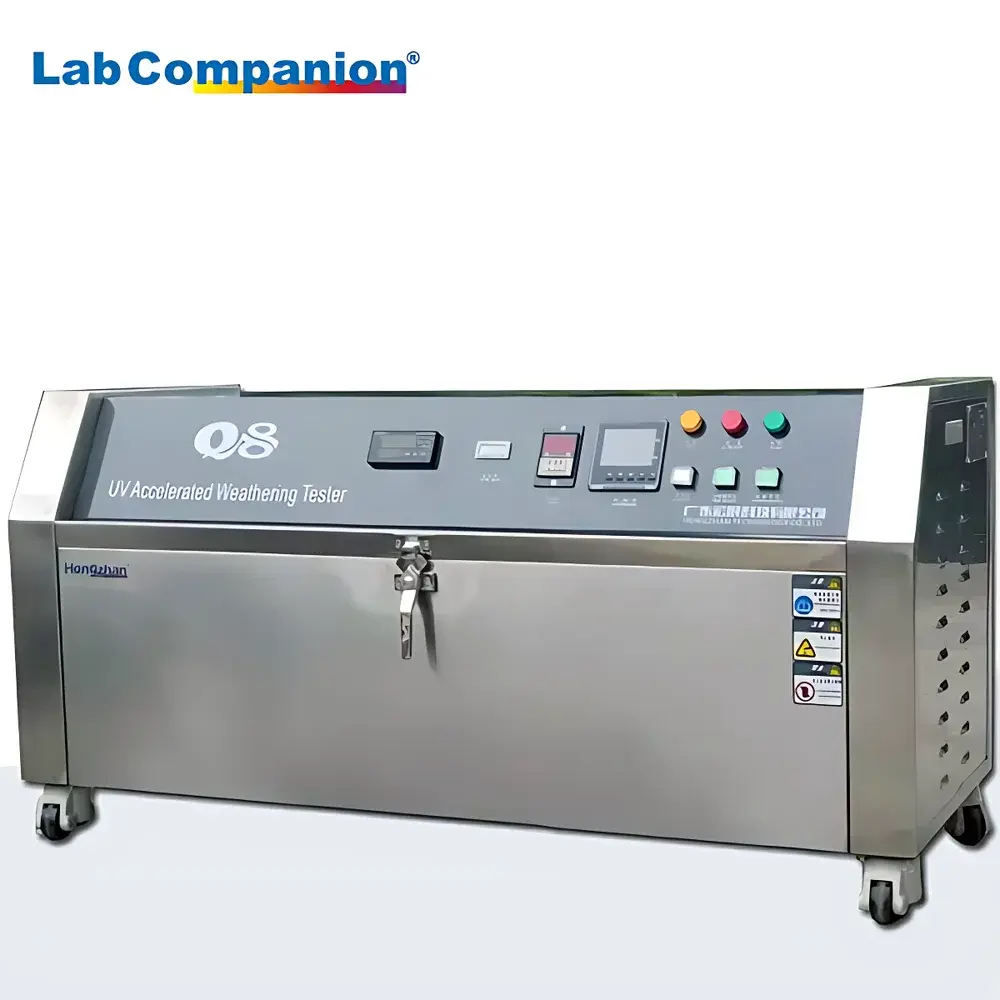
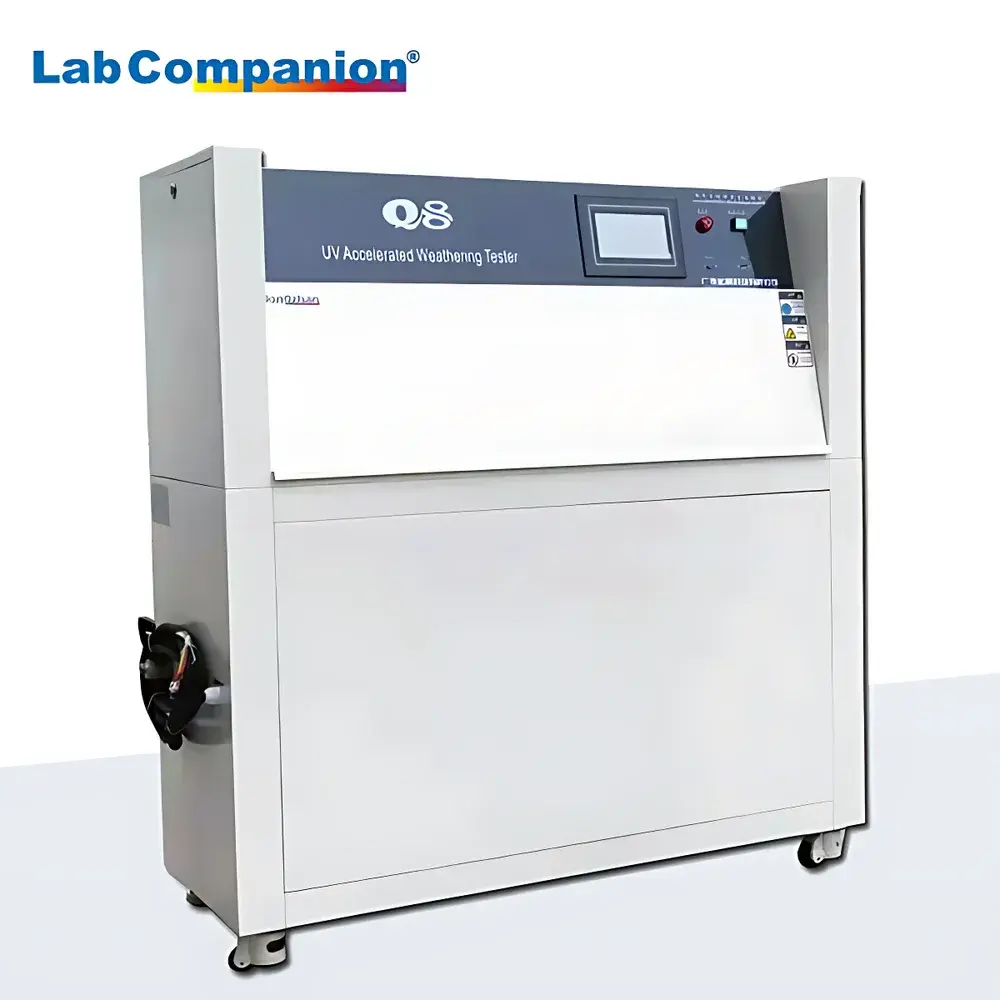
LabCompanion Q8-UV1 UV Aging Test Chamber
| Brand | LabCompanion |
|---|---|
| Origin | Guangdong, China |
| Manufacturer | Yes |
| Model | Q8-UV1 |
| Test Duration | 1–9999 h (adjustable) |
| Irradiance Range | ≤1.0 W/m² at 340 nm |
| Lamp Power | 40 W per lamp |
| Humidity Range | ≥95% RH |
| Light Exposure Temperature Range | 40–60 °C |
| Black Panel Temperature Range | 50–70 °C |
| UV Wavelength Range | 290–400 nm |
| Chamber Internal Dimensions | Customizable (L×W×H) |
Overview
The LabCompanion Q8-UV1 UV Aging Test Chamber is an engineered environmental simulation system designed to accelerate photodegradation of polymeric materials, coatings, adhesives, and outdoor components under controlled ultraviolet radiation, temperature, and humidity conditions. Based on the fundamental principle of xenon-arc–free UV exposure—specifically utilizing fluorescent UV lamps (UVA-340 and UVB-313 spectral types)—this chamber replicates the most damaging short-wavelength UV portion of natural sunlight (290–400 nm), enabling reliable prediction of long-term weathering behavior in accordance with ASTM G154, ISO 4892-3, and SAE J2020 standards. Unlike full-spectrum xenon testers, the Q8-UV1 prioritizes high-intensity, spectrally selective UV irradiation with precise black panel temperature control and condensation-based moisture cycling—making it ideal for comparative durability screening, QC pass/fail testing, and formulation benchmarking in industrial R&D and quality assurance laboratories.
Key Features
- Single-lamp configuration (40 W UV fluorescent lamp) optimized for cost-effective routine aging validation
- Adjustable irradiance output: ≤1.0 W/m² @ 340 nm (UVA-340 equivalent) and ≤1.1 W/m² @ 313 nm (UVB-313 equivalent), calibrated per ISO 17025-accredited methodology
- Black panel temperature control (50–70 °C) with integrated thermocouple feedback loop for surface-relevant thermal stress simulation
- Light exposure temperature range maintained between 40–60 °C, decoupled from black panel setpoint to reflect real-world thermal gradients
- High-humidity condensation cycle support (≥95% RH) using distilled or deionized water reservoirs—no external plumbing required
- Digital programmable timer supporting test durations from 1 hour to 9999 hours with automatic shutdown and data retention
- Modular internal chamber geometry: dimensions fully customizable (L×W×H) to accommodate diverse sample fixtures, multi-tier racks, or large-format substrates
- Compliant with electrical safety standards IEC 61000-6-2 (immunity) and IEC 61000-6-4 (emissions); CE-marked for EU market deployment
Sample Compatibility & Compliance
The Q8-UV1 accommodates flat-panel specimens up to 150 mm × 75 mm per standard fixture slot, with optional dual-tier stacking frames enabling vertical sample density optimization. It supports both rigid and flexible substrates—including PVC, PET, acrylic, powder-coated steel, automotive trim, and architectural sealants—without mechanical distortion during prolonged exposure. All operational parameters are traceable to NIST-traceable calibration references. The system meets essential regulatory requirements for material qualification under ASTM D4329 (plastics), ISO 4892-3 (plastics—fluorescent UV exposure), and GB/T 14522 (Chinese national standard for mechanical property degradation). While not inherently 21 CFR Part 11 compliant, audit-ready operation logs can be exported in CSV format for integration into validated QA workflows under GLP/GMP environments.
Software & Data Management
The Q8-UV1 operates via a front-panel membrane keypad interface with LED status indicators and real-time display of irradiance, black panel temperature, and elapsed time. No proprietary software is bundled; however, optional RS-485/Modbus RTU communication enables integration with third-party SCADA systems or LIMS platforms for centralized monitoring and automated report generation. All parameter settings and runtime events—including lamp-on cycles, temperature deviations >±2 °C, and humidity excursions—are stored in non-volatile memory with timestamping. Data export is supported via USB flash drive (FAT32 formatted) in plain-text .log format, compatible with Excel, MATLAB, or statistical process control (SPC) tools. Firmware updates are performed offline via SD card, ensuring continuity in regulated lab environments.
Applications
- Accelerated UV resistance evaluation of automotive interior/exterior plastics and elastomers
- Photostability screening of architectural coatings, roofing membranes, and facade cladding systems
- Comparative lifetime modeling of OLED encapsulation layers and optical films
- Validation of UV-curable resin formulations under standardized UVA/UVB spectral profiles
- QC release testing for medical device packaging materials subject to ISO 11607-1
- Correlation studies between Q8-UV1 exposure and outdoor Florida/Arizona field aging data (via established acceleration factors)
FAQ
What UV lamp types are compatible with the Q8-UV1?
The chamber accepts industry-standard 40 W fluorescent UV lamps including UVA-340 (simulating solar cutoff at 340 nm) and UVB-313 (extended short-wave UV for aggressive stress testing). Replacement lamps must conform to ANSI C78.81 physical dimensions and electrical specifications.
Is distilled water mandatory for condensation operation?
Yes—use of distilled or deionized water is required to prevent mineral deposition on lamp surfaces and sensor optics, which would otherwise compromise irradiance stability and measurement accuracy over time.
Can the Q8-UV1 perform cyclic testing with dark/cool-down phases?
No—the Q8-UV1 is configured for continuous UV irradiation with condensation-only moisture cycles. For light/dark or spray/condensation sequences, consider the Q8-UV2 or Q8-UV3 variants.
How often should irradiance sensors be recalibrated?
Annual recalibration against a NIST-traceable reference radiometer is recommended; more frequent verification (e.g., quarterly) is advised when operating above 90% of maximum irradiance setpoint.
Does the system include lamp aging compensation algorithms?
No—irradiance is manually adjustable but does not auto-compensate for lamp output decay. Users must monitor and adjust setpoints based on periodic radiometer verification or scheduled lamp replacement (typically every 1600–2000 hours).



