
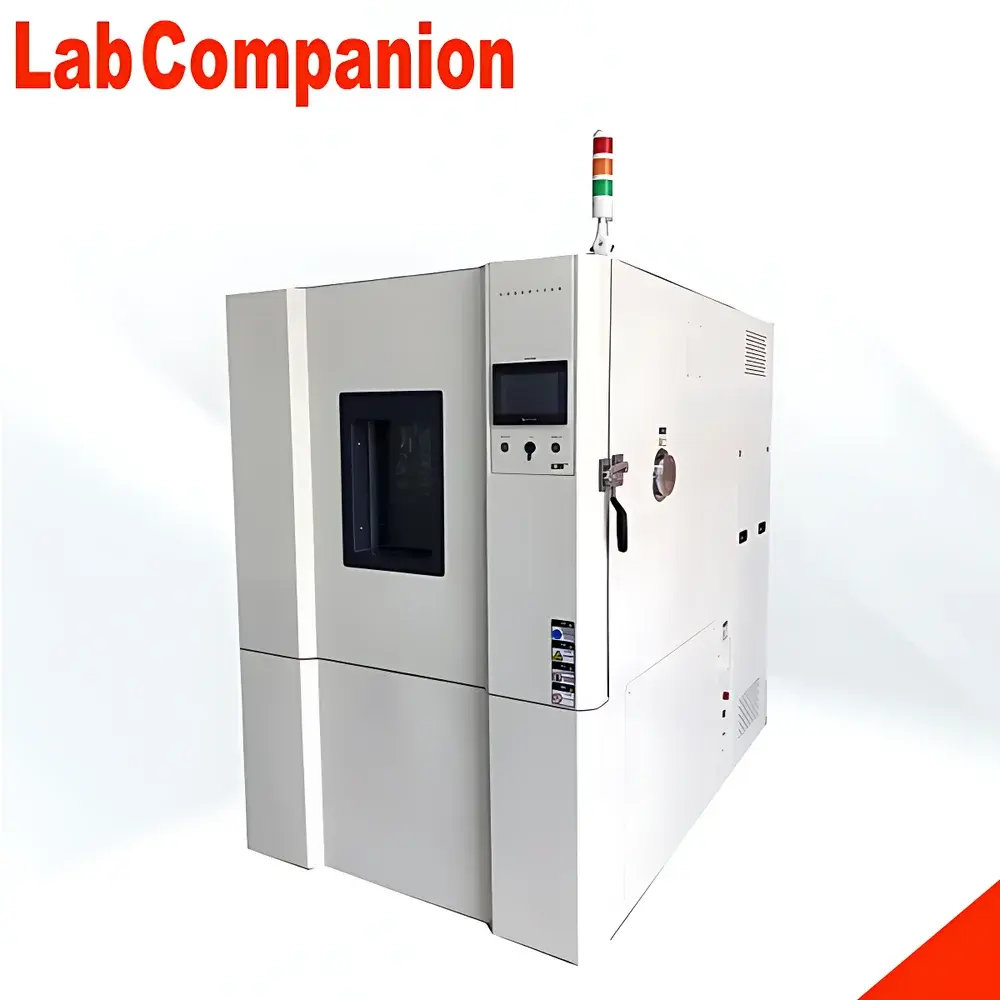
LabCompanion PDL-800 Low-Humidity High-Low Temperature Environmental Test Chamber
| Brand | LabCompanion |
|---|---|
| Origin | Guangdong, China |
| Manufacturer Type | Direct Manufacturer |
| Country of Origin | China |
| Model | PDL-800 |
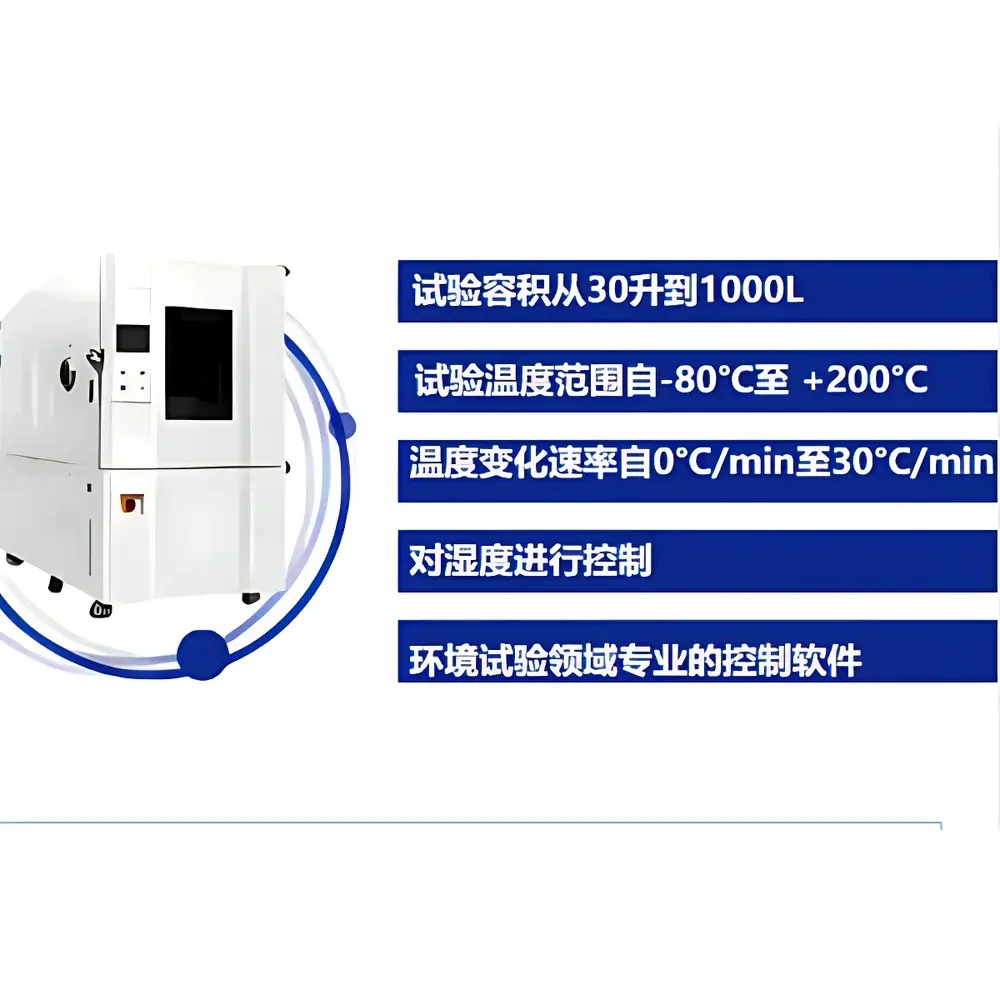
| Temperature Range | −40 °C to +150 °C |
| Refrigeration Method | Compressor-based Cooling |
| Explosion-Proof Design | Standard (Non-Explosion-Proof) |
| Temperature Uniformity | ±2 °C |
| Temperature Fluctuation | ±0.5 °C |
| Heating Rate | ≤60 min (from −40 °C to +150 °C) |
| Internal Dimensions (W×H×D) | 1000 × 1000 × 800 mm |
| Humidity Control Range | 5 %RH to 98 %RH |
| Minimum Achievable Humidity | 5 %RH at 10 °C and 40 °C |
| Dehumidification Method | Rotating Drum Regenerative Desiccant System |
| Humidification Method | Compact Steam Generator |
| Integrated Network Interface | Ethernet (Modbus TCP / HTTP API supported) |
| Compliance | Designed per IEC 60068-2 series, ISO 16750-4, MIL-STD-810H (environmental conditioning sections) |
Overview
The LabCompanion PDL-800 Low-Humidity High-Low Temperature Environmental Test Chamber is an engineered solution for rigorous environmental stress screening (ESS) and reliability qualification testing under controlled low-humidity, wide-range thermal conditions. It operates on a dual-loop BTHC (Balanced Temperature & Humidity Control) architecture—integrating independent PID-regulated temperature control with vapor pressure–based humidity regulation—to achieve stable, repeatable, and traceable environmental profiles. Unlike conventional chambers relying solely on refrigerant-based dehumidification, the PDL-800 employs a rotating drum regenerative desiccant system that enables sustained operation down to 5 %RH across its full operational temperature span (−40 °C to +150 °C), even at elevated temperatures where condensation-based methods fail. This capability is critical for validating moisture-sensitive electronics, aerospace composites, lithium-ion battery enclosures, and optical assemblies subjected to arid high-altitude or desert operational environments.
Key Features
- Rotating drum regenerative desiccant dehumidification: Eliminates consumable desiccants; ensures long-term stability and minimal maintenance over thousands of test cycles.
- Compact steam-type humidifier: Minimizes thermal inertia and spatial interference, enabling rapid humidity recovery and tight control (±2 %RH typical) without condensate pooling or chamber wall wetting.
- BTHC dual-PID control logic: Simultaneously regulates refrigerant expansion valve, heater duty cycle, and desiccant wheel speed to maintain setpoints within ±0.5 °C temperature fluctuation and ±2 %RH humidity deviation.
- Modular thermal separation design: When operating above +100 °C, the desiccant module can be physically decoupled from the main chamber body—preserving desiccant integrity and extending service life while maintaining thermal uniformity per IEC 60068-3-5.
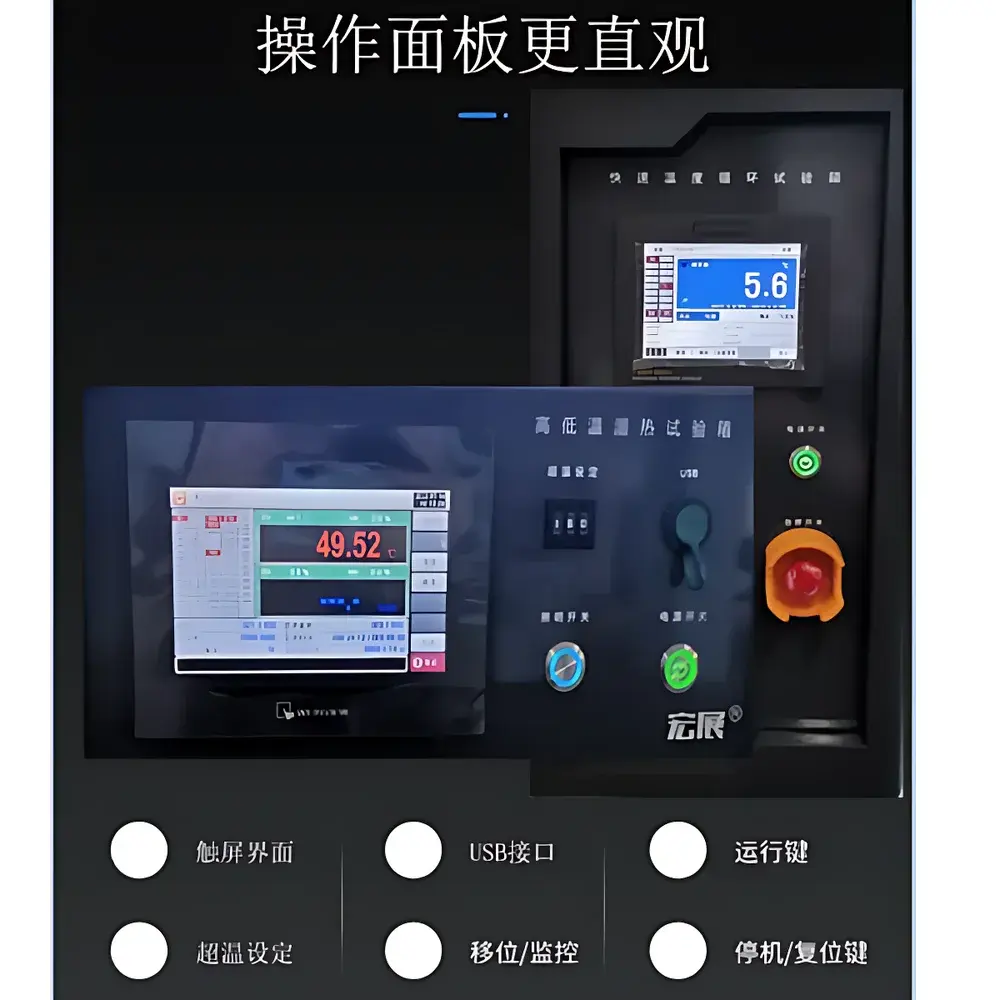
- Standard Ethernet interface with Modbus TCP and HTTP RESTful API: Enables integration into automated test systems, LIMS, and MES platforms for remote monitoring, scheduled profile execution, and real-time data logging.
- Energy-optimized compressor staging and heat recovery loop: Reduces power consumption by up to 22 % during prolonged low-temperature holds compared to single-stage fixed-speed systems.
Sample Compatibility & Compliance
The PDL-800 accommodates samples up to 800 L internal volume (1000 × 1000 × 800 mm working space), supporting large-format PCB assemblies, automotive ECUs, avionics line-replaceable units (LRUs), and sealed medical device housings. Its low-humidity performance meets the stringent requirements of MIL-STD-810H Method 502.7 (Low Temperature/Desert Dry), ISO 16750-4 (Road Vehicles – Environmental Conditions), and JEDEC JESD22-A101 (Low Temperature Operating Life). The chamber’s construction complies with IEC 61000-6-2 (immunity) and IEC 61000-6-4 (emission) standards. Optional validation packages support IQ/OQ documentation aligned with GLP and GMP Annex 15 guidelines, including temperature/humidity mapping reports and uncertainty budgets per ISO/IEC 17025.
Software & Data Management
LabCompanion’s TC-Studio v4.2 software provides native Windows-based profile programming, real-time multi-channel trending (up to 16 virtual channels), and automated report generation in PDF/CSV formats compliant with FDA 21 CFR Part 11 (audit trail, electronic signature, role-based access control). Raw sensor data—including Pt100 temperature readings, capacitive RH sensors, and compressor current—is timestamped with NTP-synchronized UTC accuracy and stored locally or streamed via MQTT to cloud-based analytics platforms. All firmware updates are digitally signed and validated prior to installation to ensure system integrity.
Applications
- Qualification of conformal-coated circuit boards under accelerated dry-heat aging (e.g., IPC-J-STD-001, IPC-A-610).
- Thermal cycling of MEMS sensors and optical coatings where hygroscopic swelling must be excluded.
- Reliability assessment of solid-state batteries under sub-zero, low-RH storage conditions per UL 1642 and UN 38.3.
- Environmental stress screening of satellite payload components per ECSS-E-ST-10-03C.
- Material compatibility testing of elastomers, adhesives, and laminates exposed to combined thermal shock and desiccation.
FAQ
What is the lowest achievable humidity level, and at which temperatures is it guaranteed?
The PDL-800 achieves and maintains 5 %RH at both 10 °C and 40 °C. At −40 °C, relative humidity is physically undefined (saturation point <0.1 %RH); chamber performance is specified in terms of dew point (≤ −70 °C) per ISO 8503-1.
Is the chamber suitable for testing lithium-ion battery modules?
Yes—its non-explosion-proof configuration meets standard safety requirements for UN 38.3 thermal preconditioning when operated within certified ambient room conditions (ventilated, non-classified space). Optional inert gas purge kits are available upon request.
Does the system support automated compliance reporting for ISO/IEC 17025 laboratories?
Yes—TC-Studio v4.2 includes configurable report templates with traceable calibration metadata, uncertainty calculations, and digital signatures required for accredited laboratory workflows.
Can the chamber operate continuously at +150 °C with humidity control enabled?
Humidity control is disabled above +100 °C per design specification. For pure high-temperature testing, the desiccant module is isolated, and the chamber functions as a high-stability thermal oven with ±0.5 °C uniformity.
What network protocols are supported for integration into factory automation systems?
Modbus TCP (register-mapped), HTTP RESTful API (JSON payloads), and optional OPC UA server add-on for seamless SCADA/MES connectivity.
Related Products



