
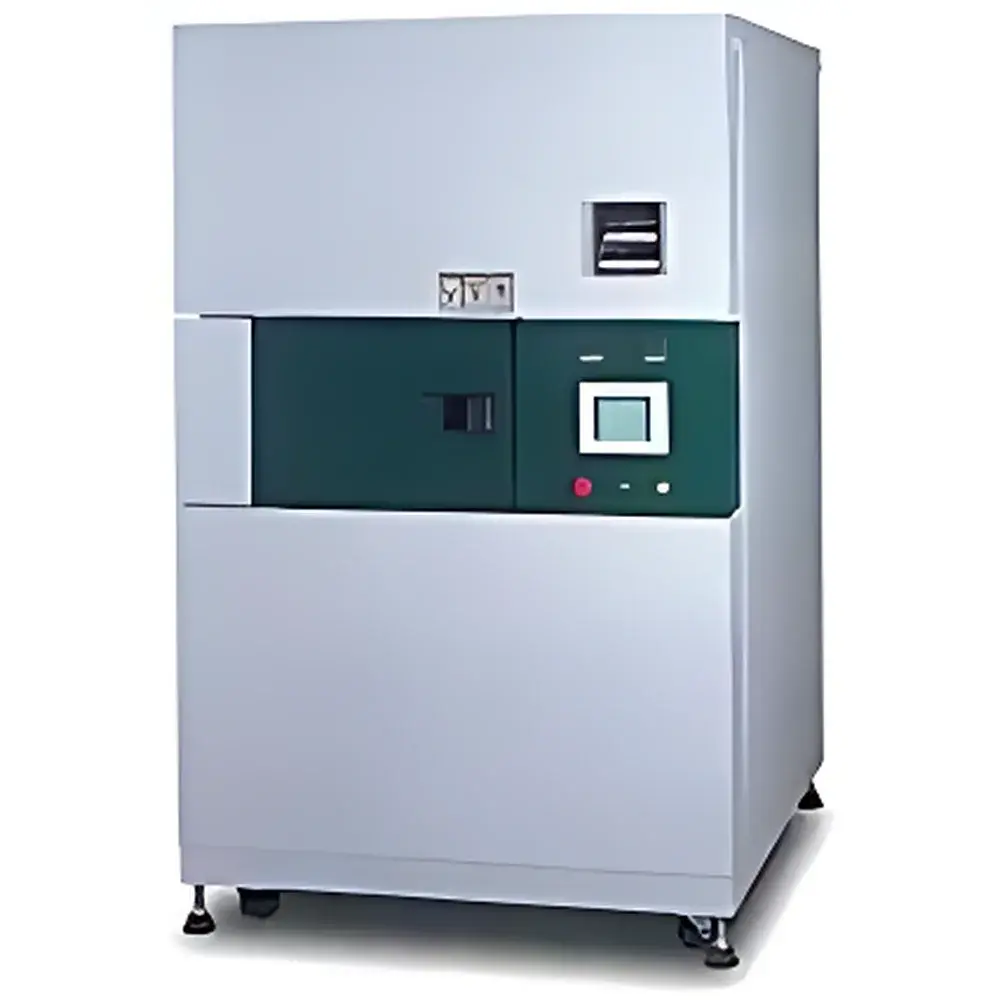
LabCompanion FT/LT/TT Series Thermal Shock Test Chamber
| Brand | LabCompanion |
|---|---|
| Origin | Guangdong, China |
| Manufacturer Type | Direct Manufacturer |
| Model Series | FT-40/FT-50/FT-60, LT-40/LT-50/LT-60, TT-40/TT-50/TT-60 |
| Temperature Range (Test Zone) | −35 °C to 150 °C (FT), −55 °C to 150 °C (LT), −65 °C to 150 °C (TT) |
| Temperature Transition Method | Static Specimen with Dual- or Triple-Zone Air-Switching |
| Temp. Rise Time (−35 → +150 °C) | 30–40 min |
| Temp. Fall Time (+150 → −35 °C) | 60–80 min |
| Temperature Stabilization Time | 5–10 min |
| Test Chamber Volume | 35–60 L |
| External Dimensions | 140–220 cm (H/W/D) |
| Payload Capacity | 2.2–7.5 kg |
| Refrigeration System | Single-stage (FT) or Dual-stage (LT/TT) |
| Condensation | Air-cooled or Water-cooled |
| Refrigerant | HFC-based Eco-friendly Refrigerant |
| Control System | Microprocessor-based Programmable Controller with PID + SSR Regulation |
| Chamber Material | SUS304 Stainless Steel |
| Safety Protections | Compressor Overload Protection, High/Low Pressure Switches, Controller Overcurrent Protection |
Overview
The LabCompanion FT/LT/TT Series Thermal Shock Test Chamber is an engineered environmental test system designed for evaluating material and component reliability under rapid, repetitive thermal transitions. It operates on the principle of static specimen testing—where the test sample remains stationary within a dedicated test chamber while conditioned air is alternately supplied from independently controlled hot and cold reservoirs. This architecture eliminates mechanical movement of specimens, minimizing vibration-induced artifacts and ensuring repeatable thermal stress application. The system supports both dual-zone (hot/cold) and triple-zone (hot/ambient/cold) configurations, enabling precise simulation of real-world thermal cycling encountered in aerospace electronics, automotive ECUs, military-grade PCB assemblies, and high-reliability semiconductor packaging. Its design adheres to core requirements of IEC 60068-2-14 (Environmental Testing – Part 2-14: Tests – Test N: Change of temperature), supporting qualification-level validation per MIL-STD-810H Method 503.5 and JEDEC JESD22-A104F.
Key Features
- Static specimen configuration ensures zero mechanical disturbance during thermal transition—critical for fragile microelectronics and thin-film sensors.
- Selectable dual-zone (FT series) or triple-zone (LT/TT series) operation enables flexible test profiles including ambient soak, accelerated ramping, and multi-step thermal dwell sequences.
- Dual-stage refrigeration system (LT/TT models) achieves extended low-temperature capability down to −65 °C with enhanced stability and reduced recovery drift across repeated cycles.
- Microprocessor-based programmable controller with full-color touch interface provides intuitive setup of cycle count, dwell time, ramp rate, defrost frequency, and alarm thresholds.
- Real-time graphical display of chamber temperature curves and operational status—including compressor load, refrigerant pressure, and heater duty cycle—facilitates in-situ process verification.
- SUS304 stainless steel interior and exterior construction ensures corrosion resistance, long-term dimensional stability, and compatibility with cleanroom and ISO 17025-accredited laboratory environments.
- Integrated safety architecture includes high/low refrigerant pressure cutoffs, compressor thermal overload protection, SSR failure detection, and independent overtemperature limiters compliant with IEC 61000-6-2 EMC immunity standards.
Sample Compatibility & Compliance
The chamber accommodates standard electronic packages (QFP, BGA, CSP), printed circuit board assemblies (PCBAs), polymer housings, metallic fasteners, and optical sensor modules. Internal dimensions (35–60 L) and payload capacity (2.2–7.5 kg) are optimized for benchtop integration without compromising thermal mass response. All models meet structural and operational requirements of ISO/IEC 17025 for accredited calibration laboratories and support audit-ready documentation for GLP and GMP environments. The HFC-based refrigerant complies with current EU F-Gas Regulation (EU No 517/2014) and EPA SNAP program guidelines. Electrical safety conforms to IEC 61010-1:2010 for laboratory equipment.
Software & Data Management
Embedded controller firmware supports data logging at user-defined intervals (1–60 sec) with onboard storage for ≥10,000 data points per test run. Export is available via USB port in CSV format for post-processing in MATLAB, JMP, or Minitab. Optional Ethernet connectivity enables remote monitoring and integration into centralized test management systems (e.g., NI TestStand or Keysight PathWave). Audit trail functionality records all parameter changes, start/stop commands, and alarm events with timestamp and operator ID—meeting FDA 21 CFR Part 11 requirements when paired with validated user access control protocols. Calibration certificates traceable to NIST or CNAS-accredited labs are provided upon request.
Applications
- Thermal cycling qualification of solder joints per IPC-9701 and IPC-J-STD-020.
- Accelerated life testing of encapsulated MEMS devices and piezoelectric actuators.
- Validation of thermal interface materials (TIMs) under cyclic shear stress induced by CTE mismatch.
- Reliability screening of automotive ADAS radar modules exposed to under-hood temperature extremes.
- Material embrittlement assessment of thermoplastics and elastomers used in medical device housings.
- Pre-conditioning of optical coatings and laser diode submounts prior to hermetic sealing.
FAQ
What is the difference between dual-zone and triple-zone thermal shock testing?
Dual-zone systems alternate directly between hot and cold reservoirs, producing sharper transitions but no ambient reference. Triple-zone adds a stabilized ambient chamber, allowing for controlled soak periods at room temperature—essential for simulating field conditions where devices experience intermittent power cycling.
Can this chamber be integrated into an automated test cell?
Yes—RS-485 Modbus RTU and optional Ethernet/IP interfaces enable seamless communication with PLCs and test sequencers. Digital I/O terminals support external start/stop, fault reset, and status signaling.
Is calibration and maintenance documentation included?
Each unit ships with a factory calibration report covering temperature uniformity (±1.5 °C across test volume) and transition repeatability (±10% variation over 10 consecutive cycles). Preventive maintenance schedules and spare parts lists are provided in the technical manual.
Does the system comply with MIL-STD-810H thermal shock methodology?
Yes—the FT/LT/TT series meets Method 503.5 requirements for exposure duration, transition time limits, and stabilization criteria when configured per specified test profiles. Full compliance documentation is available upon request.
What refrigerant is used, and is it globally acceptable?
HFC-404A or HFC-407C (model-dependent), both non-ozone-depleting and approved under current EPA SNAP and EU F-Gas regulations for new equipment installations.
Related Products



