
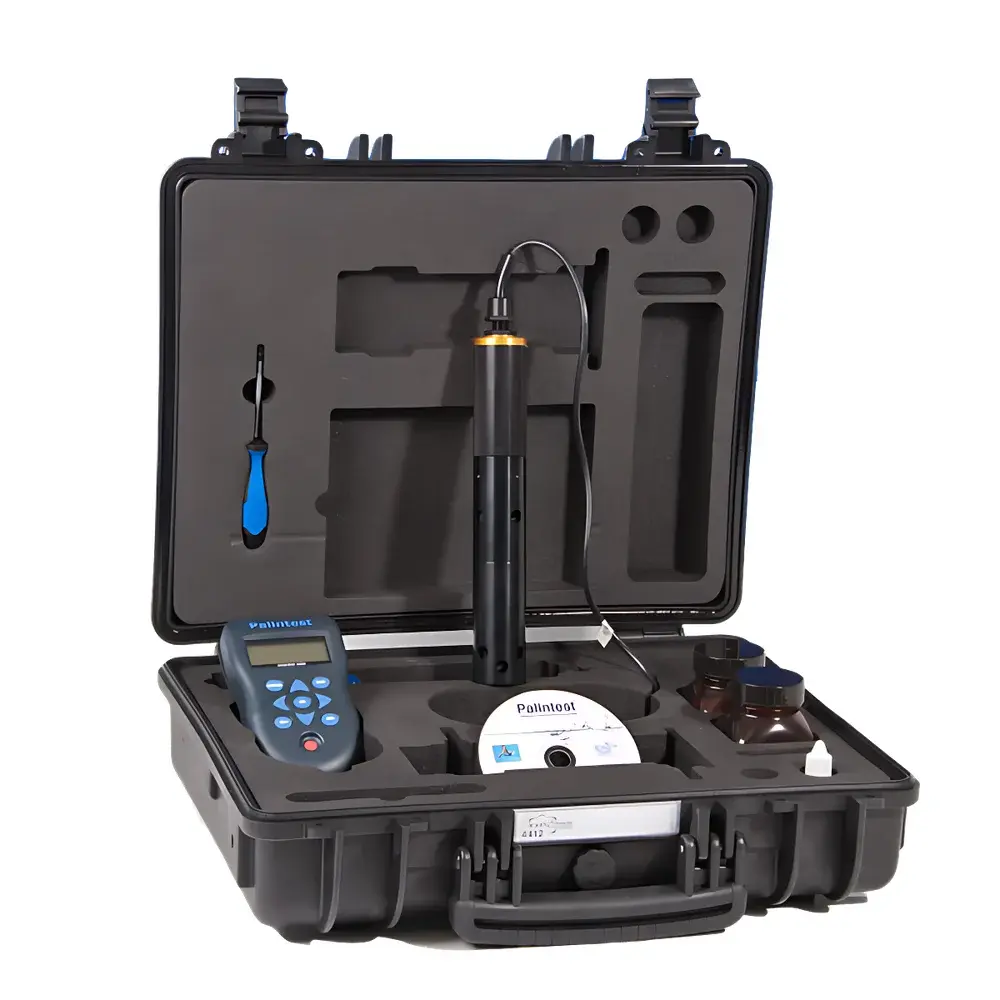
Palintest Macro 900 Multi-Parameter Water Quality Analyzer
| Brand | Palintest |
|---|---|
| Origin | United Kingdom |
| Model | Macro 900 |
| Instrument Type | Portable/Handheld Water Quality Analyzer |
| Detection Parameters | Water Temperature, Depth, Dissolved Oxygen (DO), pH, ORP, Conductivity, Resistivity, TDS, Salinity, Specific Gravity of Seawater, Ammonium/Ammonia-N, Chloride, Fluoride, Nitrate, Calcium, Turbidity, Chlorophyll-a, Phycocyanin, Phycoerythrin, Rhodamine WT Dye, Oil-in-Water, Fluorescein, CDOM/FDOM |
| Display | 80-character backlit LCD |
| Data Storage | 1,000 measurement records (including GPS-tagged data) |
| Data Output | USB interface with cable |
| GPS | 12-channel receiver, internal antenna, ±10 m 3D positional accuracy |
| Barometric Pressure Range | 150–1150 mbar (±1 mbar) |
| Power Supply | 5 × AA alkaline or NiMH rechargeable batteries |
| Battery Life | >20 h (alkaline), >40 h (NiMH) |
| Operating Temperature | −20 °C to +70 °C |
| Ingress Protection | IP67 (submersible to 1 m for 30 min) |
| Dimensions | 90 × 180 × 39 mm |
| Weight | 450 g (with batteries) |
| Ordering Code | PT 1401 Macro 900 Host Unit with Accessories |
Overview
The Palintest Macro 900 Multi-Parameter Water Quality Analyzer is a field-deployable, integrated sensing platform engineered for high-reliability in situ monitoring of freshwater, estuarine, and marine environments. Built upon a modular probe architecture grounded in electrochemical, optical, and physical transduction principles, the Macro 900 simultaneously acquires up to 12 core parameters—including temperature, depth, dissolved oxygen (via Clark-type polarographic sensor), pH (glass electrode), ORP (platinum reference), conductivity (four-electrode cell), resistivity, TDS, salinity, and seawater specific gravity—without requiring manual probe swapping. Its dual-brush mechanical cleaning system mitigates biofouling and particulate accumulation during extended deployments, ensuring signal stability over multi-day unattended operation. Designed and manufactured in the UK, the instrument complies with IEC 60529 (IP67), EN 61000-6-3 (EMC emissions), and ISO 7027 (turbidity by nephelometry) where applicable. It serves as both a handheld survey tool for rapid site assessment and a configurable node for semi-permanent surface or submerged installations.
Key Features
- Modular multi-sensor probe with standardized 8-pin connector enabling plug-and-play integration of up to six additional sensors beyond the base configuration
- Dual-motorized brush cleaning system actuated automatically at user-defined intervals or manually via software command
- Integrated 12-channel GPS module with internal antenna and NMEA 0183 output for georeferenced data logging (WGS84 datum)
- Backlit 80-character alphanumeric LCD display with real-time parameter overlay and status indicators (battery, GPS lock, sensor health)
- Onboard barometric pressure sensor (150–1150 mbar, ±1 mbar) for automatic DO compensation and elevation-aware salinity calculation
- USB 2.0 interface supporting direct data download and firmware updates; no proprietary drivers required on Windows/macOS/Linux
- Ruggedized housing rated IP67—fully dust-tight and submersible to 1 m for 30 minutes—validated per IEC 60529
- Extended battery autonomy: >20 hours with alkaline AA cells; >40 hours with NiMH rechargeables (low-power sensor polling mode enabled)
Sample Compatibility & Compliance
The Macro 900 supports direct immersion in natural waters ranging from oligotrophic lakes and groundwater wells to turbid rivers, tidal estuaries, and coastal seawater. Its ion-selective electrodes (ISEs) for ammonium, chloride, fluoride, nitrate, and calcium meet ASTM D1293 (pH), D3370 (sampling), and D511 (calcium), while optical sensors for chlorophyll-a, phycocyanin, phycoerythrin, rhodamine WT, oil-in-water, fluorescein, and CDOM/FDOM adhere to EPA Method 420.1 (oil & grease), ISO 10260 (chlorophyll fluorescence), and APHA Standard Methods 10200 H (fluorescent dyes). The turbidity module conforms to ISO 7027 and USEPA Method 180.1. All calibration protocols are traceable to NIST-certified standards, and the device supports GLP-compliant audit trails when paired with Palintest’s optional PC-based data management software.
Software & Data Management
Data acquisition, configuration, and reporting are managed through Palintest’s free MacroLink Desktop Software (v3.2+), compatible with Windows 10/11. Each logged record includes timestamp (UTC), GPS coordinates (latitude/longitude/elevation), sensor IDs, raw and compensated values, and operator-defined site tags. The software enables batch export to CSV, Excel (.xlsx), or PDF report formats compliant with ISO/IEC 17025 documentation requirements. Audit logs capture user login events, calibration actions, sensor swaps, and firmware updates—meeting FDA 21 CFR Part 11 electronic record integrity criteria when used in regulated environmental monitoring programs. USB data transfer preserves full metadata integrity without loss of GPS or pressure context.
Applications
- Regulatory compliance monitoring for wastewater discharge permits (e.g., NPDES, EU Urban Wastewater Treatment Directive)
- Ecological baseline studies and long-term trend analysis in protected aquatic habitats
- Drinking water source surveillance including reservoirs, springs, and distribution networks
- Marine aquaculture site characterization (nutrient loading, algal bloom indicators, dissolved oxygen stratification)
- Post-flood or post-spill rapid response assessments requiring simultaneous multi-analyte screening
- Educational field labs and undergraduate environmental science coursework
- Integration into low-power telemetry networks via optional RS-485 or LoRaWAN gateway adapters
FAQ
Can the Macro 900 be used for continuous unattended monitoring?
Yes—the instrument supports scheduled logging intervals (1 min to 24 h), automatic brush activation, and power management modes suitable for fixed-site deployment up to 30 days with external power or solar charging.
Are calibration certificates provided with each sensor?
Each factory-calibrated sensor ships with a traceable calibration certificate referencing NIST-traceable standards; field recalibration is supported using Palintest-certified calibration solutions.
Is the GPS module compatible with differential correction services?
The built-in GPS receiver supports SBAS (WAAS, EGNOS, MSAS) for enhanced positional accuracy but does not support RTK or PPK correction protocols.
How is sensor cross-sensitivity addressed in multi-parameter measurements?
The firmware applies empirically derived compensation algorithms—for example, temperature- and salinity-corrected DO, pH-dependent ammonia speciation, and conductivity-based TDS conversion—based on ISO/IEC 17025-validated models.
Does the Macro 900 meet requirements for drinking water testing under WHO or EU Directive 98/83/EC?
While the Macro 900 itself is not a certified compliance instrument, its sensor modules—when operated per Palintest’s validated SOPs and calibrated against accredited reference materials—support data generation aligned with WHO Guidelines for Drinking-water Quality and Annex II of EU Directive 98/83/EC for indicative parameters.
Related Products







