
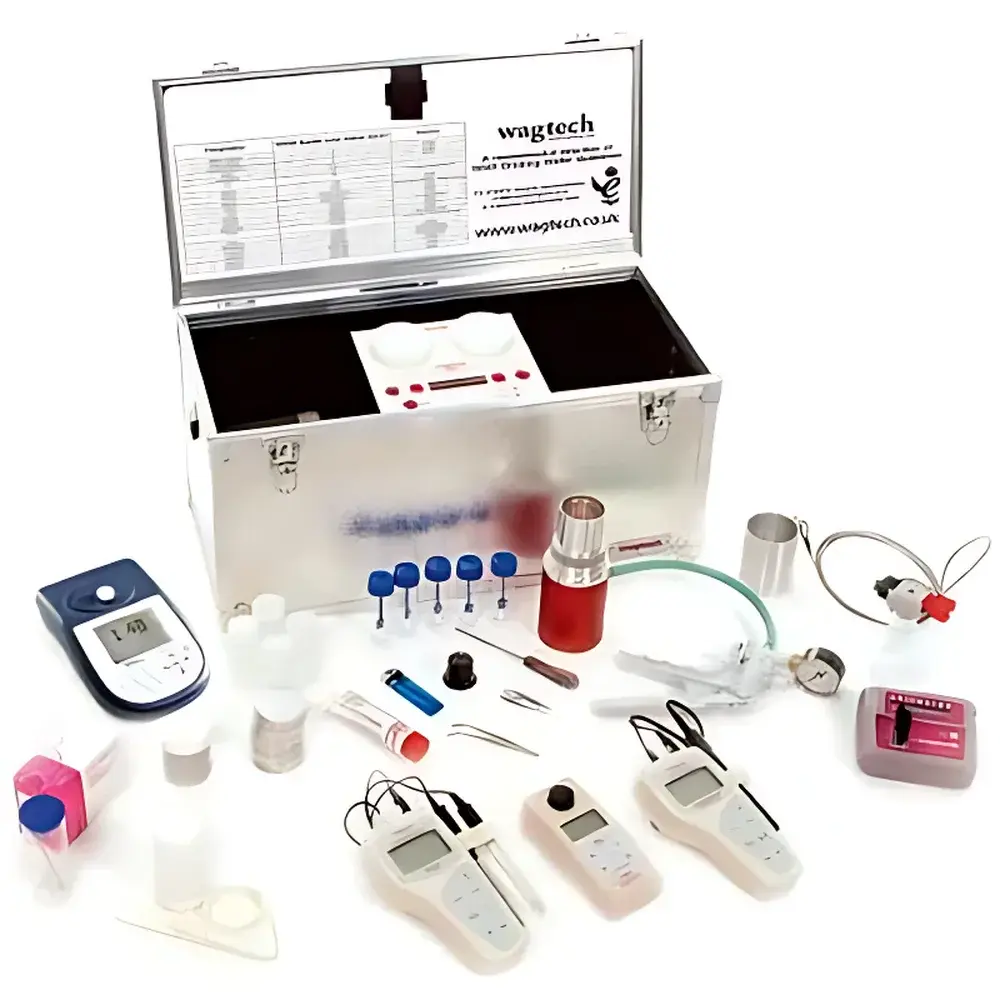
Wagtech Potalab® Portable Comprehensive Water Quality Analysis Laboratory
| Brand | Wagtech |
|---|---|
| Origin | United Kingdom |
| Model | Potalab |
| Instrument Type | Portable/Handheld Water Quality Analyzer |
| Detection Capabilities | Microbiological Testing, Physicochemical Parameter Analysis |
| Key Components | Portable Incubator (dual-zone, 20–50 °C), Digital Arsenic Analyzer (2–100 µg/L, arsenical spot method), 7100 Multi-parameter Photometer (≥100 pre-programmed calibration curves, IP67 rated), Portable Turbidimeter (ISO 7027 compliant, 0.01–1000 NTU), pH/Conductivity/TDS Meter (IP67, auto-temp compensation) |
Overview
The Wagtech Potalab® Portable Comprehensive Water Quality Analysis Laboratory is an integrated, field-deployable analytical platform engineered for rapid, reliable assessment of drinking water safety in resource-limited and emergency-response settings. Designed to meet the operational requirements of international humanitarian agencies—including UNICEF, WHO, and national public health programs—the system consolidates five core analytical modules into a single ruggedized transport case. Its architecture supports simultaneous microbiological enumeration (total coliforms, E. coli) and physicochemical profiling (arsenic, turbidity, residual chlorine, nutrients, metals, and general water quality indices) without dependency on fixed laboratory infrastructure. The system operates on fundamental principles of membrane filtration microbiology, digital colorimetric quantification (arsenic spot assay), dual-beam photometry (7100 analyzer), near-infrared 90° scattered light turbidimetry (ISO 7027), and potentiometric pH/conductometric TDS measurement. All components are calibrated traceably to NIST- or ISO-standard reference materials and validated per internationally recognized protocols including ISO 9308-1 (coliforms), ISO 10523 (pH), ISO 7027 (turbidity), and EPA Method 200.7 (metals screening).
Key Features
- Dual-zone portable incubator with independent temperature control (20–50 °C, ±0.1 °C accuracy, 0.1 °C resolution); accommodates up to 50 aluminum Petri dishes (2 × 25) or 16 plastic/glass dishes (2 × 8)
- Digital arsenic analyzer based on the standardized Gutzeit arsenical spot method; delivers quantitative results in ≤20 minutes with 1 µg/L resolution across 2–100 µg/L range; integrated fume absorption eliminates need for fume hood
- 7100 multi-parameter photometer featuring IP67 ingress protection, 100+ embedded calibration curves, automatic wavelength selection, and optical precision of ±0.005 Abs at 0.3 Au; compliant with ISO 8466-1 for calibration function validation
- Portable turbidimeter employing 850 nm LED source and 90° scatter detection per ISO 7027; four-point calibration (0.02, 20.0, 100, 800 NTU) using AMCO-Green standards; stray light < 0.02 NTU
- Multi-parameter meter (pH, conductivity, TDS, temperature) with IP67-rated housing, automatic temperature compensation (ATC), and selectable temperature coefficient (α); supports single- or multi-point calibration with NIST-traceable buffers and KCl standards
- All instruments powered via replaceable or rechargeable batteries (12 V DC for incubator; PP3 9 V for arsenic analyzer; AA/AAA alkaline cells for photometer, turbidimeter, and meter); no external AC dependency required for full field operation
Sample Compatibility & Compliance
The Potalab® system is validated for use with raw surface water, groundwater, treated drinking water, and point-of-use samples from boreholes, wells, piped networks, and emergency distribution points. It complies with WHO Guidelines for Drinking-water Quality (4th ed., 2017) for indicator organism detection and chemical parameter screening. Microbiological testing adheres to ISO 9308-1:2014 (membrane filtration), while arsenic analysis follows the principle of ISO 10523:2012 (colorimetric determination after hydride generation). The photometer’s optical performance satisfies ISO 7027:2016 (turbidity) and ISO 8466-1:1993 (calibration curve linearity). All instruments are CE-marked and conform to IEC 61000-4 electromagnetic compatibility standards. Data integrity meets GLP-aligned documentation requirements, with manual recording logs compatible with audit-ready reporting frameworks used by WHO Emergency Response Units and national regulatory authorities.
Software & Data Management
While the Potalab® suite operates as a standalone hardware platform without embedded software or Bluetooth connectivity, its design enables seamless integration into structured data workflows. Each instrument provides direct digital readouts (LED or LCD) with SI-unit formatting (µg/L, NTU, mg/L, µS/cm, etc.), eliminating transcription errors. Calibration records, batch numbers of reagents (e.g., pre-filled culture media, AMCO standards, certified arsenic test kits), and environmental conditions (ambient temperature, sampling time/date) are documented manually using standardized WHO Field Data Sheets—designed for subsequent digitization into LIMS or DHIS2-compatible databases. Reagent lot traceability, instrument ID tagging, and operator signature fields support 21 CFR Part 11–aligned audit trails when paired with electronic data capture tools in supervised deployment contexts.
Applications
- Rapid response to waterborne disease outbreaks (e.g., cholera, typhoid) through concurrent E. coli enumeration and residual chlorine verification
- Baseline water safety assessments in post-disaster zones (floods, earthquakes) where grid power and lab access are unavailable
- Monitoring compliance with national drinking water standards (e.g., China GB 5749-2022, India IS 10500:2012, EU Directive 98/83/EC) during rural WASH program implementation
- Training field technicians and community health workers in standardized, low-cost water quality verification per WHO “Water Safety Plan” methodology
- Verification of household water treatment systems (e.g., biosand filters, solar disinfection, ceramic filters) using turbidity, chlorine, and microbial endpoints
- Supporting UN Sustainable Development Goal 6.1 (universal safe drinking water) through decentralized, real-time data collection at village-level monitoring nodes
FAQ
Does the Potalab® require annual recalibration by an accredited lab?
No—each instrument includes user-executable calibration routines using supplied standards (e.g., AMCO turbidity standards, NIST pH buffers, KCl conductivity solutions). However, periodic verification against traceable reference materials every 6 months is recommended for GLP-compliant deployments.
Can the incubator operate continuously on battery power during extended field missions?
Yes—the dual-zone incubator runs for up to 12 hours on a fully charged 12 V DC battery under typical 37 °C/44 °C dual-setpoint conditions; battery life is extended via thermal insulation and duty-cycle optimization.
Is the 7100 photometer suitable for wastewater effluent analysis?
It is optimized for drinking water and ambient surface water matrices. For high-turbidity or highly colored wastewater, sample dilution and method validation per ISO 7027 Annex B are required prior to use.
Are replacement culture media and arsenic test kits supplied with ongoing consumables support?
Wagtech provides globally distributed consumables logistics, including sterile, dehydrated, pre-poured membrane filtration media (mEndo, mFC) and EPA-validated arsenic test kits (Lot-certified, shelf life ≥24 months at 4–25 °C).
Does the system meet ISO/IEC 17025 requirements for testing laboratories?
The Potalab® itself is not a certified testing laboratory—but when operated under documented SOPs, trained personnel, and verified reagents, it generates data suitable for inclusion in ISO/IEC 17025-accredited lab reports as part of field screening workflows.
Related Products







