
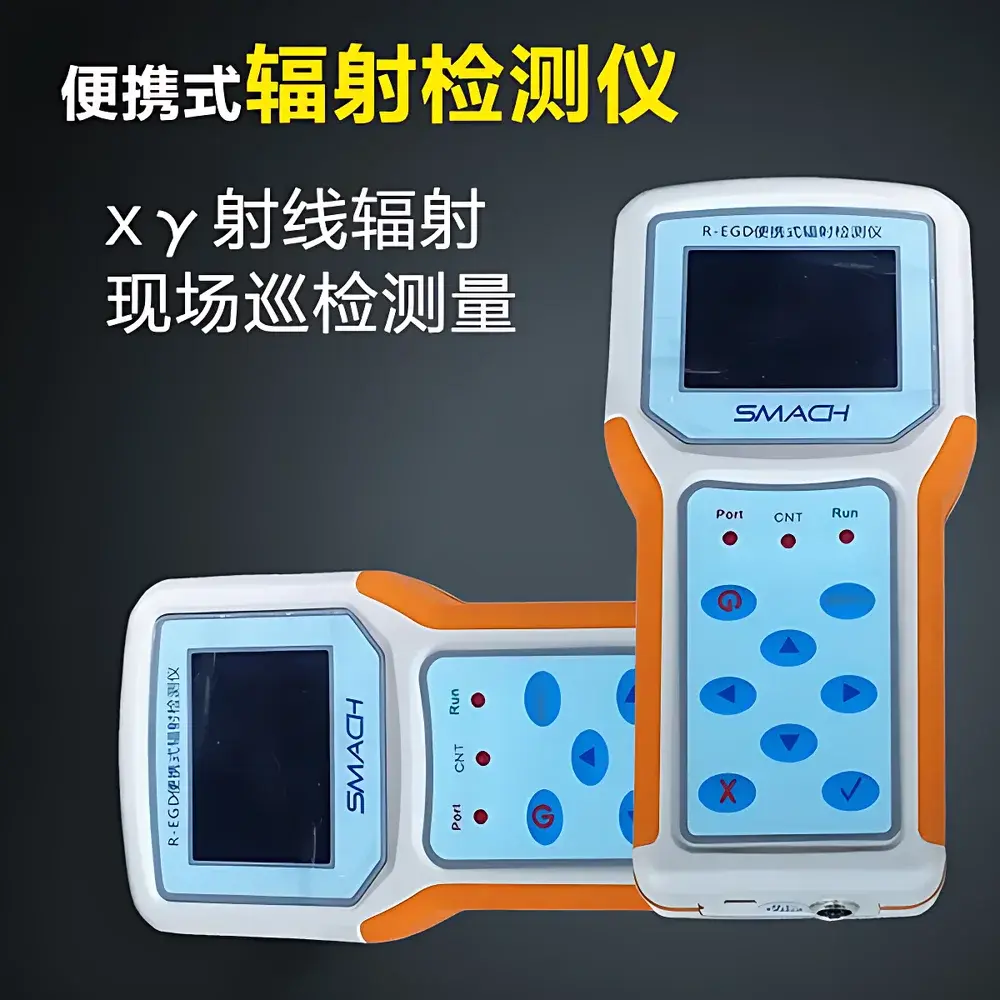
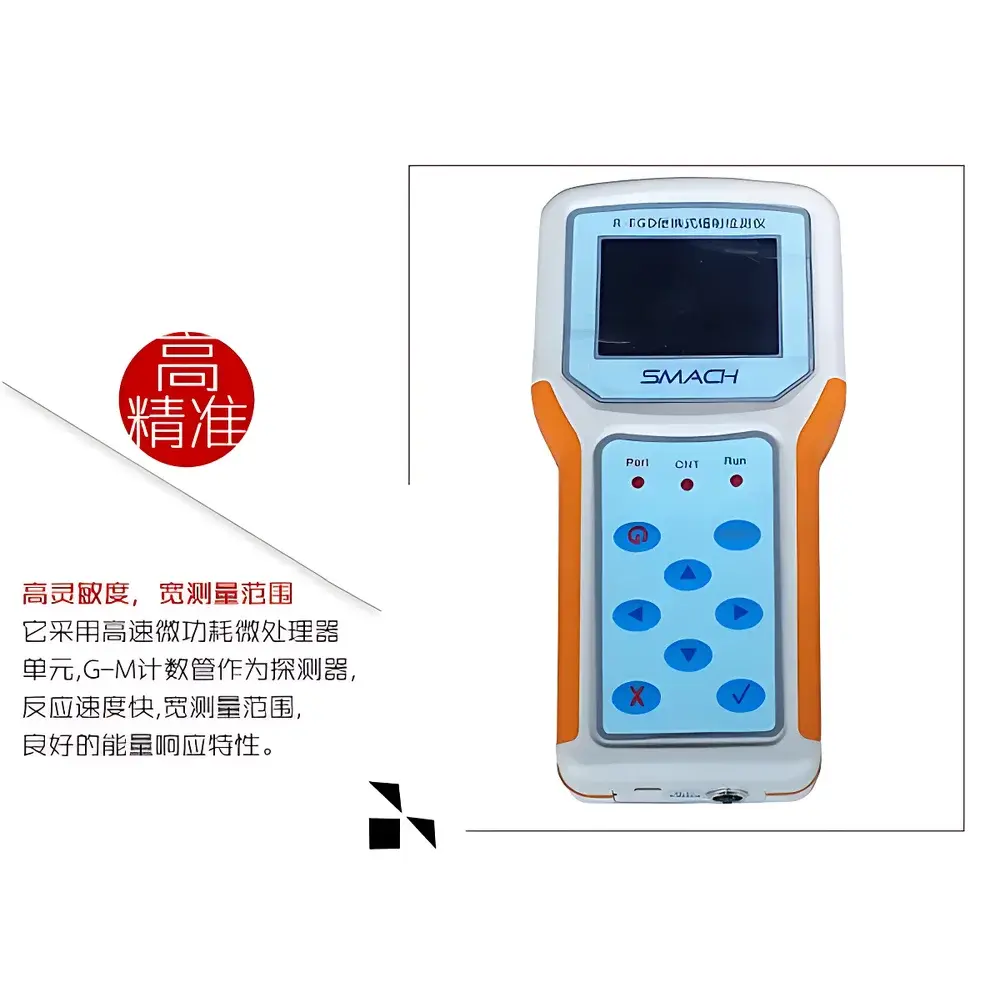
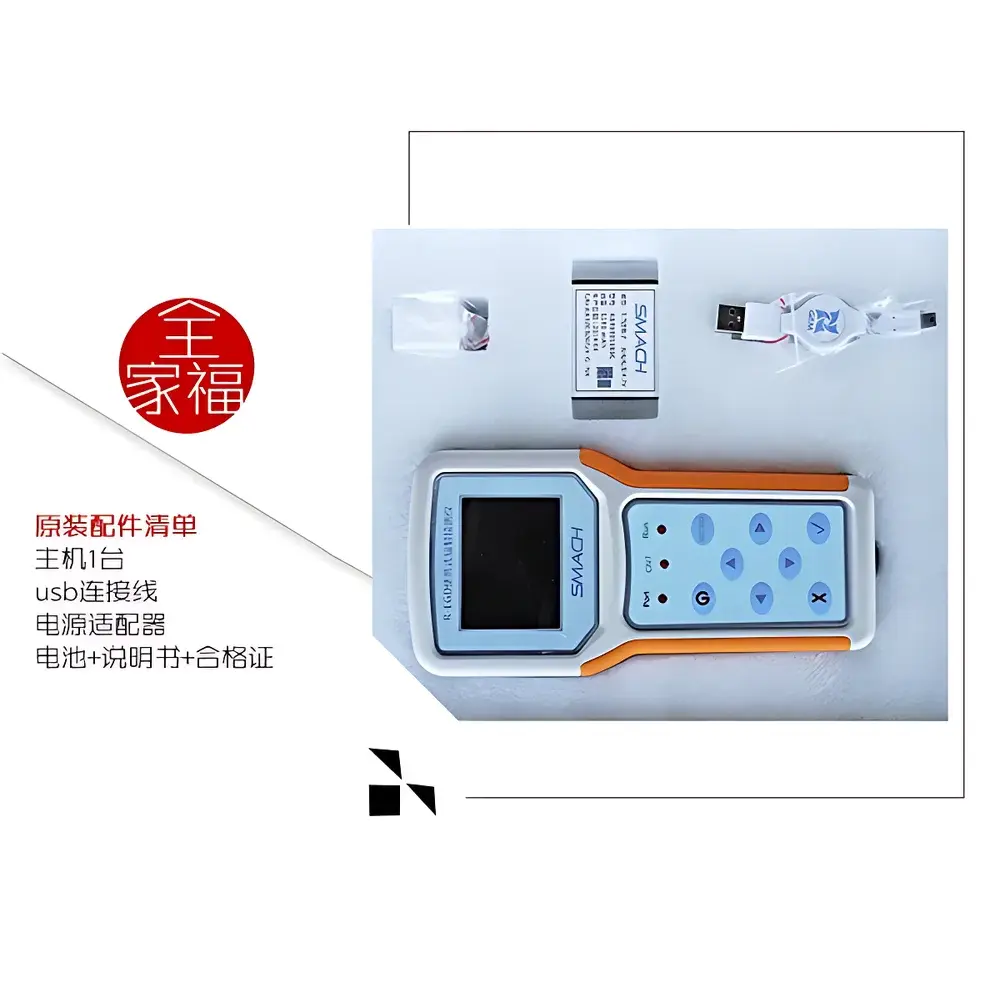
SMACH R-EGD Portable Radiation Survey Meter
| Brand | SMACH |
|---|---|
| Model | R-EGD |
| Type | Portable Dose Rate & Integrated Dose Meter |
| Detector | Geiger-Müller (G-M) Tube |
| Measured Radiation | X-rays and Gamma (γ) Rays |
| Dose Rate Range | 0.01 µSv/h – 15 mSv/h |
| Integrated Dose Range | 0.00 µSv – 9.99 Sv |
| Sensitivity | 80 CPM per µSv/h (typical, referenced to ¹³⁷Cs) |
| Energy Response | ±30% from 48 keV to 3.0 MeV (¹³⁷Cs calibrated) |
| Angular Dependence | ≤25% deviation at 0°–90° relative to calibration axis |
| Accuracy | ±5% in dose rate range 0.01–1000 µSv/h (¹³⁷Cs) |
| Display Units | µSv/h (dose rate), µSv (integrated dose) |
| Power | Rechargeable 3.7 V Li-ion battery |
| Weight | 700 g (with battery) |
| Dimensions | 200 × 100 × 35 mm |
| Audible Alarm | >80 dB at 50 cm |
| Operating Temperature | −10 °C to +50 °C |
| Compliance | Meets IEC 60846-1:2014 requirements for portable radiation protection instruments |
Overview
The SMACH R-EGD Portable Radiation Survey Meter is a field-deployable, microprocessor-controlled instrument engineered for real-time detection and quantification of ionizing radiation in occupational, environmental, and emergency response settings. It operates on the principle of gas-filled Geiger-Müller (G-M) tube detection, where incident X-ray and gamma photons induce ionization events within the tube’s fill gas, generating measurable electrical pulses proportional to radiation intensity. Unlike scintillation or semiconductor-based systems, the G-M tube provides robust, cost-effective detection with high intrinsic efficiency for low-to-medium energy photons (35 keV–3.0 MeV), making the R-EGD particularly suitable for broad-spectrum survey applications where reliability and operational simplicity are prioritized over spectral resolution. Its dual-parameter capability—simultaneous real-time dose rate (µSv/h) and accumulated dose (µSv/Sv) measurement—enables compliance verification against regulatory exposure limits defined in ICRP recommendations and national frameworks such as China’s GBZ 128–2019 and international standards including IEC 60846-1:2014.
Key Features
- Wide dynamic dose rate range (0.01 µSv/h to 15 mSv/h) supports both background-level monitoring and high-intensity incident assessment without manual range switching.
- Optimized energy response (±30% from 48 keV to 3.0 MeV, referenced to ¹³⁷Cs) ensures accurate readings across common diagnostic X-ray (e.g., 30–150 kVp) and industrial/therapeutic gamma sources (e.g., ⁶⁰Co, ¹³⁷Cs, ¹⁹²Ir).
- Integrated data logging with non-volatile memory retains dose and dose rate history even after power loss—critical for audit-ready recordkeeping in GLP-compliant environments.
- User-configurable alarm thresholds (predefined: 2.5 / 25 / 200 mSv/h; custom: user-defined) coupled with >80 dB audible alert (at 50 cm) and visual LED indicators enable rapid hazard identification during field inspections.
- Low-power ARM-based microcontroller architecture ensures continuous operation (>100 hours typical) on a single 3.7 V Li-ion charge, with real-time battery status display and under-voltage warning.
- Ergonomic handheld design (200 × 100 × 35 mm, 700 g) includes high-brightness backlit LCD, intuitive Chinese-language menu navigation, and directional source localization support via response mapping.
Sample Compatibility & Compliance
The R-EGD is designed for direct measurement of ambient photon fields in air—no sample preparation or shielding correction is required. It is validated for use with sealed radioactive sources (e.g., calibration check sources), unsealed contamination scenarios (surface dose rate estimation), and scattered radiation fields encountered in radiography rooms or cargo screening zones. The instrument conforms to IEC 60846-1:2014 for performance, metrological traceability, and environmental robustness—including specified angular dependence (≤25% variation from 0° to 90°), temperature stability (−10 °C to +50 °C), and mechanical durability per IEC 60068-2. While not certified for FDA 21 CFR Part 11 electronic records, its timestamped internal logging supports ALARA documentation and routine QA/QC reporting in accordance with ISO/IEC 17025-accredited laboratories.
Software & Data Management
Data export is supported via USB interface to host PC using proprietary Windows-compatible utility software. The application enables retrieval of time-stamped dose rate logs (1-second resolution), cumulative dose snapshots, and alarm event timestamps. Export formats include CSV and PDF report templates compliant with internal radiation safety program requirements. Audit trail functionality records operator ID (if configured), session start/end times, and firmware version—facilitating review during regulatory inspections or internal GLP audits. No cloud connectivity or remote telemetry is implemented, preserving data sovereignty and aligning with institutional IT security policies.
Applications
- Environmental radiation surveillance near nuclear facilities, uranium mining sites, or NORM-contaminated industrial zones.
- Routine occupational monitoring in radiotherapy departments, nuclear medicine labs, and industrial radiography operations.
- Border control and customs inspection for illicit radioactive material in cargo, luggage, or scrap metal shipments.
- Emergency response deployment during radiological dispersal device (RDD) incidents or lost source recovery operations.
- Construction material screening (e.g., granite, fly ash, recycled steel) per national building code radionuclide exemption thresholds.
- Geological prospecting support for natural gamma-ray spectrometry baseline surveys.
FAQ
What radiation types does the R-EGD detect?
It detects X-rays and gamma rays only. It is not sensitive to alpha, beta, or neutron radiation due to inherent G-M tube wall attenuation and lack of appropriate converter layers.
Is the instrument calibrated traceable to national standards?
Yes—each unit ships with a factory calibration certificate traceable to CNIM (China National Institute of Metrology) or equivalent regional primary standard laboratories, including energy-specific response curves for ²⁴¹Am, ¹³⁷Cs, and ⁶⁰Co.
Can the R-EGD be used for surface contamination checks?
No—it measures ambient dose rate in air (µSv/h), not surface activity (Bq/cm²). For contamination screening, dedicated alpha/beta probes or smear assay protocols are required.
Does it meet IEC 61526 for personal dosimetry?
No—the R-EGD is classified as a survey meter per IEC 60846-1, not a personal dosimeter per IEC 61526. It is intended for area monitoring, not individual dose assignment.
How often should recalibration be performed?
Annual recalibration is recommended per ISO/IEC 17025 guidelines, or after any physical shock, battery replacement, or suspected performance drift verified via check source testing.
Related Products







