
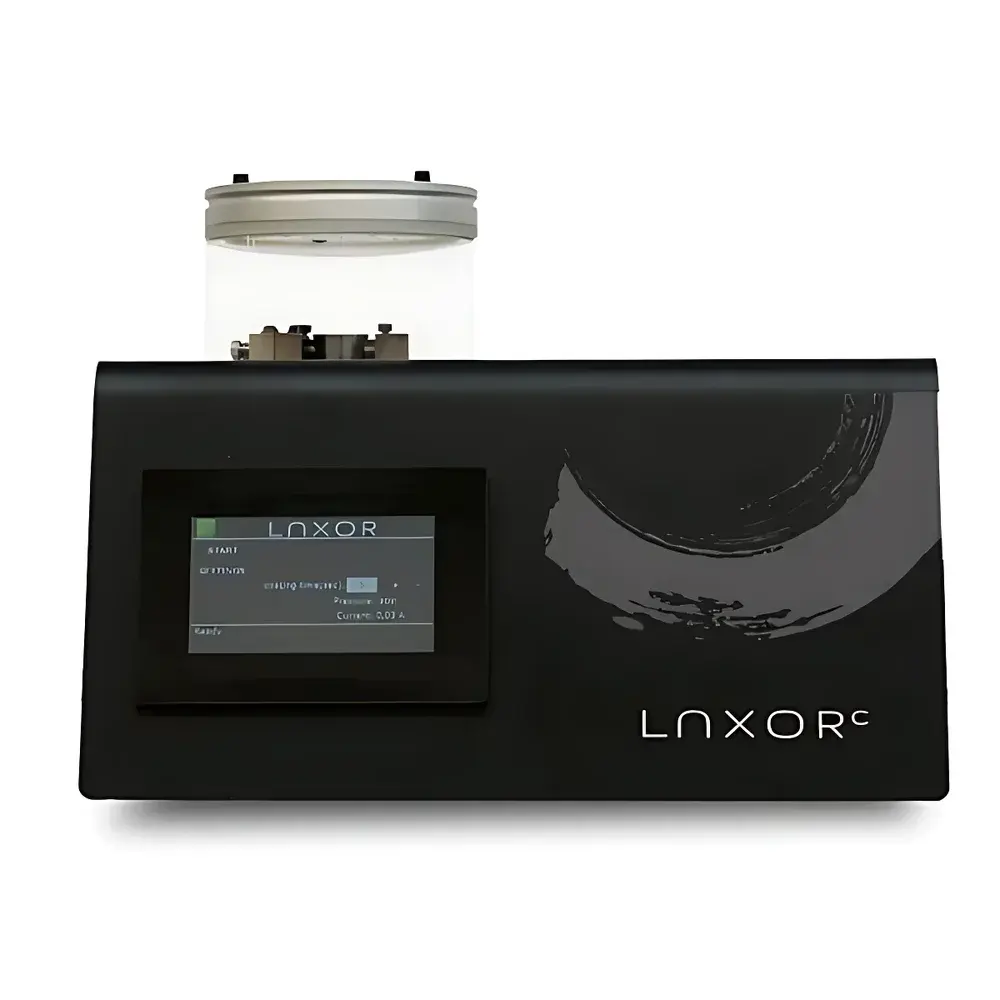
LUXOR C Carbon Thermal Evaporator for SEM Sample Preparation
| Brand | LUXOR (Aptco Technologies, Belgium) |
|---|---|
| Origin | Belgium |
| Model | LUXOR C |
| Evaporation Source | Bradley-type carbon rod |
| Max. Sample Capacity | 7 × 12.5 mm pin stubs or 3 × 25 mm pin stubs |
| Design | Inverted configuration |
| Automation Level | Fully automated touchscreen interface |
| Compliance | CE-marked, designed for ISO/IEC 17025-compliant labs, compatible with GLP/GMP documentation workflows |
Overview
The LUXOR C Carbon Thermal Evaporator is a fully automated, benchtop thermal evaporation system engineered specifically for high-precision carbon coating of non-conductive or semi-conductive specimens prior to scanning electron microscopy (SEM) and energy-dispersive X-ray spectroscopy (EDS) analysis. Unlike sputter coaters that rely on plasma-driven metal deposition, the LUXOR C employs resistive heating of high-purity graphite rods—using the Bradley-type evaporation source—to generate uniform, ultra-thin (typically 5–20 nm), amorphous carbon films under high vacuum (≤5 × 10⁻⁶ mbar). This process ensures minimal topographic masking, negligible beam-induced charging, and optimal X-ray transmission for quantitative EDS, making it the preferred method for electron-transparent conductive layers in microanalysis workflows.
Key Features
- Inverted chamber architecture: The sample stage doubles as the hinged lid, enabling direct, tool-free access to stubs—eliminating the need for tweezers or alignment fixtures during loading/unloading.
- Bradley-type carbon rod source: Precision-machined, water-cooled crucible assembly ensures stable evaporation rate, extended source lifetime, and consistent film thickness reproducibility across multiple runs.
- Intelligent A² (Adaptive Algorithmic Automation) technology: Self-calibrating deposition control eliminates manual rotation-stage programming; automatically adjusts evaporation time and current profile based on real-time vacuum stability and source resistance drift.
- Integrated safety engineering: All high-voltage circuits (up to 12 V DC at >100 A) are fully encapsulated within grounded, interlocked housing; conforms to IEC 61010-1 safety standards for laboratory electrical equipment.
- Clean-coating design: Gravity-assisted particle management directs residual carbon particulates away from the sample zone toward the cryo- or turbomolecular pump inlet—reducing chamber contamination and extending maintenance intervals.
Sample Compatibility & Compliance
The LUXOR C accommodates standard SEM stub formats—including 12.5 mm and 25 mm pin-type stubs (up to 7 × 12.5 mm or 3 × 25 mm simultaneously)—as well as specialized holders: resin-embedded sample stages (25–40 mm diameter, 10–50 mm height, secured via three M4 screws) and cylindrical sample carriers (with dedicated positions for 9 mm, 12 mm, and 25 mm stubs). All mechanical interfaces comply with ISO 80000-4 (quantities and units—mechanics) and ASTM E1558 (standard guide for preparation of specimens for SEM). The system supports audit-ready operation under GLP and GMP environments, with optional timestamped log export (CSV/Excel) and user-access-level controls aligned with FDA 21 CFR Part 11 requirements when paired with validated LUXOR LabSuite software.
Software & Data Management
Operation is managed via a 7-inch capacitive touchscreen running embedded Linux-based firmware. The interface provides intuitive preset selection (e.g., “EDS-Carbon”, “High-Resolution SEM”, “Low-Dose Imaging”) and manual parameter override (evaporation current, dwell time, vacuum threshold). Each run generates a metadata-rich log file containing chamber pressure trace, source current ramp profile, final film thickness estimate (calculated via pre-characterized deposition rate curves), operator ID, and timestamp. Logs are exportable via USB or network share and integrate natively with LUXOR LabSuite v3.2—enabling centralized fleet monitoring, SOP versioning, and electronic signature capture for regulated laboratories.
Applications
- Preparation of insulating geological, biological, or polymeric specimens for high-resolution secondary electron imaging without charging artifacts.
- Thin carbon overcoating of FIB-prepared TEM lamellae to improve conductivity and reduce beam damage during STEM-EDS mapping.
- Routine carbon replication for replica metallurgy and surface topography preservation.
- Standardized carbon calibration layer deposition for quantitative EDS matrix correction (ZAF or φ(ρz) methods).
- Multi-sample throughput coating for quality control labs performing routine SEM inspection of ceramics, composites, or additive-manufactured parts.
FAQ
What carbon source material is used, and what purity level is recommended?
High-purity (99.9995%) spectroscopic-grade graphite rods (diameter 3.2 mm, length 50 mm) conforming to ASTM D4292 are recommended for optimal film homogeneity and low hydrocarbon outgassing.
Is the LUXOR C compatible with existing vacuum pumping systems?
Yes—the system requires a base pressure ≤5 × 10⁻⁶ mbar and accepts standard KF-40 or CF-63 flanges; compatibility with common turbomolecular pumps (e.g., Pfeiffer HiPace, Edwards nXR) and cryopumps is verified per manufacturer specifications.
How is film thickness monitored or verified?
Thickness is estimated algorithmically using calibrated source resistance–time curves and validated against quartz crystal microbalance (QCM) reference runs; for traceable metrology, users may integrate an optional Inficon XTM/2 QCM module with real-time feedback.
Can the LUXOR C be integrated into automated lab workflows?
Yes—RS-232, Ethernet, and dry-contact I/O ports support integration with LIMS, robotic sample handlers, and facility SCADA systems via Modbus TCP or custom API endpoints.
What maintenance is required for long-term reliability?
Routine tasks include quarterly chamber cleaning with IPA-wiped lint-free wipes, annual source rod alignment verification, and biannual calibration of vacuum gauges per ISO/IEC 17025 internal procedure guidelines.
Related Products



