
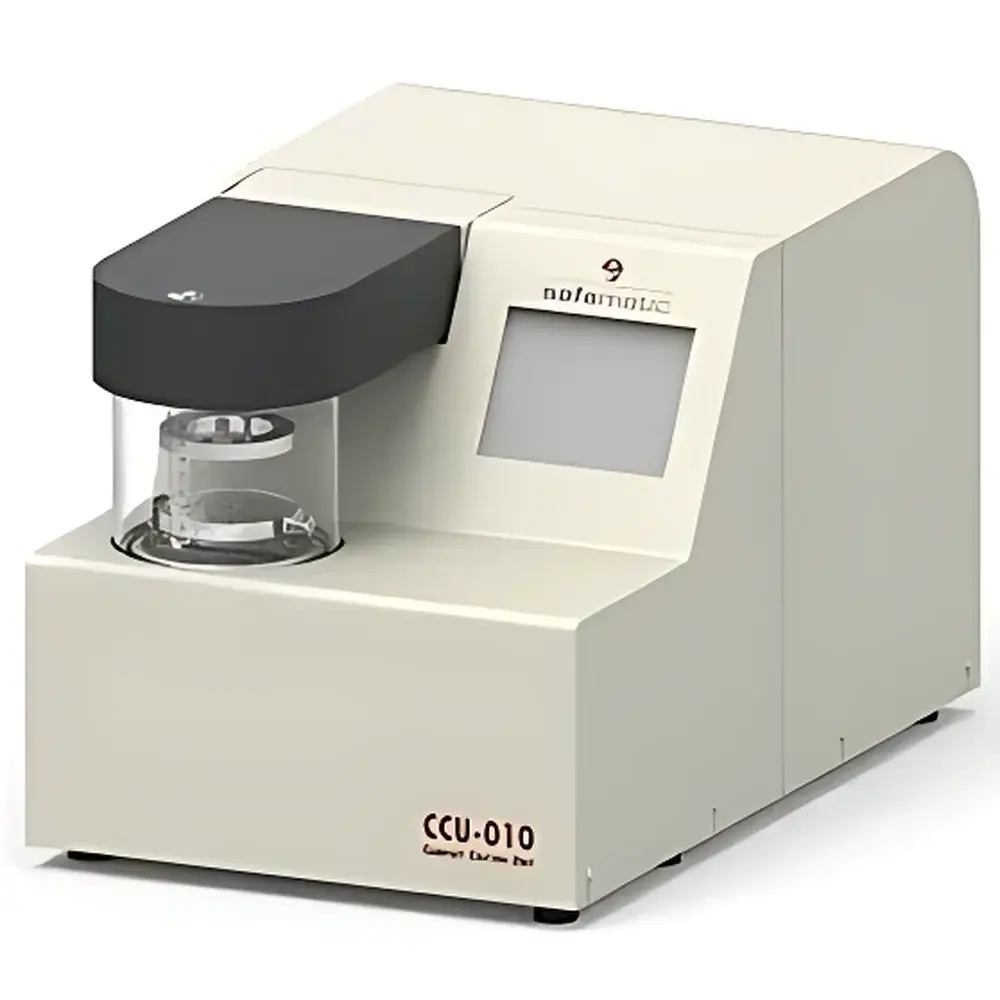
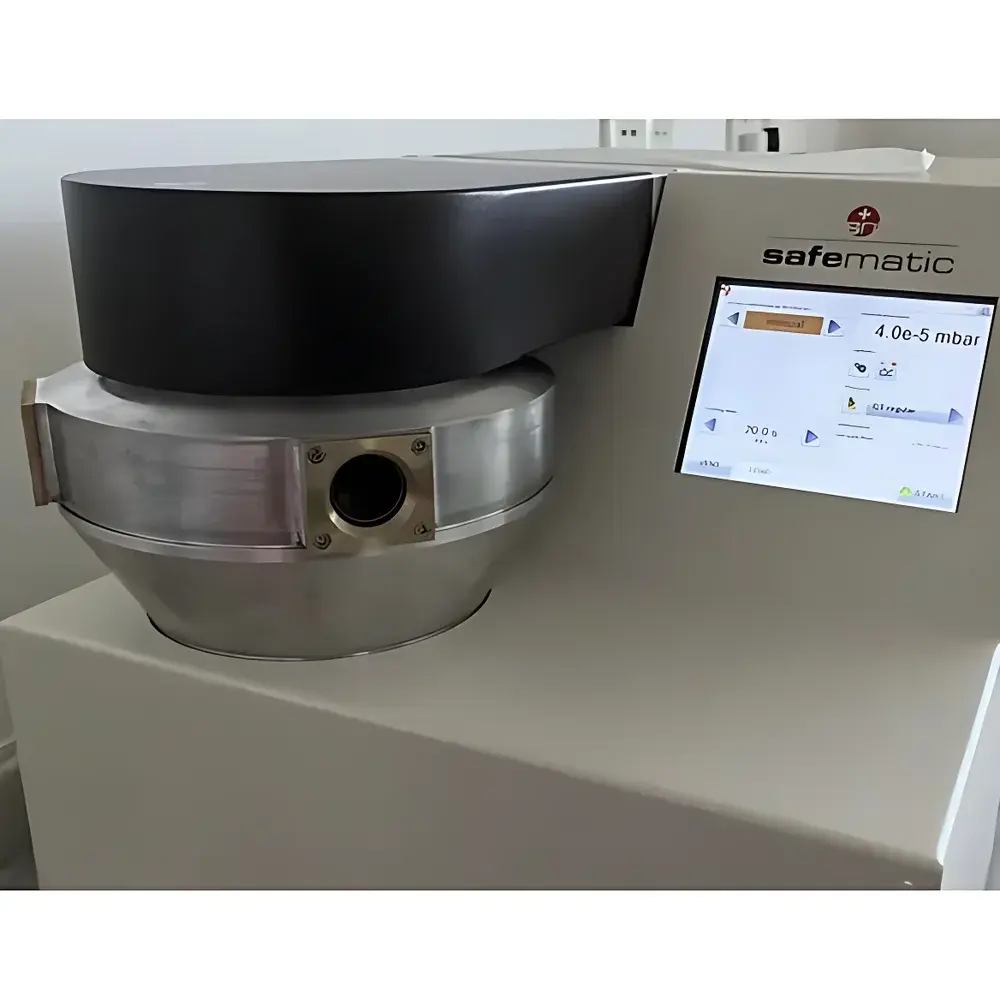
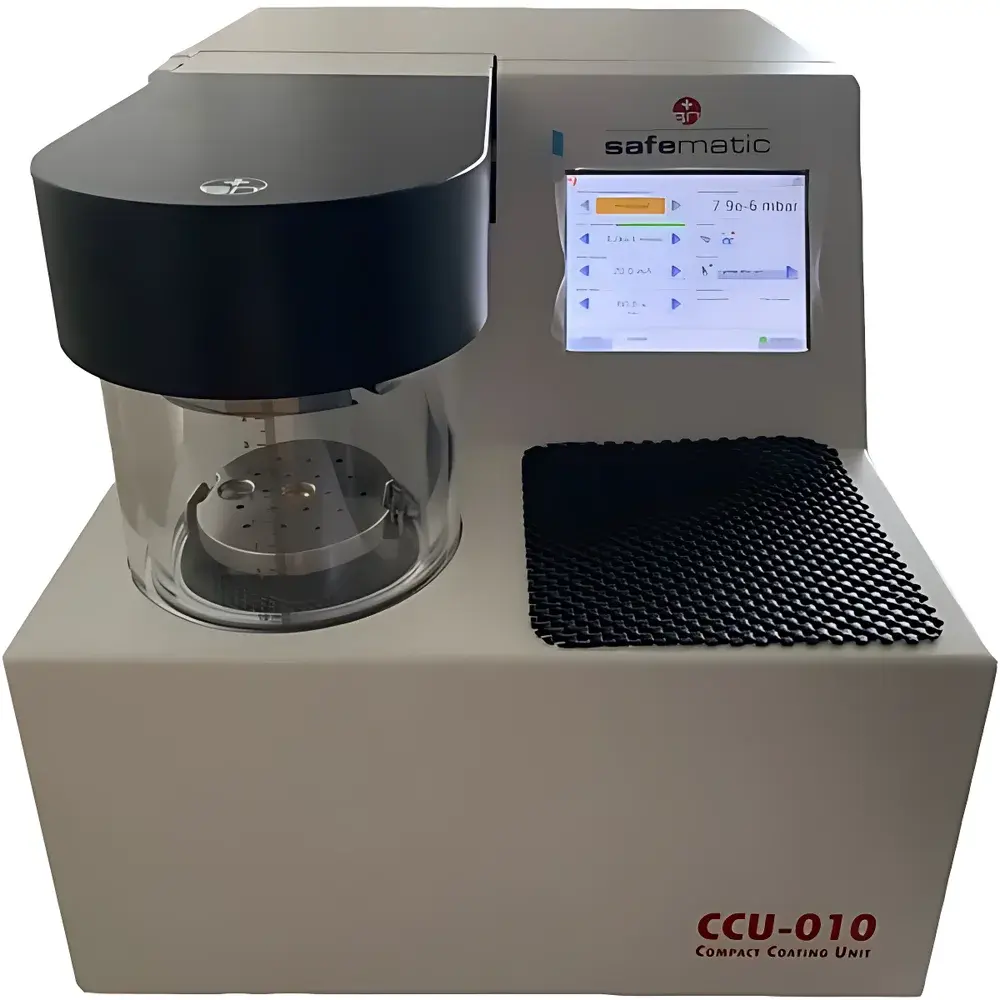
Safematic CCU-010 HV_CT High-Vacuum Carbon Evaporation Coater
| Brand | Safematic |
|---|---|
| Origin | Switzerland |
| Model | CCU-010 HV_CT |
| Vacuum Level | <5×10⁻⁷ mbar (base pressure) |
| Evaporation Source | Automatic carbon fiber feed system |
| Thickness Monitoring | Dual-position quartz crystal microbalance (QCM) |
| Pumping System | Integrated oil-free turbomolecular + diaphragm pump |
| Plasma Options | GD-010 glow discharge, ET-010 plasma etching |
| Control Interface | TFT touchscreen with programmable recipes |
| Software Options | Coating-LAB PC software, RC-010 glovebox remote control |
| Sample Stage | Ø ≥60 mm, height-adjustable & tilt-capable, compatible with rotary, planetary, and slide holders |
Overview
The Safematic CCU-010 HV_CT is a fully automated, high-vacuum thermal evaporation coater engineered specifically for electron microscopy sample preparation. It operates on the principle of resistive heating of high-purity carbon filaments under ultra-high vacuum conditions (<5×10⁻⁷ mbar base pressure), enabling controlled deposition of uniform, low-contamination carbon films for SEM, TEM, STEM, and FIB applications. Unlike conventional carbon coaters relying on manual filament loading or single-use carbon rods, the CCU-010 HV_CT integrates a proprietary European-designed automatic carbon fiber feed mechanism—capable of executing dozens of consecutive depositions without venting or user intervention. Its compact, modular architecture eliminates cross-contamination between processes and supports seamless integration of optional surface modification modules—including glow discharge (GD-010) and plasma etching (ET-010)—within a single vacuum cycle. This enables full workflow automation: pre-deposition plasma cleaning, carbon film evaporation, and post-deposition surface functionalization—all performed in situ without breaking vacuum.
Key Features
- Oil-free, fully integrated vacuum system: High-speed turbomolecular pump backed by a maintenance-free diaphragm pump—no external oil reservoirs or bulky foreline tubing.
- Automatic carbon fiber feed system: Precision-controlled advancement and tensioning of carbon wire; supports reproducible deposition of films ranging from sub-nanometer TEM support films to >100 nm conductive coatings for EDS analysis.
- Dual-position quartz crystal microbalance (QCM): Real-time thickness monitoring at two independent locations—optimized for both standard planar substrates and irregular or tilted samples.
- Plug-and-play CT-010 carbon evaporation module: Tool-free insertion into the main chamber; rapid exchange with other Safematic modules (e.g., sputtering, glow discharge) without recalibration.
- Intelligent power management: Pulse-mode evaporation, automatic shutter pre-bake, and current/voltage feedback loops ensure stable deposition rates and eliminate arcing-induced non-uniformity.
- Vacuum retention capability: Chamber maintains high vacuum during standby—minimizing moisture adsorption, particulate ingress, and pump-down time between runs.
Sample Compatibility & Compliance
The CCU-010 HV_CT accommodates a wide range of specimen geometries via its Ø ≥60 mm height-adjustable and tilt-capable stage. Optional stages—including rotating, planetary, and microscope slide holders—support heterogeneous sample batches and high-throughput workflows. All internal wetted materials comply with ASTM F2459 (standard guide for evaluating vacuum compatibility of materials) and ISO 14644-1 Class 5 cleanroom requirements when operated in controlled environments. The system’s fully documented vacuum protocols, recipe-based operation, and audit-trail-capable Coating-LAB software align with GLP and GMP laboratory practices. When configured with RC-010 remote control software and integrated into inert-atmosphere gloveboxes, it satisfies ISO 14644-8 requirements for particle-controlled thin-film processing.
Software & Data Management
Coating-LAB software provides real-time graphical visualization of process parameters—including chamber pressure, evaporation current/voltage, QCM-derived deposition rate (nm/s), and cumulative thickness (nm). All data are timestamped, recipe-tagged, and exportable in CSV, Excel, and PNG formats. The software supports version-controlled parameter libraries, automated calibration logging, and configurable alarm thresholds. For glovebox-integrated installations, RC-010 remote control software enables Windows-based operation with secure network authentication, encrypted recipe transfer, and synchronized multi-device scheduling. Both software packages generate electronic records compliant with FDA 21 CFR Part 11 requirements—including user login tracking, electronic signatures, and immutable audit trails for all critical actions.
Applications
- TEM grid coating: Ultra-thin, continuous carbon films (0.5–5 nm) for specimen support and electron transparency.
- SEM conductivity enhancement: Uniform 5–30 nm carbon layers for non-conductive biological, polymeric, or ceramic specimens.
- EDS quantification standards: Pinhole-free, stoichiometrically stable carbon films serving as matrix-matched calibration references.
- FIB lamella protection: Thick (>50 nm), mechanically robust carbon caps for lift-out and milling stability.
- Hydrophilicity tuning: In-situ glow discharge treatment (air/Ar/O₂) post-carbon deposition to render carbon surfaces wettable for cryo-EM grid preparation.
- Surface activation: Argon plasma etching prior to coating improves adhesion of carbon films on low-energy substrates such as fluoropolymers or aged oxides.
FAQ
What vacuum level does the CCU-010 HV_CT achieve, and how is it maintained?
The system achieves a base pressure of <5×10⁻⁷ mbar using an integrated oil-free turbomolecular pumping station. Vacuum integrity is preserved during idle periods via active pressure monitoring and automatic valve sealing—enabling rapid restart without extended pump-down cycles.
Can the CT-010 carbon module be replaced with other Safematic modules without breaking vacuum?
Yes. The CCU-010 HV_CT employs a standardized flange interface and tool-free bayonet locking mechanism. Modules including GD-010 (glow discharge), ET-010 (plasma etch), and MS-010 (magnetron sputtering) are hot-swappable under vacuum.
How many carbon depositions can be performed before reloading the carbon source?
The automatic carbon fiber feed system supports ≥30 consecutive depositions under typical operating conditions (e.g., 10 nm SEM coatings), depending on film thickness and evaporation rate settings.
Is the dual-position QCM calibrated traceably to NIST standards?
Each QCM sensor is factory-calibrated against certified reference films; full calibration certificates—including sensitivity factor, frequency drift, and temperature coefficient—are supplied with every instrument.
Does the system support automated recipe execution for unattended overnight operation?
Yes. Up to 99 programmable recipes—including vacuum ramp profiles, evaporation power ramps, shutter timing, plasma gas selection, and endpoint criteria—can be stored and executed sequentially with zero operator input.




