
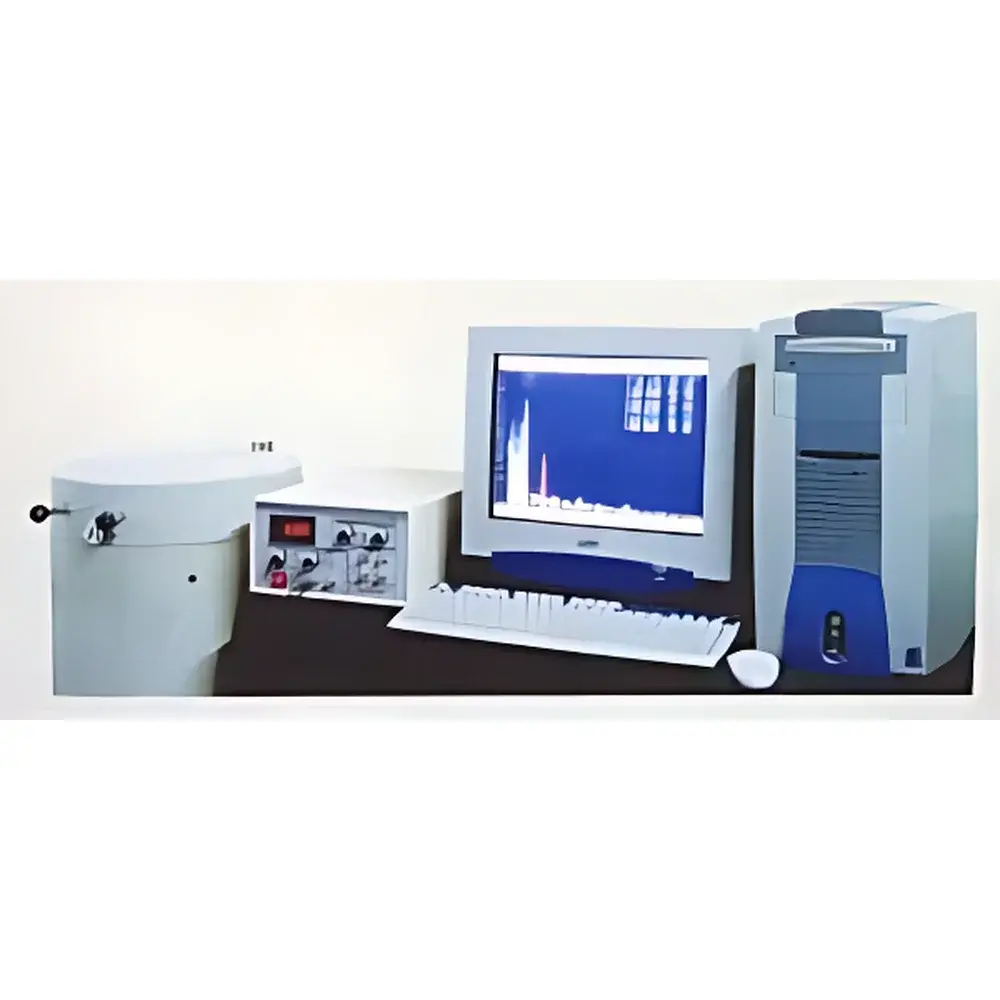
CNCS BH1324F Desktop Gamma Spectrometer System
| Brand | CNCS (China Nuclear Control System) |
|---|---|
| Model | BH1324F |
| Detector Type | NaI(Tl) Scintillation Spectrometer |
| Energy Range | 50 keV – 2.0 MeV |
| Energy Resolution | ≤7.0% FWHM at 662 keV (with imported low-potassium Φ75×75 mm NaI(Tl) detector) |
| Background Count Rate | ≤160 cpm (50 keV–2.0 MeV) |
| Energy Linearity | ≤±1% (50 keV–2.0 MeV) |
| System Stability | ≤±1% over 8 h |
| MCA Channels | 512 / 1024 / 2048 / 4096 (software-selectable) |
| Max Counts per Channel | 2²⁴−1 |
| Integral Nonlinearity | ≤±0.1% (99.5% full scale) |
| Differential Nonlinearity | ≤±1% (99.5% full scale) |
| Channel Drift | ≤±1 channel over 8 h |
| HV Supply | 0–1500 V, manually adjustable, current limit 2 mA with overload/short-circuit protection |
| LV Supply | Overvoltage, overload and short-circuit protected |
| Preamplifier Gain | 0–160×, fixed shaping time 1 µs (optimized for NaI(Tl)) |
| Shielding | Lead castle (NG401-261), attenuation factor ≥80 (50 keV–2.0 MeV) |
| Software | UMS38 (MCA emulation & acquisition), WIN-NaI (gamma spectral analysis), fully compatible with Windows 98/Me/2000/XP/NT |
| Communication | RS-232 DMA interface, 912 kbps data transfer rate, no ISA slot required |
| Calibration Sources | Certified ²²⁶Ra, ²³²Th, ⁴⁰K single-nuclide standards + mixed standard (NIM traceable) |
| Compliance | ISO 9001 certified manufacturing |
| Detection Limit for Radon (activated charcoal method) | 6 Bq/m³ (average ambient air concentration) |
Overview
The CNCS BH1324F Desktop Gamma Spectrometer System is a high-stability, low-background gamma-ray spectrometry platform engineered for quantitative radionuclide analysis in environmental and building material matrices. Based on the proven BH1224 architecture and enhanced for improved energy resolution, system linearity, and operational robustness, the BH1324F implements scintillation-based gamma spectroscopy using thallium-doped sodium iodide [NaI(Tl)] detection. It operates on the principle of pulse-height analysis: incident gamma photons interact with the NaI(Tl) crystal to produce scintillation light, which is converted to proportional electrical pulses by a photomultiplier tube (PMT); these pulses are digitized and histogrammed by the integrated 4096-channel multichannel analyzer (MCA) to generate energy spectra. The system is calibrated against NIM-traceable reference standards and validated for compliance with national regulatory requirements for radioactivity assessment in construction materials, soil, water, biological samples, and indoor air.
Key Features
- Integrated 4096-channel MCA with 80 MHz ADC, supporting selectable channel depths (512/1024/2048/4096) and 24-bit dynamic range per channel (up to 16,777,215 counts)
- High-performance Φ75 × 75 mm NaI(Tl) detector available with either domestic or imported low-potassium crystal—ensuring reduced intrinsic background and optimal resolution (≤7.0% FWHM at 662 keV)
- Dedicated lead shielding (NG401-261 castle) providing ≥80-fold attenuation across 50 keV–2.0 MeV, critical for low-level environmental measurements
- Stable high-voltage supply (0–1500 V, 2 mA max) with real-time protection against overcurrent and short-circuit conditions
- Digitally optimized pulse processing: fixed 1 µs Gaussian shaping time, differential nonlinearity ≤±1%, integral nonlinearity ≤±0.1%
- RS-232 DMA interface enabling high-throughput, plug-and-play communication (912 kbps) with any modern Windows PC—no internal expansion card required
- Modular architecture supporting optional 4-channel mixed-mode operation via external quad-mixer module for parallel α/γ sample analysis
Sample Compatibility & Compliance
The BH1324F is specifically validated for regulatory-grade analysis of solid and liquid environmental matrices—including concrete, ceramic tiles, granite, soil cores, sediment, drinking water, plant tissue, and air-filtered charcoal cartridges. Its measurement protocol for ²²⁶Ra, ²³²Th, and ⁴⁰K in building materials conforms to GB 6566–2010 (Chinese National Standard for Radioactivity in Building Materials) and supports reporting in Bq/kg with uncertainty <20% above 37 Bq/kg. For airborne radon assessment, it implements the activated charcoal adsorption method per GB/T 14582–1993, achieving a minimum detectable concentration of 6 Bq/m³ (24-hour integrated sampling). Each unit undergoes full metrological verification at the National Institute of Metrology (NIM), Beijing, and ships with an official NIM calibration certificate. The system complies with ISO 9001:2015 quality management requirements and holds China Metrology Accreditation (CMC) license JingZhi 00000178-03.
Software & Data Management
The BH1324F operates two complementary Windows-native applications: UMS38 serves as the real-time MCA emulator—handling acquisition control, live spectrum display, energy calibration, and basic peak search—while WIN-NaI provides advanced spectral deconvolution, nuclide identification, activity quantification, and report generation. Both support multi-isotope fitting using least-squares algorithms and incorporate built-in efficiency calibration curves derived from certified point sources (²²⁶Ra, ²³²Th, ⁴⁰K, and mixed standard). All spectral data are stored in standard binary format (.spe) with embedded metadata (acquisition time, HV setting, live time, geometry). Audit trails, user access logs, and electronic signatures are configurable to align with GLP-compliant laboratory workflows. Raw data export to CSV, ASCII, or Excel formats enables third-party validation and statistical review.
Applications
- Regulatory screening of natural radionuclides (²²⁶Ra, ²³²Th, ⁴⁰K) in construction materials for compliance with national radiation safety limits
- Environmental monitoring of soil and sediment contamination following nuclear incidents or industrial releases
- Radioecological assessment of agricultural products, marine biota, and freshwater systems
- Radon progeny quantification in indoor/outdoor air using passive charcoal sampling followed by gamma counting
- Quality assurance in radiopharmaceutical production facilities and nuclear medicine departments
- Research-grade gamma spectroscopy in university physics and environmental science laboratories
FAQ
What is the minimum detectable activity (MDA) for ²²⁶Ra in soil samples?
The MDA depends on sample mass, counting time, and background level. Under typical conditions (250 g dried soil, 24-h count, low-background lead shield), MDA is approximately 1.2 Bq/kg (k=2, 95% confidence).
Does the system support IEC 61452 or ISO 20042 compliance?
While not formally certified to IEC 61452 (which applies to HPGe systems), the BH1324F meets functional equivalency requirements for NaI(Tl)-based environmental gamma spectrometry as defined in ISO 20042 Annex B.
Can WIN-NaI perform self-absorption correction for heterogeneous samples?
Yes—WIN-NaI includes empirical and semi-empirical correction modules based on matrix density, composition, and geometry, validated against NIST SRM 4357 and IAEA RGU-1 reference materials.
Is FDA 21 CFR Part 11 compliance supported?
Electronic signature and audit trail features are implemented in WIN-NaI v3.2+ and can be configured to meet Part 11 requirements when deployed on validated Windows platforms with domain-level user authentication.
What maintenance is required for long-term stability?
Annual recalibration using certified sources is recommended. PMT gain drift is monitored automatically; HV adjustment is rarely needed if operated within temperature-controlled environments (20–25°C, ±2°C).
Related Products







