
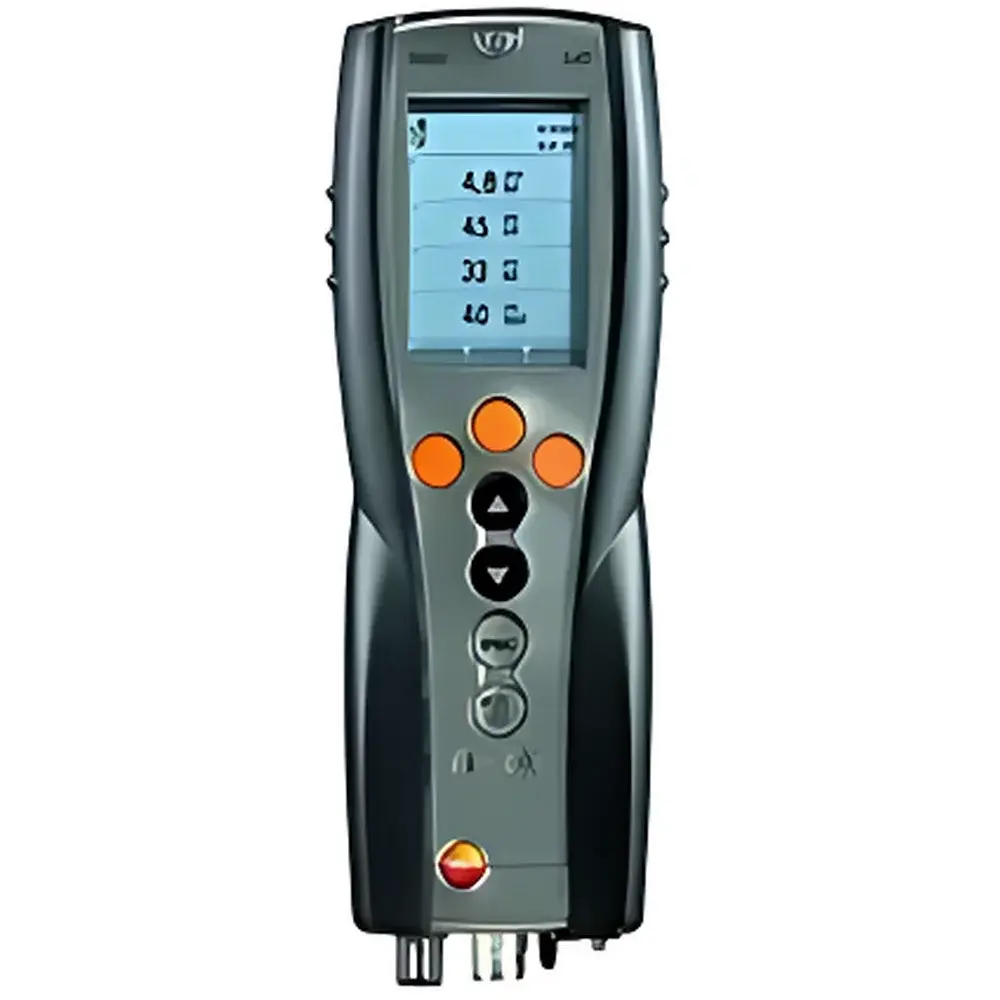
Testo TESTO340 Portable Flue Gas Analyzer
| Brand | Testo |
|---|---|
| Origin | Germany |
| Model | TESTO340 |
| Instrument Type | Portable Flue Gas Analyzer |
| Indication Error | < ±5% |
| Repeatability | < ±5% |
| Response Time | < 40 s |
| Stability | < ±5% |
| Measurable Gases | SO₂, CO, COlow, NO, NOlow, NO₂, O₂ |
| Differential Pressure & Flow Velocity Measurement | Built-in |
| Sensor Architecture | Modular, 3 Expandable Sensor Slots (O₂ standard |
| Fuel Database | 10 Predefined + 10 User-Defined Fuels |
| Data Interface | USB to easyEmission PC Software |
| Compliance | Designed for EN 50379-1/-2, EN 15545, VDI 3862, and applicable EPA Method 6C/7E prerequisites |
Overview
The Testo TESTO340 is a modular, portable flue gas analyzer engineered for precision combustion efficiency assessment and regulatory-compliant emissions monitoring in industrial, commercial, and municipal heating systems. Operating on electrochemical sensor principles for toxic and oxygen species detection—and incorporating integrated differential pressure and thermal anemometry for real-time flue gas velocity and volumetric flow calculation—the TESTO340 delivers trace-level quantification of key combustion byproducts including O₂, CO, COlow, NO, NOlow, NO₂, and SO₂. Its architecture adheres to the physical measurement fundamentals of stoichiometric combustion analysis: O₂ concentration enables excess air ratio (λ) calculation; CO and NOₓ levels indicate incomplete combustion and thermal NO formation; SO₂ quantifies sulfur-bearing fuel contribution. Designed for field-deployable use under variable ambient conditions, the instrument meets core functional requirements outlined in EN 50379-1 (portable emission analyzers) and supports method validation pathways aligned with EN 15545 (determination of gaseous emissions from combustion plants) and VDI 3862 (measurement of exhaust gases from small and medium combustion plants).
Key Features
- Modular sensor configuration: Standard O₂ sensor pre-installed; three additional sensor slots allow flexible, application-specific selection from CO, COlow (range: 0–100 ppm), NO, NOlow (0–100 ppm), NO₂, and SO₂—enabling optimized cross-sensitivity management and calibration traceability.
- Integrated differential pressure transducer and thermistor-based flow probe: Enables direct in-stack velocity measurement and mass flow normalization without external manometers or Pitot tubes.
- Automatic flow-controlled sampling pump: Maintains constant sample draw rate across varying stack backpressures, minimizing dilution artifacts and ensuring representative gas capture.
- Pre-calibrated, plug-and-play sensor modules: Each sensor carries individual calibration certificate with date-stamped verification; hot-swap capability allows field replacement without instrument downtime or recalibration of unaffected channels.
- Extended range functionality: Single-sensor range extension (e.g., CO up to 10,000 ppm) available via firmware activation; optional full-sensor-range expansion kit supports high-concentration industrial boiler and incinerator applications.
- Rugged IP54-rated housing with ergonomic handle and integrated tripod mount: Optimized for extended handheld operation or fixed-position measurements during boiler tune-ups, commissioning, and periodic compliance audits.
Sample Compatibility & Compliance
The TESTO340 is validated for use with dry and conditioned flue gases from oil-, gas-, biomass-, and coal-fired combustion sources operating at temperatures up to 600 °C (with compatible high-temp probe). It complies with essential European harmonized standards for portable emission analyzers, including EN 50379-1 (general requirements) and EN 50379-2 (performance criteria for CO, NOₓ, SO₂, and O₂). While not certified as a Class I, Division 1 hazardous area device, its sensor design incorporates catalytic poison resistance against H₂S and silicone vapors common in biogas and waste-derived fuels. Data acquisition meets GLP-aligned documentation practices: all measurements include timestamp, ambient T/P, probe temperature, and sensor status flags. For regulated reporting environments, the instrument serves as a primary field tool supporting data collection workflows compliant with ISO 5167 (flow measurement) and EPA Methods 6C (SO₂), 7E (NOₓ), and 10 (CO)—subject to site-specific QA/QC protocols.
Software & Data Management
Data acquisition and post-processing are managed via Testo’s easyEmission PC software (Windows-compatible, USB 2.0 interface). The software provides automated calculation of combustion parameters—including excess air (λ), CO₂ concentration, net thermal efficiency (ηth), and dew point—based on user-selected fuel type (10 built-in profiles: natural gas, LPG, light fuel oil, anthracite, etc.) or custom fuel composition (10 definable entries with C/H/O/S/N ash content and calorific value). All calculations conform to DIN EN 12952-15 and VDI 2046 methodologies. Audit trails record operator ID, calibration history, sensor swap events, and firmware version. Export formats include CSV, PDF reports (with company logo header), and XML for integration into LIMS or CMMS platforms. The software supports 21 CFR Part 11 readiness through optional electronic signature modules and configurable user access levels.
Applications
- Combustion optimization of residential and commercial boilers, furnaces, and thermal oil heaters
- Periodic emissions verification for small- and medium-scale CHP units and district heating plants
- Commissioning and troubleshooting of gas turbines and reciprocating engines
- Stack testing for environmental permit compliance (e.g., local air quality ordinances, EU IED Annex IV reporting)
- Educational labs and technical training centers requiring hands-on flue gas metrology instruction
- Energy service companies (ESCOs) conducting ASHRAE Level I/II energy audits with combustion diagnostics
FAQ
What is the minimum number of sensors required for operational functionality?
The TESTO340 requires at least two active sensors—including the standard O₂ module—to compute combustion parameters and initiate measurement sequences.
Can the instrument measure unburned hydrocarbons (UHC) or particulate matter?
No. The TESTO340 is configured exclusively for gaseous species detection via electrochemical and paramagnetic (O₂) sensors; UHC and PM require complementary FID or optical scattering instrumentation.
Is calibration verification traceable to national standards?
Yes. Each sensor module ships with a factory calibration certificate referencing PTB-traceable gas standards; field verification gases must be ISO 6141-certified and used within their expiration date.
Does the device support Bluetooth or Wi-Fi connectivity?
No. Data transfer is limited to USB 2.0 interface with easyEmission software; no wireless communication modules are integrated or supported.
What maintenance intervals are recommended for long-term accuracy?
Electrochemical sensors exhibit finite service life: O₂ (24 months), CO/NOₓ (18 months), SO₂ (12 months) under typical field use; annual full-system verification against certified span gases is advised per ISO 17025-aligned QA procedures.
Related Products







