
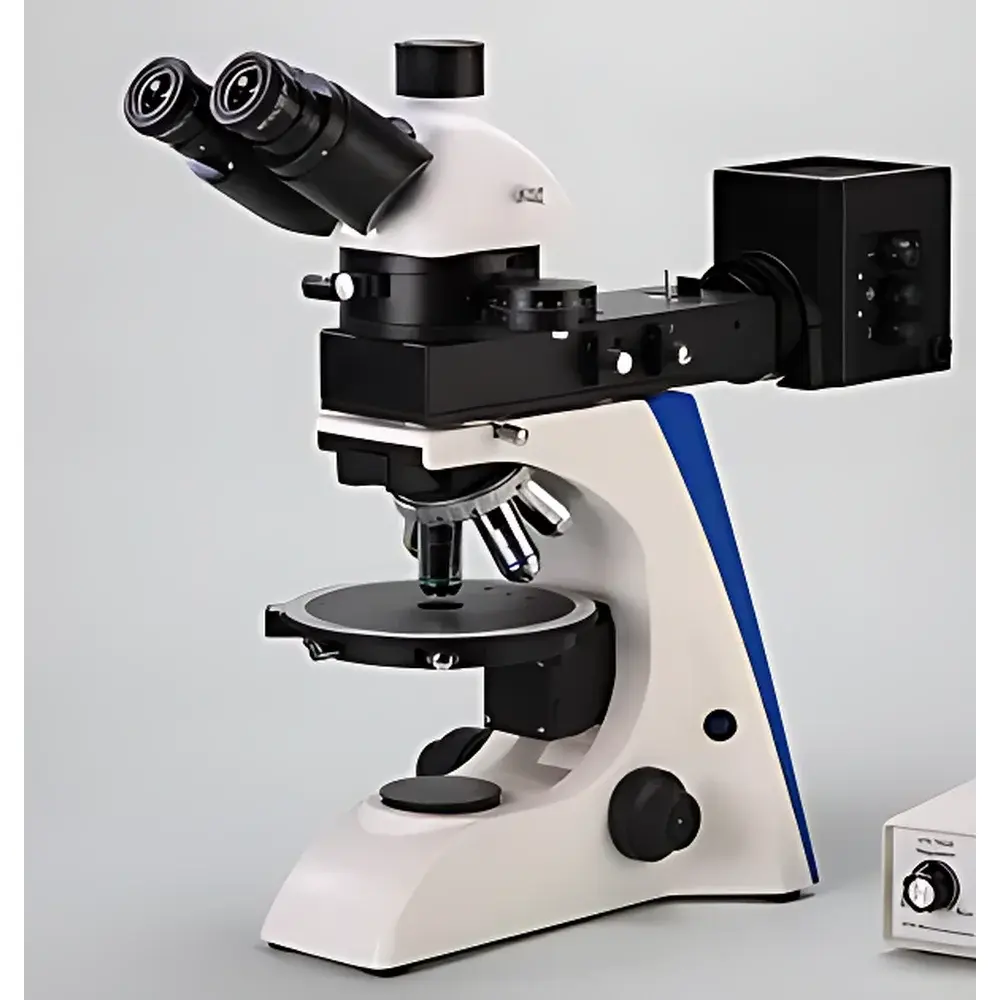
CNOPTEC BK-POL Polarizing Microscope
| Brand | CNOPTEC |
|---|---|
| Origin | Chongqing, China |
| Model | BK-POL |
| Optical System | OTICS Infinity-Corrected Achromatic Polarizing System |
| Eyepieces | 10× Widefield High-Eye-Point Plan Eyepieces (Field Number Φ22 mm / Φ20 mm) |
| Objectives | Infinity-Corrected Stress-Free Plan Objectives — Transmitted Light: 4× / 10× / 20×(S) / 40×(S) / 60×(S) |
| Reflected Light | 5× / 10× / 20× / 50×(S) |
| Observation Tube | Hinged Binocular or Trinocular Tube, 30° Inclination, Interpupillary Adjustment 48–76 mm, Right Eyepiece Tube Coupled |
| Nosepiece | Five-Position Inclined, Center-Adjustable Revolving Nosepiece |
| Analyzer Assembly | 360° Rotatable, Lockable, Removable Analyzer Module with Focus-Adjustable Bertrand Lens |
| Polarizer | 360° Rotatable, Graduated, Lockable Polarizer |
| Compensators | λ (First-Order Red), λ/4, and Quartz Wedge (I–IV Order) Insertion Plates |
| Focusing Mechanism | Coaxial Coarse/Fine Focus — Coarse Travel 25 mm, Fine Focus 0.2 mm per Revolution, Graduation 2 µm, Upper Limit Stop, Tension Adjustment |
| Stage | 360° Rotatable Polarizing Stage with Centering Adjustment, Scale Division 1°, Vernier Division 6′, Diameter Φ174 mm |
| Condenser | N.A. 0.9 / 0.13 Swing-Out Condenser |
| Illumination | Transmitted — 6 V / 30 W Halogen or 5 W LED (100–240 V AC Input) |
| Mechanical Stage | Polarization-Specific Translation Stage |
| C-Mount Photo Adapters | 0.5× / 0.75× / 1× |
| Optional Heating Stage | Temperature Range RT–400 °C, Accuracy ≤ ±0.5 °C Full Scale, Touchscreen Control & Data Logging, Response Time ≤ 0.01 s, Max Load 200 g, Working Surface Φ31.5 mm, Compatible with Both Transmission and Reflection Modes |
Overview
The CNOPTEC BK-POL Polarizing Microscope is an engineered solution for quantitative birefringence analysis in research and routine materials characterization. Built upon the OTICS infinity-corrected achromatic optical platform, it delivers high-fidelity polarization contrast across transmission and reflected light configurations. Its core measurement principle relies on controlled orthogonal polarization states—generated by a precisely aligned polarizer-analyzer pair—to resolve anisotropic optical properties such as retardation, extinction angle, and interference color order. This enables rigorous identification and structural interpretation of crystalline phases, mineral assemblages, polymer domain orientation, pharmaceutical polymorphs, and stress-induced birefringence in transparent or semi-transparent specimens. Designed for compliance with ASTM D4100 (Standard Test Method for Birefringence of Plastics), ISO 6508-1 (Rockwell hardness correlation with crystallographic texture), and USP (Optical Microscopy for Pharmaceutical Particulate Analysis), the BK-POL serves as a foundational instrument in geological laboratories, metallurgical QA/QC facilities, polymer R&D centers, and forensic material science units.
Key Features
- OTICS infinity-corrected optical path ensures uniform resolution and minimal chromatic aberration across all magnifications and compensator configurations.
- Dual-mode illumination architecture supports both Köhler-transmitted and episcopic-reflected polarized observation—critical for opaque metallic inclusions, coated surfaces, and composite cross-sections.
- 360° continuously rotatable, lockable analyzer module with integrated focus-adjustable Bertrand lens enables precise conoscopic imaging and interference figure analysis without mechanical drift.
- Center-adjustable five-position nosepiece maintains optical alignment during objective switching, preserving extinction accuracy under high-magnification stress analysis.
- Swing-out condenser (N.A. 0.9/0.13) permits rapid transition between orthoscopic and conoscopy—essential for evaluating uniaxial vs. biaxial crystal symmetry.
- Stress-free plan objectives are certified free of residual birefringence, meeting ISO 10934-1 requirements for quantitative retardation measurement.
- Integrated quartz wedge, λ, and λ/4 compensators facilitate full-order retardation quantification (0–5,600 nm) via Michel-Lévy chart correlation or digital image subtraction workflows.
Sample Compatibility & Compliance
The BK-POL accommodates standard 26 mm × 76 mm glass slides, 1-inch polished metallographic mounts, and thin-sectioned geological specimens up to 3 mm thickness. Its rotating stage (360°, 1° scale, 6′ vernier) and dedicated polarizing mechanical stage eliminate objective collision during rotational scanning—a necessity for extinction angle mapping in oriented polymer films or textile fibers. The system complies with IEC 61000-4-3 (EMC immunity), UL 61010-1 (safety for laboratory equipment), and supports GLP audit trails when paired with validated digital imaging software. Optional heated stage (RT–400 °C, ±0.5 °C accuracy) meets ASTM E1113 for thermal birefringence profiling and phase-transition monitoring under controlled conditions.
Software & Data Management
While hardware-controlled operation ensures reproducibility without software dependency, the BK-POL integrates seamlessly with third-party image acquisition platforms via C-mount adapters (0.5×/0.75×/1×). When used with FDA 21 CFR Part 11–compliant microscopy software (e.g., NIS-Elements, ZEN Blue, or ImageJ-Fiji with Polarization Plugin), it supports timestamped metadata embedding—including polarizer/analyzer angles, compensator insertion status, and stage rotation coordinates—for traceable reporting in regulated environments. All thermal stage parameters (ramp rate, dwell time, setpoint history) are logged internally and exportable as CSV for statistical process control (SPC) integration.
Applications
- Mineralogical identification in petrographic thin sections using interference figures and optic sign determination.
- Metallurgical phase analysis of steel alloys, aluminum composites, and nickel-based superalloys via etch-pit birefringence and grain boundary mapping.
- Pharmaceutical solid-state characterization—including polymorph screening, hydrate/dehydrate kinetics, and tablet coating uniformity assessment.
- Forensic fiber analysis for origin differentiation based on molecular orientation and refractive index anisotropy.
- Polymer processing validation, including injection-molded part stress distribution, blown-film orientation, and electrospun nanofiber alignment quantification.
FAQ
Does the BK-POL support both transmitted and reflected polarized light observation?
Yes—the system includes independent halogen/LED illumination paths for transmission (6 V / 30 W or 5 W LED) and reflection (12 V / 50 W or 5 W LED), each equipped with dedicated polarizers and optimized condenser/objective optics.
What level of angular precision does the rotating stage provide?
The stage offers 1° main scale division and a 6′ vernier scale, enabling manual angular resolution down to approximately 0.1°—sufficient for extinction angle measurements per ASTM D4100 Annex A2.
Is the heated stage compatible with both transmission and reflection modes?
Yes—the Φ31.5 mm working surface is optically clear and thermally stable for simultaneous use with transmitted light condensers and reflected light objectives, verified per ISO 10110-7 for thermal lensing effects.
Can the BK-POL be validated for ISO/IEC 17025 accredited testing?
Yes—its mechanical repeatability (stage rotation hysteresis < 0.2°, analyzer lock repeatability ±0.3°), documented optical specifications, and compatibility with metrology-grade calibration standards (e.g., NIST-traceable retardation plates) support full scope validation.
What maintenance intervals are recommended for long-term polarization fidelity?
Annual verification of polarizer/analyzer extinction ratio (>1,000:1) and objective stress-free certification is advised; cleaning protocols follow ISO 10110-7 guidelines using non-abrasive optics-grade solvents and lint-free wipes.




