
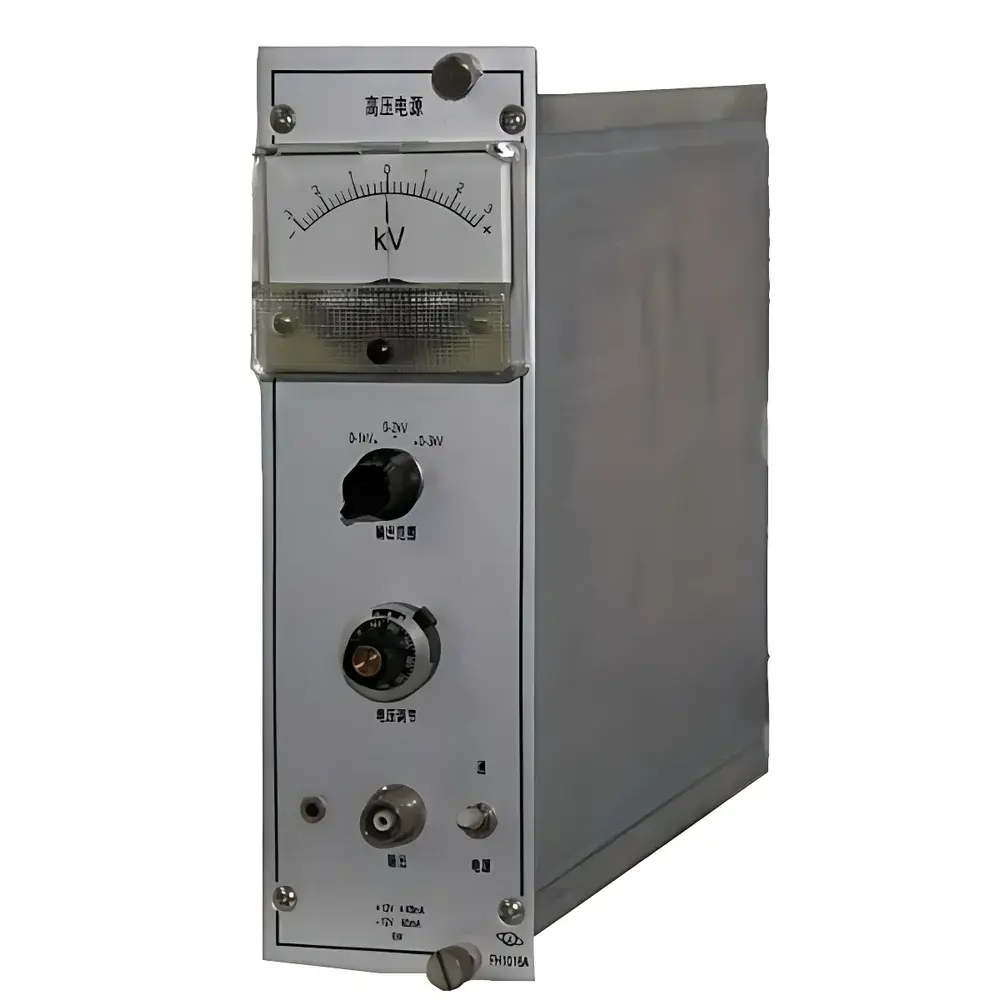
CNCS FH1016A High-Voltage Power Supply
| Brand | CNCS |
|---|---|
| Origin | Beijing, China |
| Model | FH1016A |
| Output Voltage Range | ±300 V to ±3 kV (3-range selectable: 0–1 kV, 0–2 kV, 0–3 kV) |
| Rated Output Current | 0–500 µA |
| Output Ripple | ≤20 mV (p-p) |
| Voltage Stability | ≤±0.1% over 8 hours |
| Operating Temperature | 0–50 °C |
| Form Factor | 2-unit NIM module |
| Polarity | Selectable positive or negative DC output |
| Application | Bias supply for nuclear radiation detectors (e.g., PMTs, SiPMs, proportional counters) |
Overview
The CNCS FH1016A High-Voltage Power Supply is a precision-engineered, dual-polarity DC voltage source designed specifically for laboratory and industrial nuclear instrumentation applications. As a standard 2-unit Nuclear Instrumentation Module (NIM), it integrates seamlessly into modular NIM bin systems widely deployed in nuclear physics laboratories, radiation safety monitoring stations, and analytical spectroscopy facilities. The FH1016A operates on the principle of regulated high-voltage DC generation using feedback-stabilized switching topology combined with multi-stage filtering, ensuring low-noise, low-drift biasing for sensitive radiation detection components. Its primary function is to provide stable, adjustable bias voltage to photomultiplier tubes (PMTs), silicon photomultipliers (SiPMs), gas-filled proportional counters, and scintillation detector assemblies—enabling accurate pulse-height analysis, energy calibration, and count-rate linearity in gamma/X-ray spectrometry and alpha/beta particle detection workflows.
Key Features
- Wide, continuously adjustable output range from ±300 V to ±3 kV, with three user-selectable voltage spans (0–1 kV, 0–2 kV, 0–3 kV) for optimal resolution and control granularity
- Programmable polarity selection (positive or negative output) via front-panel toggle switch, supporting both anode- and cathode-biased detector configurations
- Low output ripple (≤20 mV peak-to-peak) achieved through active regulation and passive LC filtering—critical for minimizing baseline noise in pulse-amplitude measurements
- High long-term stability of ≤±0.1% over 8 hours under constant load and ambient conditions, meeting requirements for extended spectral acquisition sessions
- Rugged NIM mechanical format (8.7 cm × 22.1 cm × 5.4 cm) compliant with ANSI/IEEE 321-1973 and IEC 60581 standards for modular nuclear instrumentation
- Front-panel analog voltage meter with 3-digit LED display and calibrated potentiometer for precise manual adjustment; no external controller required for basic operation
- Over-current protection circuitry prevents damage during detector arcing or load fault conditions, enhancing system reliability in unattended operation
Sample Compatibility & Compliance
The FH1016A is compatible with all standard NIM-compatible detectors requiring stable high-voltage bias, including NaI(Tl), LaBr3(Ce), HPGe, and plastic scintillators coupled to PMTs or SiPM arrays. It supports common nuclear measurement protocols defined in ASTM E1452 (Standard Guide for Calibration of Germanium Spectrometers) and ISO 8529-1 (Reference neutron radiations). While not certified for medical device use, its electrical performance aligns with general-purpose radiation measurement instrumentation requirements under IEC 61000-6-3 (EMC emission limits) and IEC 61010-1 (safety for electrical equipment for measurement). No proprietary software or driver dependencies are required; integration with data acquisition systems (e.g., CAEN DT57xx, Struck SIS3316) is achieved via standard analog monitor outputs and TTL-compatible interlock lines.
Software & Data Management
The FH1016A is a stand-alone analog instrument with no embedded firmware or digital interface. All parameter setting and monitoring are performed manually via front-panel controls and indicators. For automated test environments, optional external voltage monitors (e.g., Keithley 2450 SourceMeter) may be used to log output stability over time. When deployed in GLP- or GMP-regulated laboratories conducting environmental radioactivity screening or nuclear material assay, users should document calibration history per ISO/IEC 17025:2017 clause 6.5, including traceable verification of output accuracy using a calibrated high-voltage meter (e.g., Fluke 8508A with HV adapter). Audit trails for voltage settings during spectral acquisition are maintained externally within the host spectrometer’s acquisition software.
Applications
- Energy calibration and resolution optimization of gamma-ray spectrometers using 137Cs, 60Co, and 22Na reference sources
- Bias stabilization for low-background alpha spectrometry systems employing PIPS detectors
- Multi-channel analyzer (MCA) system commissioning and routine QC checks in nuclear regulatory compliance labs
- Teaching laboratories for nuclear physics experiments involving pulse-height discrimination and dead-time correction
- Portable field spectrometry units where compact NIM-based HV supplies replace bulkier rack-mounted alternatives
FAQ
Is the FH1016A compatible with modern USB- or Ethernet-connected MCA systems?
Yes—its analog monitor output (0–10 V = 0–full-scale kV) and interlock status line allow seamless integration with third-party MCAs that accept analog HV feedback signals.
Does it support remote programming via RS-232 or GPIB?
No—the FH1016A is a manually operated analog module without digital communication interfaces. Remote control requires external HV controllers or custom DAQ-based voltage regulation loops.
What is the recommended recalibration interval?
CNCS recommends annual calibration against a NIST-traceable high-voltage standard, especially when used in accredited testing laboratories performing quantitative radionuclide analysis.
Can it drive multiple detectors simultaneously?
It is designed for single-detector biasing. Parallel connection to multiple detectors is not advised due to potential current-sharing imbalances and degraded stability.
Is CE or UKCA marking available?
The FH1016A complies with EMC and safety principles outlined in relevant EU directives but is supplied without formal CE marking; end-users must perform conformity assessment as part of their own system-level certification process.






