
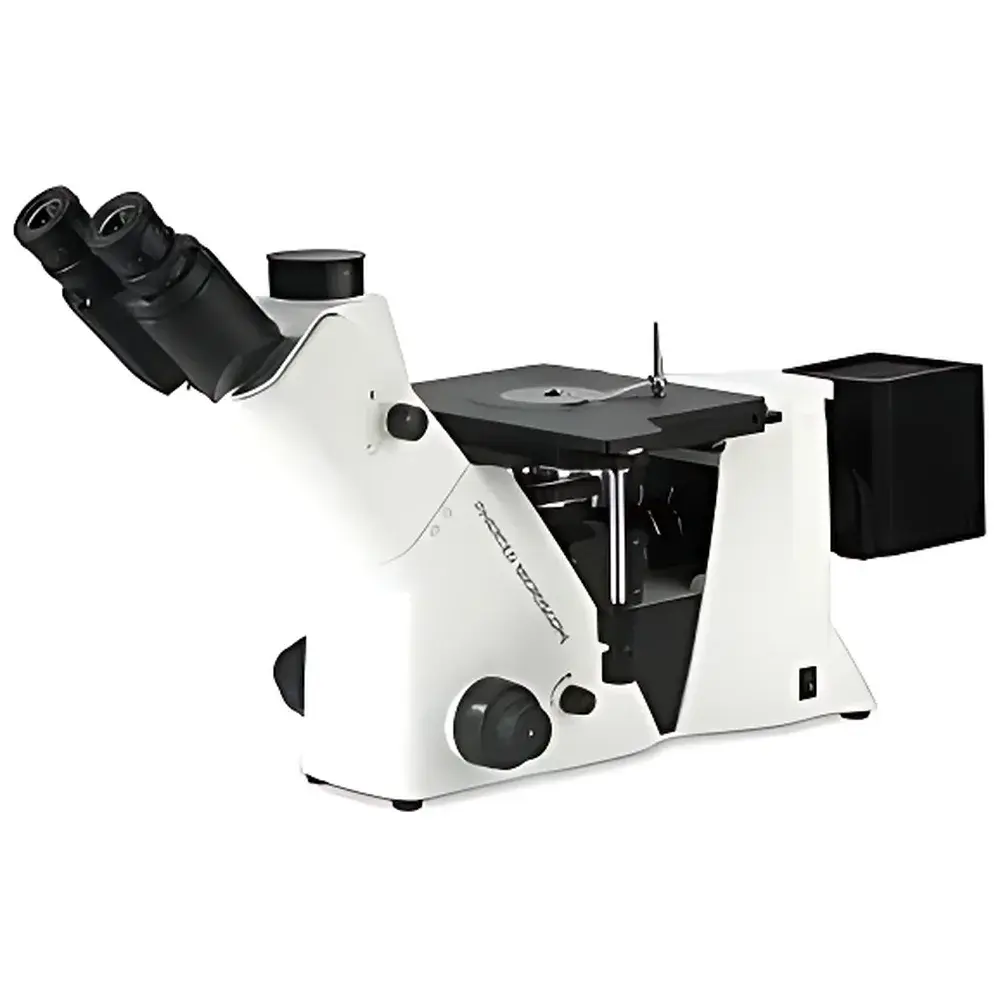
Otoscope MDS400 Inverted Metallurgical Microscope
| Brand | CNOPTEC (Otoscope) |
|---|---|
| Origin | Chongqing, China |
| Model | MDS400 |
| Type | Inverted |
| Total Magnification | 50×–1000× |
| Eyepieces | Wide-field, high-eyepoint plan eyepieces, 10×, field number Φ22 mm |
| Objectives | LMPlan FL 5× (NA 0.15, WD 21.0 mm), 10× (NA 0.30, WD 20.0 mm), 20× (NA 0.40, WD 15.0 mm), 50× (NA 0.55, WD 10.0 mm), LPL 50× (NA 0.75, WD 3.0 mm), LPL 80× (NA 0.80, WD 0.85 mm), LMPlan FL 100× (dry, NA 0.85, WD 3.0 mm) |
| Observation Modes | Brightfield, Darkfield, Polarized Light |
| Optical System | OTICS infinity-corrected achromatic optical path |
| Trinocular Head | Dual-beam split (100% viewing / 20% viewing + 80% imaging), 45° inclination, interpupillary adjustment 48–76 mm |
| Nosepiece | Five-position objective turret |
| Focus Mechanism | Coaxial coarse/fine focus |
| Stage | Triple-layer mechanical stage, 210 × 180 mm surface, 50 × 50 mm travel range, vernier scale 0.1 mm |
| Illumination | 12 V/50 W halogen or 5 W LED (100–240 V AC input) |
| Polarization Accessories | Rotatable polarizer and analyzer |
| Camera Interface | C-mount with 1×/0.75×/0.5× reduction options |
| Image Analysis Software | OPTPro Professional Metallographic Analysis & Rating Software |
| Digital Imaging Compatibility | Canon, Nikon DSLR systems |
Overview
The Otoscope MDS400 Inverted Metallurgical Microscope is an engineered solution for high-fidelity microstructural characterization of opaque, polished specimens—primarily metals, alloys, ceramics, semiconductors, and electronic packaging materials. Its inverted optical architecture positions the objectives beneath the specimen stage, enabling unobstructed access to large, heavy, or thermally sensitive samples mounted on standard metallographic holders. The system employs the OTICS infinity-corrected achromatic optical pathway, ensuring consistent chromatic and spherical aberration correction across all magnifications and observation modes. Designed for routine and advanced metallurgical laboratories, the MDS400 supports quantitative analysis workflows compliant with ASTM E3, ISO 643, and USP , facilitating standardized grain size evaluation, inclusion rating, phase distribution mapping, and defect documentation in QA/QC and R&D environments.
Key Features
- Inverted configuration with large-stage accessibility (210 × 180 mm surface, 50 × 50 mm mechanical travel) for accommodating bulk specimens, wafer fragments, or multi-sample holders without repositioning.
- Multi-mode illumination system supporting brightfield, darkfield, and polarized light observation—each optimized via dedicated long-working-distance (LWD) objective series calibrated for contrast fidelity and edge resolution.
- High-NA objective suite including LMPlan FL semi-apochromatic and LPL plan apochromatic lenses (5×–100×), delivering diffraction-limited resolution at working distances ranging from 0.85 mm (80×) to 21.0 mm (5×), critical for safe operation over coated or fragile surfaces.
- Ergonomic trinocular head with dual-beam path selection (100% visual observation or 20%/80% beam split for simultaneous viewing and imaging), 45° inclined tube, and adjustable interpupillary distance (48–76 mm) to accommodate diverse user anthropometry.
- Coaxial coarse/fine focusing mechanism with tactile feedback, 10 mm coarse travel, and 2 µm fine-focus graduation—calibrated for repeatable Z-axis positioning during serial sectioning or depth profiling studies.
- Integrated polarization module with rotating polarizer and analyzer, enabling rapid birefringence assessment of non-cubic crystalline phases (e.g., Ti alloys, quartz inclusions, or polymer composites) without external accessories.
Sample Compatibility & Compliance
The MDS400 accommodates standard 25 mm and 30 mm metallographic mounts, as well as custom-sized specimens up to 100 mm in diameter when placed directly on the stage. Its long-working-distance optics permit examination of specimens with surface coatings, thin-film layers, or embedded interconnects—common in semiconductor failure analysis and PCB cross-sectioning. The system meets electromagnetic compatibility (EMC) requirements per IEC 61326-1 and electrical safety standards per IEC 61010-1. When paired with OPTPro software, image acquisition, measurement annotation, and report generation support audit-ready documentation aligned with GLP and GMP principles—including timestamped metadata, operator ID logging, and version-controlled analysis protocols.
Software & Data Management
OPTPro Professional Metallographic Analysis & Rating Software provides ISO/ASTM-compliant grain sizing (ASTM E112, E1382), inclusion quantification (ASTM E45, ISO 4967), phase area fraction calculation, and automatic hardness indentation measurement (Vickers/Knoop). The software features calibrated pixel-to-micron scaling, multi-layer ROI annotation, batch processing for statistical reporting, and export of annotated TIFF/PDF reports with embedded calibration certificates. All imaging sessions record full hardware configuration metadata—including objective ID, illumination mode, exposure time, and camera gain—ensuring traceability under FDA 21 CFR Part 11 requirements when deployed in regulated manufacturing settings.
Applications
- Metallurgical QC: Grain structure verification, decarburization depth measurement, and heat-affected zone (HAZ) analysis in welded joints per AWS D1.1.
- Electronics Reliability: Solder joint integrity assessment, void detection in die-attach layers, and intermetallic compound (IMC) thickness measurement in flip-chip assemblies.
- Materials R&D: Phase identification and distribution mapping in high-entropy alloys, oxide dispersion-strengthened steels, and additively manufactured microstructures.
- Failure Analysis: Crack propagation path reconstruction, corrosion pit morphology classification, and fatigue striation spacing quantification.
- Geological & Ceramics: Mineral phase discrimination in sintered oxides, pore network analysis in refractory bricks, and thermal barrier coating (TBC) delamination assessment.
FAQ
What is the maximum usable magnification for quantitative metallography on the MDS400?
The system achieves reliable quantitative imaging up to 1000× using the 100× dry objective (NA 0.85); resolution is limited by diffraction to approximately 0.4 µm under optimal Köhler illumination conditions.
Can the MDS400 be integrated into automated inspection lines?
Yes—via USB 3.0 or GigE Vision-compatible DV/TP-series cameras and programmable TTL-triggered illumination control, enabling synchronization with robotic stage controllers and PLC-based workflow managers.
Is darkfield illumination compatible with all objectives?
Darkfield functionality is supported exclusively by the dedicated LMPlan FL brightfield/darkfield objective series (5×, 10×, 20×, 50×); higher-magnification LPL lenses are optimized for brightfield and polarized contrast only.
Does OPTPro software support multi-user role-based permissions?
Yes—administrator, analyst, and reviewer roles can be defined with granular access controls for method editing, result approval, and audit trail review, satisfying ALCOA+ data integrity criteria.
What power input specifications does the LED illumination module support?
The 5 W LED illuminator accepts universal AC input (100–240 V, 50/60 Hz), eliminating the need for external voltage converters in global laboratory deployments.



