
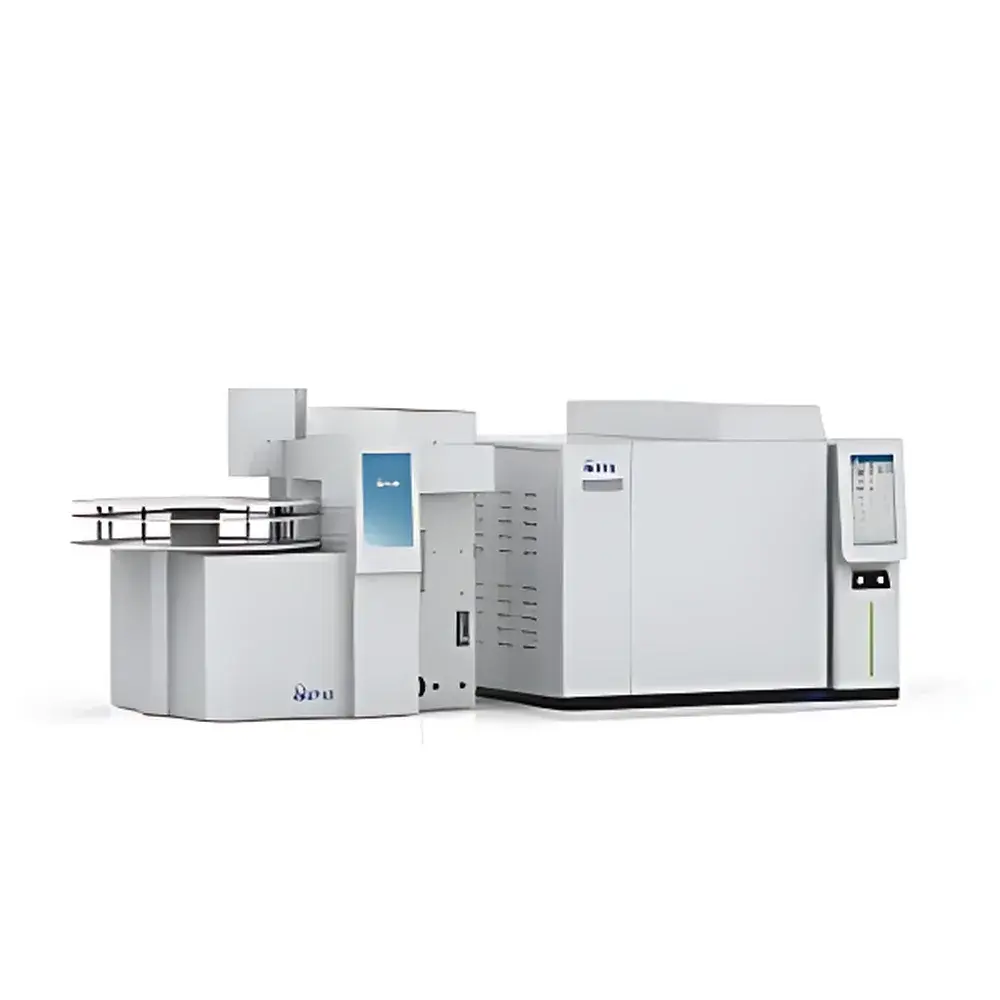
Beifen Ruili MAS-100 Alkylmercury Analyzer
| Brand | Beifen Ruili |
|---|---|
| Origin | Beijing, China |
| Model | MAS-100 |
| Detection Principle | Purge-and-Trap GC-Cold Vapor Atomic Fluorescence Detection (GC-AFD) |
| Compliance | HJ 977–2018 |
| Detector Type | Integrated Miniaturized Cold Vapor Atomic Fluorescence Detector (AFD) |
| Column Compatibility | Capillary GC columns |
| Auxiliary Detectors Supported | FID, ECD, TCD, FPD, TSD |
| Mercury Speciation | Methylmercury, Ethylmercury |
| Sample Matrix | Aqueous solutions |
| Derivatization Reagent | Sodium Tetrapropylborate (NaBPr₄) |
| Trapping Medium | Tenax® sorbent tube |
| Carrier Gas | Argon |
| Post-Detector Mercury Capture | Gold-coated Wire Trap with Active Vacuum Pump |
| Optical Design | Multi-stage stray-light suppression fluorescence cell |
| High-Temperature Module | 950 °C pyrolysis with nano-scale thermal insulation |
| Footprint | <120 mm × 100 mm × 80 mm (AFD unit only) |
Overview
The Beifen Ruili MAS-100 Alkylmercury Analyzer is a purpose-engineered gas chromatography–cold vapor atomic fluorescence detection (GC-AFD) system designed for trace-level speciated mercury analysis in aqueous environmental matrices. It implements the purge-and-trap sample introduction protocol specified in China’s national standard HJ 977–2018, enabling quantitative determination of methylmercury (MeHg) and ethylmercury (EtHg) at sub-pg/L levels. Unlike standalone atomic fluorescence spectrometers, the MAS-100 adopts a modular, “general-instrument–specialized-application” architecture: it integrates a proprietary miniaturized atomic fluorescence detector (AFD) directly onto conventional laboratory gas chromatographs—without requiring dedicated instrumentation or platform replacement. This design preserves full GC functionality while adding high-selectivity, element-specific mercury detection capability. The core measurement principle relies on post-column thermal decomposition (950 °C) of alkylmercury derivatives—formed via sodium tetrapropylborate (NaBPr₄) derivatization—into elemental mercury vapor, followed by UV excitation (184.9 nm and 253.7 nm) and fluorescence emission detection at 253.7 nm. The system’s sensitivity enhancement stems from optical optimization—including multi-stage stray-light traps—and minimized dead volume between the GC column outlet and the fluorescence cell.
Key Features
- Modular AFD integration: Direct mounting onto existing GC platforms (e.g., Agilent, Shimadzu, Thermo ISQ series), supporting concurrent use with FID, ECD, TCD, FPD, or TSD detectors.
- Ultra-compact AFD unit: Dimensions under 120 × 100 × 80 mm; occupies <3% of conventional CV-AFS instrument footprint while delivering comparable or improved signal-to-noise ratio for MeHg/EtHg.
- Nano-insulated pyrolysis module: Maintains stable 950 °C operation with <15 °C external surface temperature rise, eliminating thermal interference with upstream capillary column performance.
- Capillary GC-optimized workflow: Compatible with 30 m × 0.25 mm ID × 0.25 µm film thickness fused-silica columns; achieves baseline separation of MeHg and EtHg in ≤4.0 minutes.
- Active mercury vapor capture: Integrated vacuum pump draws effluent through a gold-coated wire trap post-detection, achieving >99.97% Hg retention and ensuring operator safety and environmental compliance.
- Optical noise suppression: Fluorescence cell employs sequential reflective baffles and spectral filtering to reduce Rayleigh and Raman scatter, enhancing detection limit stability over extended run times.
Sample Compatibility & Compliance
The MAS-100 is validated for direct application to aqueous environmental samples—including surface water, groundwater, wastewater, and pore water—per HJ 977–2018 methodology. Sample preparation includes pH adjustment, NaBPr₄ derivatization, argon purging, and Tenax®-based trapping. No matrix-specific calibration is required when using isotope-dilution internal standards (e.g., Me²⁰⁰Hg, Et¹⁹⁹Hg). The system meets GLP-aligned data integrity requirements: all method parameters (purge time, trap desorption temp, GC oven ramp, AFD lamp current, dwell time) are software-configurable and logged with timestamps. While not pre-certified to ISO/IEC 17025 or USP , its operational traceability supports audit-ready documentation for regulatory submissions under China’s Ministry of Ecology and Environment (MEE) frameworks.
Software & Data Management
Instrument control and data acquisition are managed via Beifen Ruili’s GC-AFD Control Suite (v3.2+), a Windows-based application compliant with FDA 21 CFR Part 11 Annex 11 principles. Features include electronic signatures, role-based user access (Admin, Analyst, Reviewer), full audit trail (parameter changes, calibration events, sequence edits), and automatic generation of raw data (.raw), processed results (.csv), and PDF analytical reports. Peak integration follows ASTM D7011–18 guidelines for mercury speciation, with optional integration of certified reference materials (CRMs) such as NIST SRM 2736a (MeHg in water) for daily QC verification. Data export supports LIMS interoperability via ASTM E1384-compliant XML schema.
Applications
- Environmental monitoring: Routine analysis of MeHg/EtHg in drinking water sources, sediment pore water, and industrial effluents.
- Ecotoxicology research: Quantification of bioaccumulative alkylmercury species in fish tissue digests (post-acid leaching and derivatization).
- Regulatory compliance: Support for MEE provincial monitoring programs and third-party testing laboratories accredited under CNAS CL01:2018.
- Multi-analyte GC expansion: When AFD is disengaged, the host GC platform retains full capability for VOCs (EPA TO-17), halogenated hydrocarbons (EPA 8260), organophosphorus pesticides (EPA 8141A), and PCBs (EPA 8082).
- Method development labs: Platform for evaluating novel derivatization reagents, alternative sorbents (e.g., Carbopack™ B), or low-bleed column chemistries for enhanced alkylmercury resolution.
FAQ
Can the MAS-100 be used without a purge-and-trap autosampler?
Yes—manual purge-and-trap using standardized glassware per HJ 977–2018 is supported, though reproducibility is optimized with automated systems (e.g., Tekmar Atomx).
Is the AFD compatible with split/splitless injection modes?
The AFD operates exclusively in splitless mode during alkylmercury analysis to maximize analyte transfer efficiency; split mode is available only when using auxiliary detectors.
Does the gold trap require regeneration or replacement?
Gold-coated wire traps are single-use consumables per 200–250 injections; capacity verification is performed quarterly using Hg⁰ vapor challenge tests.
Can the MAS-100 quantify inorganic mercury (Hg²⁺)?
No—the system targets only alkylmercury species derivatized with NaBPr₄; inorganic Hg requires separate hydride generation–AFS or ICP-MS workflows.
What maintenance intervals are recommended for the pyrolysis furnace?
Quartz liner replacement every 500 injections; furnace thermocouple calibration annually or after 1,000 heating cycles.
Related Products






