
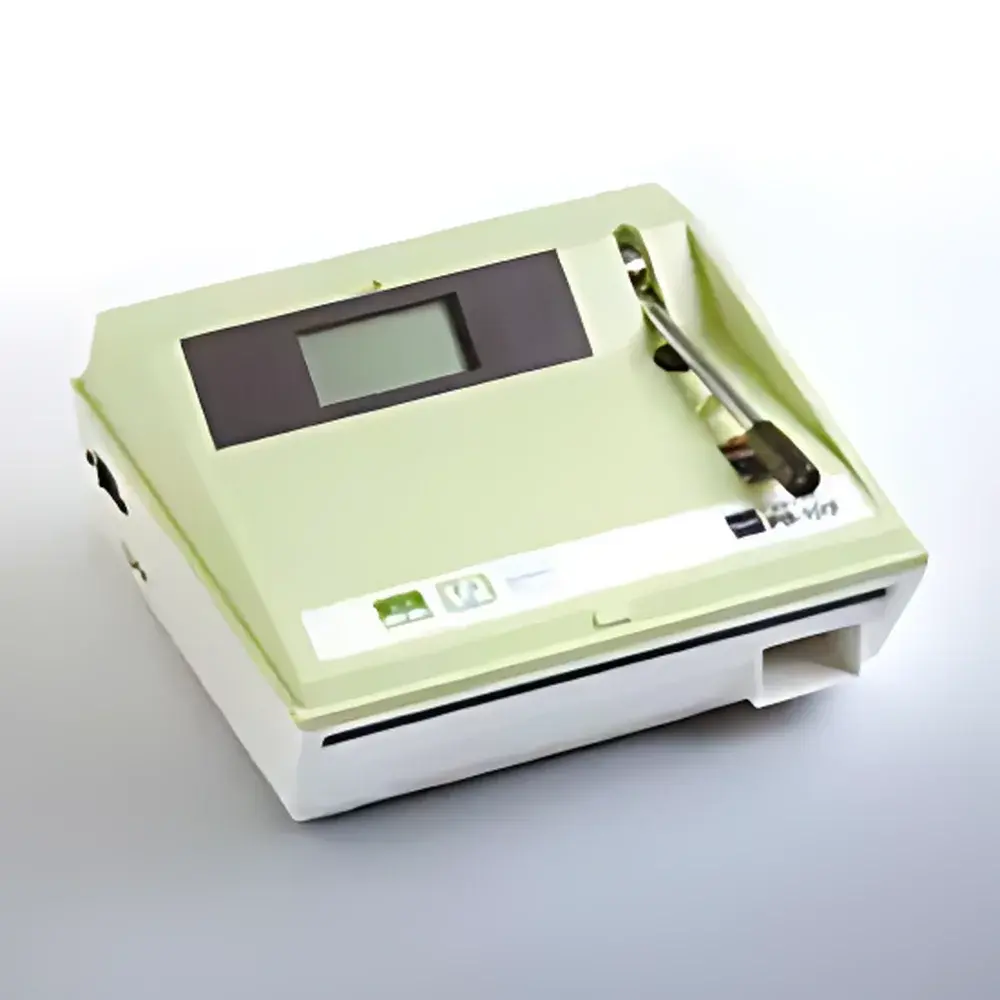
KETT PB-1D3 High-Moisture Grain Moisture Analyzer
| Brand | KETT |
|---|---|
| Origin | Japan |
| Model | PB-1D3 |
| Measurement Principle | Electrical Resistance |
| Sample Types | Paddy Rice, Brown Rice, Milled Rice, Barley, Wheat, Rye |
| Moisture Range | Paddy Rice: 11–35% |
| Brown/Milled Rice | 11–20% |
| Barley/Wheat | 10–40% |
| Rye | 10–20% |
| Accuracy | ±0.1% (at ≤20%), ±0.5% vs. 105°C Oven-Drying Reference Method |
| Display | 128×64 Dot-Matrix LCD, Resolution: 0.1% |
| Temperature Compensation | Automatic Thermistor-Based Correction |
| Power Supply | AC 100 V (50/60 Hz) or Four 1.5 V AA Batteries |
| Dimensions & Weight | 250 × 240 × 125 mm, 3.5 kg |
| Accessories | Sample Pan, 15% Calibration Standard, Measuring Spoon, Hand Grinder Handle, Cleaning Brush, Power Cord, Instruction Manual |
Overview
The KETT PB-1D3 High-Moisture Grain Moisture Analyzer is a purpose-engineered, field-deployable resistance-type moisture meter designed specifically for rapid, on-site quantification of moisture content in high-moisture cereal grains—particularly paddy rice, barley, and wheat—under operational conditions common in grain drying facilities, elevators, and procurement stations. Unlike standard capacitance-based analyzers optimized for low-to-mid moisture ranges (typically <20%), the PB-1D3 employs a calibrated electrical resistance measurement principle that remains stable and linear across extended moisture domains: up to 35% for paddy rice and 40% for barley and wheat. This capability addresses a critical gap in post-harvest quality control, where over-drying incurs energy cost and grain fissuring, while under-drying risks mold proliferation and storage instability. The instrument’s architecture integrates real-time thermistor-based temperature compensation, eliminating manual correction steps and ensuring consistent readings across ambient fluctuations typical in unconditioned drying environments.
Key Features
- Extended high-moisture range: Validated performance from 10% to 40% moisture, with model-specific calibration curves for paddy rice (11–35%), milled/brown rice (11–20%), barley/wheat (10–40%), and rye (10–20%)
- Automatic temperature compensation: Integrated thermistor sensor dynamically corrects for sample temperature drift during measurement, enhancing reproducibility without operator intervention
- Rugged industrial design: Electromagnetic noise suppression circuitry minimizes interference from dryers, conveyors, and motor-driven equipment—critical for reliable operation inside active grain processing facilities
- Dual power configuration: Operates on AC 100 V (50/60 Hz) for stationary use or four standard 1.5 V AA batteries for portable, off-grid deployment
- Intuitive local interface: Backlit 128×64 dot-matrix LCD displays moisture %, measurement count, running average, and selected grain type—all with 0.1% resolution
- Field-serviceable accessories: Includes calibrated 15% reference standard, stainless steel sample pan, ergonomic hand grinder handle for uniform particle size reduction, and cleaning tools for routine maintenance
Sample Compatibility & Compliance
The PB-1D3 is validated for homogeneous, ground or whole-grain samples of paddy rice, brown rice, milled rice, barley, wheat, and rye. Sample preparation follows standardized procedures outlined in ISO 712:2022 (Cereals and cereal products — Determination of moisture content — Reference method) and JIS Z 8806 (Moisture determination methods for agricultural products). While not a primary oven-dry reference instrument, its ±0.1% accuracy (for samples ≤20% MC) and ±0.5% deviation relative to the 105°C AOAC 950.46 / ISO 712 reference method support its use in process monitoring, intake inspection, and drying endpoint verification per GMP-aligned grain handling protocols. Its compact form factor and battery operation facilitate compliance with on-farm and mobile inspection requirements under national grain grading standards (e.g., USDA FGIS, JAS, and China GB/T 5497).
Software & Data Management
The PB-1D3 operates as a standalone hardware analyzer with no embedded firmware-based data logging or USB connectivity. However, it supports external documentation via optional thermal printer interface (KETT PRT-1, sold separately), enabling hard-copy generation of measurement records—including date/time stamp (when used with compatible timer module), grain type, moisture value, and batch identifier—for traceability in QA/QC logs. All printed outputs comply with basic GLP documentation expectations for non-automated instruments: legible, permanent, and attributable. For integration into digital quality management systems (QMS), users may manually transcribe results into LIMS or Excel-based tracking templates aligned with ISO/IEC 17025 clause 7.7 (Reporting of results) and FDA 21 CFR Part 11 Annex A (electronic record retention guidelines).
Applications
- Real-time drying endpoint determination: Monitoring moisture decline during batch or continuous drying to prevent over-drying and optimize energy consumption
- Procurement and intake inspection: Rapid assessment of delivered grain lots against contractual moisture specifications prior to storage or milling
- In-process quality assurance: Spot-checking at transfer points between drying, tempering, and storage units
- Research and extension services: Field evaluation of drying protocols, varietal moisture retention behavior, and post-harvest loss mitigation strategies
- Regulatory compliance support: Generating auditable moisture records for grain export certifications and domestic quality audits
FAQ
What measurement principle does the PB-1D3 employ, and why is it suitable for high-moisture grains?
It uses calibrated electrical resistance, which maintains linearity and repeatability at moisture levels above 25%—where capacitance-based sensors often saturate or exhibit non-linear drift.
Does the PB-1D3 require periodic recalibration with certified standards?
Yes. Users must verify performance using the supplied 15% calibration standard before each shift or daily, per KETT’s recommended practice and ISO/IEC 17025 clause 6.4.2 (verification of equipment suitability).
Can the PB-1D3 measure intact (unground) paddy rice?
Yes—but for optimal accuracy and inter-laboratory comparability, KETT recommends grinding samples to ≤2 mm particle size using the included hand grinder handle, in accordance with ISO 712 section 6.2.
Is the instrument compliant with international grain trade standards?
While not certified to a specific conformity mark, its measurement uncertainty profile and adherence to ISO 712 and AOAC reference methods make it suitable for use in environments governed by USDA, JAS, and ASEAN grain trade agreements.
How is temperature compensation implemented, and does it require user input?
A built-in thermistor continuously monitors sample temperature during measurement and applies real-time correction based on preloaded grain-specific thermal response curves—no manual entry or adjustment is needed.





