
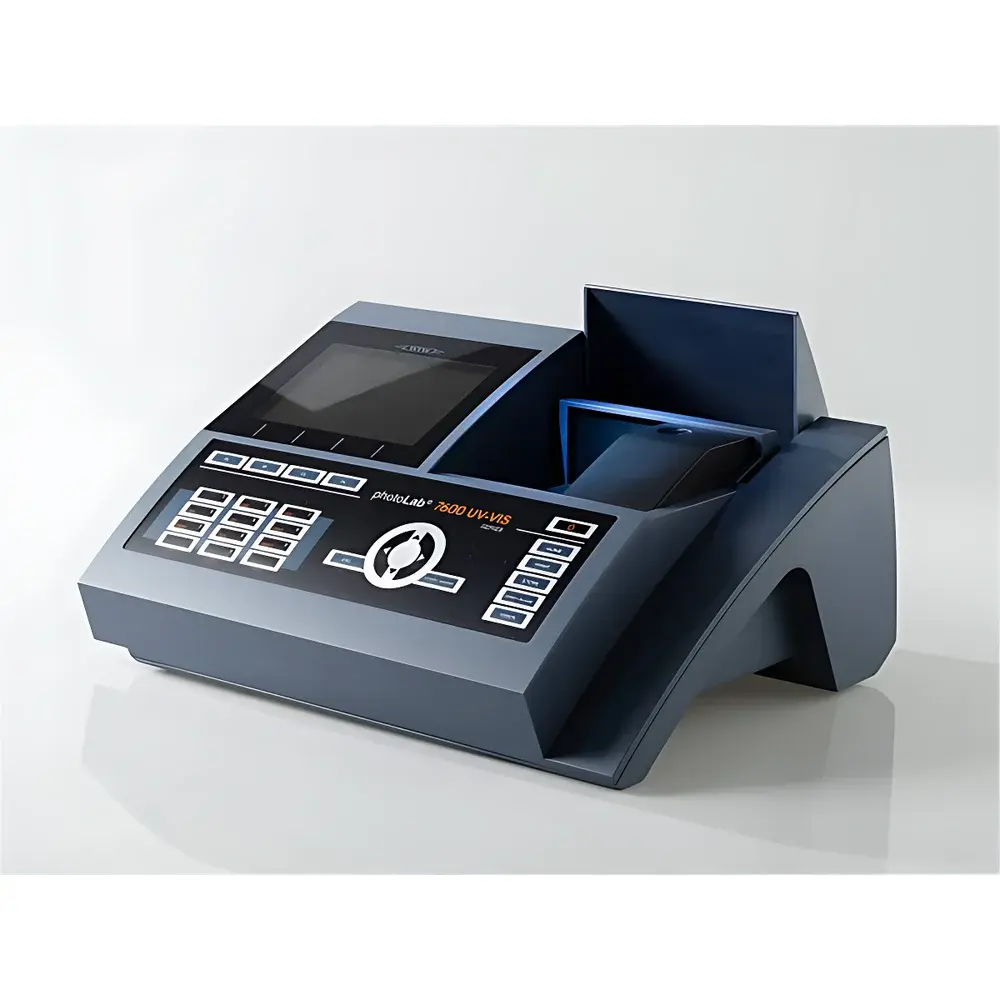
WTW photoLab 7000 UV-VIS Spectrophotometric Water Quality Analyzer
| Brand | WTW |
|---|---|
| Origin | Germany |
| Model | photoLab 7000 |
| Instrument Type | Laboratory Water Quality Analyzer |
| Detection Parameters | Ammonia-N, Volatile Phenols, COD, Heavy Metals |
| Wavelength Range | 190–1100 nm (UV-VIS) |
| Optical Resolution | ±1 nm (typ.), <0.5 nm (FWHM) |
| Photometric Accuracy | ±0.003 E (E < 0.600), ±0.5% (0.600 < E < 2.000) |
| Scan Speed | 700–2000 nm/min |
| Cuvette Compatibility | Automatic barcode recognition for 10 mm, 20 mm, and 50 mm rectangular cuvettes |
| Data Storage | 5,000 measurements, 500 spectra, 400 kinetic curves |
| Built-in Methods | >200 pre-validated methods (incl. free ammonia, CO₂, SAC, color) |
| Software | photolab® Database & Color Library, AQA (Analytical Quality Assurance) tools, GLP-compliant audit trail |
| Interfaces | 1× USB-A, 1× USB-B, 1× Ethernet |
| Power Supply | Universal AC adapter (100–240 VAC) or 12 V DC automotive battery operation |
| Operating Temperature | +10 °C to +35 °C |
| Storage Temperature | −25 °C to +65 °C |
| Dimensions & Weight | 404 × 197 × 314 mm, approx. 4.5 kg |
Overview
The WTW photoLab 7000 is a high-performance, laboratory-grade UV-VIS spectrophotometer engineered for precise, trace-level water quality analysis in environmental monitoring, municipal wastewater treatment, drinking water laboratories, and regulatory compliance settings. Based on double-beam optical architecture with a grating monochromator and tungsten-halogen/deuterium light source, it delivers stable spectral acquisition across 190–1100 nm—enabling quantification of both conventional and emerging contaminants via absorbance, transmittance, kinetics, and full-spectrum scanning. Its core measurement principle relies on Beer-Lambert law-based photometry, calibrated against NIST-traceable standards, with automated wavelength verification and photometric linearity validation embedded in every startup routine. Unlike portable or single-wavelength meters, the photoLab 7000 integrates reference-beam compensation, thermal stabilization of optical components, and real-time stray-light correction—ensuring reproducibility ≤0.5% RSD for repeated COD or heavy metal determinations under ISO 7027 and DIN 38404-4 conditions.
Key Features
- Barcode-enabled cuvette recognition system automatically detects pathlength (10/20/50 mm) and selects optimal wavelength, integration time, and calibration curve—eliminating manual setup errors.
- OptRF (Optical Reference-Free) methodology enables reagent-free, direct UV-VIS quantification of COD, nitrate, and nitrite in complex matrices (e.g., wastewater effluent, surface water with humic interference), validated per DIN EN ISO 15705 and ASTM D1253.
- Integrated AQA (Analytical Quality Assurance) module supports GLP/GMP workflows with automatic system suitability checks, drift monitoring, and electronic signature-ready audit trails compliant with FDA 21 CFR Part 11 requirements.
- 7-inch backlit TFT display with intuitive touch interface allows method navigation, spectral overlay, and real-time kinetic plot rendering without PC dependency.
- Dual-mode data acquisition: single-point absorbance, multi-wavelength step scans, full 190–1100 nm spectral sweeps (700–2000 nm/min), and time-resolved kinetic assays with configurable sampling intervals from 0.1 s to 60 min.
- Rugged mechanical design includes shock-absorbing chassis, IP30-rated enclosure, and thermally compensated optics—certified for continuous operation in ISO/IEC 17025-accredited labs.
Sample Compatibility & Compliance
The photoLab 7000 accepts standard quartz and high-quality optical glass cuvettes (16 mm round, 10 mm square, 20/50 mm rectangular), with automatic pathlength normalization ensuring equivalence between DIN 38404-4 (Cuvette Method) and DIN EN ISO 10510 (Spectrophotometric Method) protocols. All built-in methods—including ammonia-N (salicylate/hypochlorite), volatile phenols (4-aminoantipyrine), COD (dichromate digestion alternative via OptRF), and heavy metals (e.g., Cr(VI) by diphenylcarbazide)—are aligned with EPA Methods 350.1, 425.1, 410.4, and ISO 6060, ISO 11969. The instrument’s firmware and method library undergo annual revision to reflect updates in EU Water Framework Directive Annexes and WHO Guidelines for Drinking-water Quality (4th ed.).
Software & Data Management
photolab® PC software provides centralized method deployment, spectral database management, and report generation compliant with ISO/IEC 17025 Clause 7.7 (Reporting of Results). It includes the photolab® Color Library for standardized APHA/Pt-Co/Hazen color matching, spectral deconvolution tools for overlapping peaks (e.g., NO₂⁻/NO₃⁻ in UV region), and export modules for LIMS integration (CSV, XML, PDF/A-1a). All raw spectral data are stored with metadata (operator ID, timestamp, cuvette ID, ambient temperature, lamp hours), enabling full traceability during regulatory audits. Remote firmware updates via Ethernet or USB ensure alignment with evolving metrological requirements without service downtime.
Applications
- Regulatory compliance testing for municipal and industrial wastewater discharge permits (e.g., NPDES, IPPC).
- Drinking water quality control: residual chlorine speciation, bromate screening, organic carbon estimation (SAC/UV254).
- Research applications: reaction kinetics of advanced oxidation processes (AOPs), ligand-metal binding studies, and fulvic/humic acid characterization.
- Method development labs requiring flexible wavelength selection, custom curve fitting (polynomial, spline, multi-component regression), and validation per ICH Q2(R2).
- Field-deployable lab support: battery-powered operation enables mobile testing at remote sampling sites with synchronized cloud backup via optional WTW Connect services.
FAQ
Does the photoLab 7000 require annual recalibration by an authorized service center?
No—its internal wavelength and photometric self-check routines (per ISO 6143) allow user-performed verification using certified reference filters. Full recalibration is recommended only after physical impact, lamp replacement, or when audit findings indicate drift beyond ±0.3 nm or ±0.005 E.
Can OptRF COD measurements replace traditional dichromate-based COD tests for regulatory reporting?
Yes—when validated per local authority requirements (e.g., German LAWA acceptance criteria or UK Environment Agency MCERTS), OptRF provides equivalent accuracy for samples with COD < 150 mg/L and turbidity < 50 NTU. Validation reports must document matrix-specific recovery studies (n ≥ 10) per ISO 5667-16.
Is the photolab® software compatible with Windows 11 and macOS Ventura or later?
The current release (v4.2.1) supports Windows 10/11 (64-bit) and macOS 12 Monterey through macOS 14 Sonoma. Virtual machine deployment is not supported for audit-trail integrity reasons.
How does the instrument handle high-absorbance samples that exceed the linear range?
It applies dynamic range extension via auto-ranging: the system sequentially measures at multiple integration times and pathlengths, then applies weighted least-squares regression to reconstruct absorbance values up to 3.5 E while maintaining photometric uncertainty <1.2%.







