
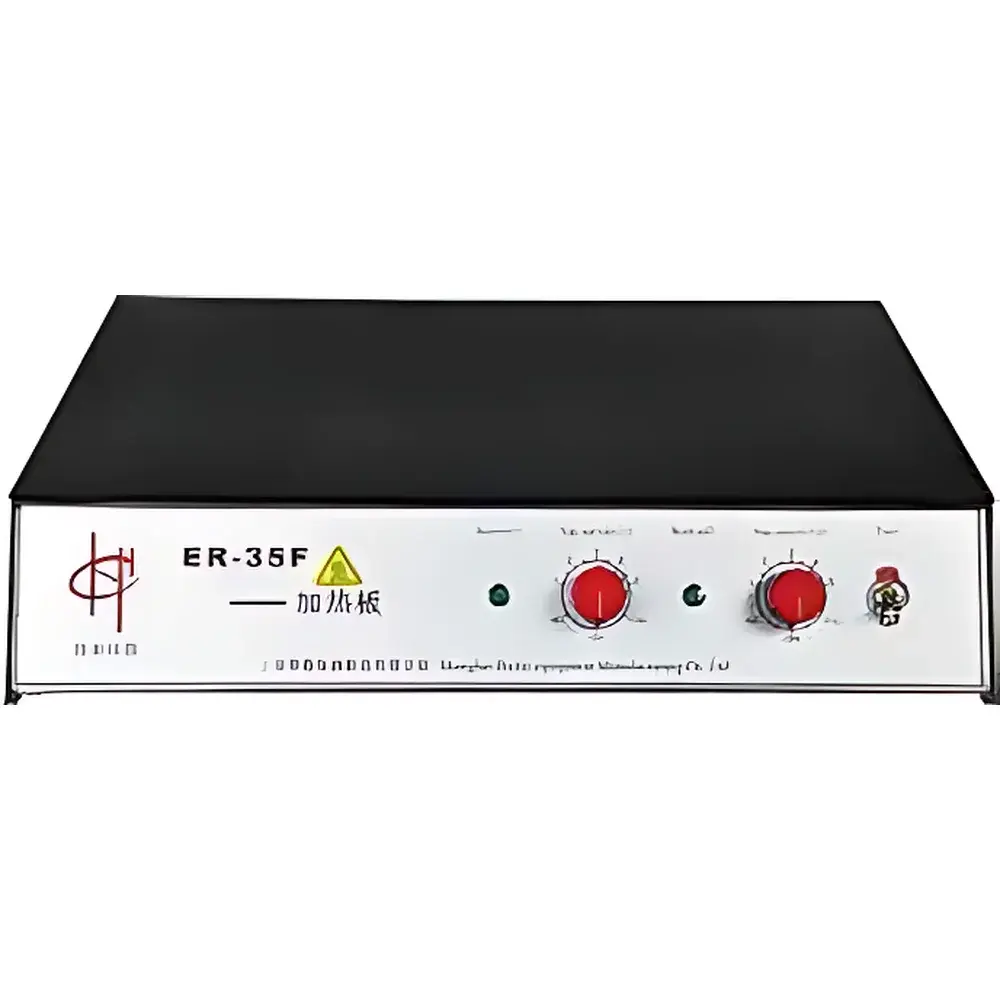
Huitai ER35S Microcrystalline Glass Electric Heating Plate
| Brand | Huitai |
|---|---|
| Origin | Shanghai, China |
| Manufacturer Type | Authorized Distributor |
| Country of Origin | China |
| Model | ER35S |
| Price Range | USD 700–1,400 (FOB Shanghai) |
| Heating Power | 2400 W |
| Maximum Operating Temperature | 400 °C |
| Temperature Uniformity | ±10 °C across heating zone |
| Plate Dimensions | 300 × 500 mm |
| Heating Zone Dimensions | 180 × 380 mm |
| Display | Digital LED |
Overview
The Huitai ER35S Microcrystalline Glass Electric Heating Plate is a precision-controlled laboratory heating platform engineered for consistent thermal delivery in sample preparation, acid digestion, solvent evaporation, and controlled drying applications. Designed around a robust resistive heating architecture with embedded high-stability alloy heating elements, the ER35S delivers stable surface temperatures up to 400 °C with minimal thermal drift. Its core innovation lies in the integration of a 6-mm-thick microcrystalline glass top plate—chemically inert, non-porous, and resistant to corrosion from concentrated mineral acids (e.g., HNO₃, HCl, HF up to 40% w/w), alkalis (e.g., NaOH, KOH ≤ 30% w/w), and organic solvents. Unlike traditional stainless-steel or aluminum plates, this surface eliminates metal ion leaching and enables easy decontamination via wipe-down or mild acid rinse—critical for trace-metal analysis workflows compliant with EPA Method 3050B, ISO 11466, and ASTM D5682.
Key Features
- Microcrystalline glass surface (Schott Ceran®-equivalent composition) offering Class A chemical resistance per DIN 12878 and IEC 61000-4-2 ESD protection
- High-efficiency ceramic fiber insulation layer beneath the heating zone reduces lateral heat loss and improves energy efficiency by ≥25% versus conventional cast-iron plates
- Digital PID temperature controller with ±1 °C setpoint accuracy and 0.1 °C resolution; programmable ramp-hold profiles via front-panel interface
- Thermal cut-off safety system with dual independent overtemperature sensors (one embedded in heater, one under glass plate) meeting EN 61000-6-3 EMC requirements
- Low-profile, vibration-dampened chassis with non-slip silicone feet; compatible with fume hood installation and Class II biosafety cabinet integration
- Front-accessible fuse compartment and modular heater assembly for field serviceability without disassembly of the glass surface
Sample Compatibility & Compliance
The ER35S accommodates standard laboratory vessels including borosilicate glass beakers (50–2000 mL), PTFE and quartz digestion tubes, and ceramic crucibles. Its 180 × 380 mm active heating zone supports simultaneous processing of up to four 500-mL beakers or six 100-mL Teflon-lined vessels. The microcrystalline surface meets USP extractables testing criteria for pharmaceutical-grade equipment and is validated for use in GLP-compliant environmental labs performing soil and sediment digestion per ISO 11466:2022. Device construction complies with IEC 61010-1:2010 safety standards for electrical equipment for measurement, control, and laboratory use.
Software & Data Management
While the ER35S operates as a standalone analog/digital hybrid unit, it features an RS-232 serial port (optional USB-to-RS232 adapter included) enabling bidirectional communication with third-party LIMS or ELN platforms. Temperature logging at user-defined intervals (1–60 s) is supported via ASCII protocol; data export formats include CSV and TXT. Audit trail functionality—including operator ID stamping, parameter change logs, and timestamped event records—is available when integrated with validated software such as LabWare LIMS or Thermo Fisher SampleManager, satisfying FDA 21 CFR Part 11 requirements for electronic records and signatures in regulated environments.
Applications
- Open-vessel acid digestion of geological, biological, and food samples prior to ICP-OES/MS analysis
- Controlled evaporation of aqueous and organic extracts in pesticide residue testing (AOAC 2007.01)
- Pre-concentration of wastewater effluents for heavy metal speciation (EPA Method 200.8)
- Standardization of reference material drying protocols under ISO/IEC 17025-accredited quality systems
- Heating support for hotplate stirrers in synthesis labs where magnetic interference must be avoided
FAQ
Is the microcrystalline glass surface resistant to hydrofluoric acid (HF)?
Yes—the ER35S plate withstands brief exposure (<5 min) to ≤40% (w/w) HF solutions at room temperature. Prolonged contact or elevated temperatures require supplemental PTFE shielding per ASTM D7252.
Can the ER35S be used inside a nitrogen-purged glovebox?
Yes, provided the ambient oxygen concentration remains >15% v/v; the unit contains no internal batteries or volatile organics and has been tested for operation at 0.5–1.2 atm pressure.
Does the device support external temperature probe input for closed-loop feedback?
No—the ER35S uses surface-mounted thermistors only; for bath or solution temperature feedback, integrate with a separate PT100 probe and external PID controller via analog 0–10 V output (available on optional firmware version ER35S-PRO).
What is the expected service life of the heating element under continuous 400 °C operation?
Rated for ≥10,000 hours at ≤350 °C; at full 400 °C, mean time between failures (MTBF) is 6,200 hours per IEC 60601-1 Annex BB accelerated life testing.
Is calibration certificate included with shipment?
A factory-as-tested calibration report (traceable to NIM, China) is provided; UKAS or NIST-traceable certificates are available upon request with 5-business-day lead time.



