
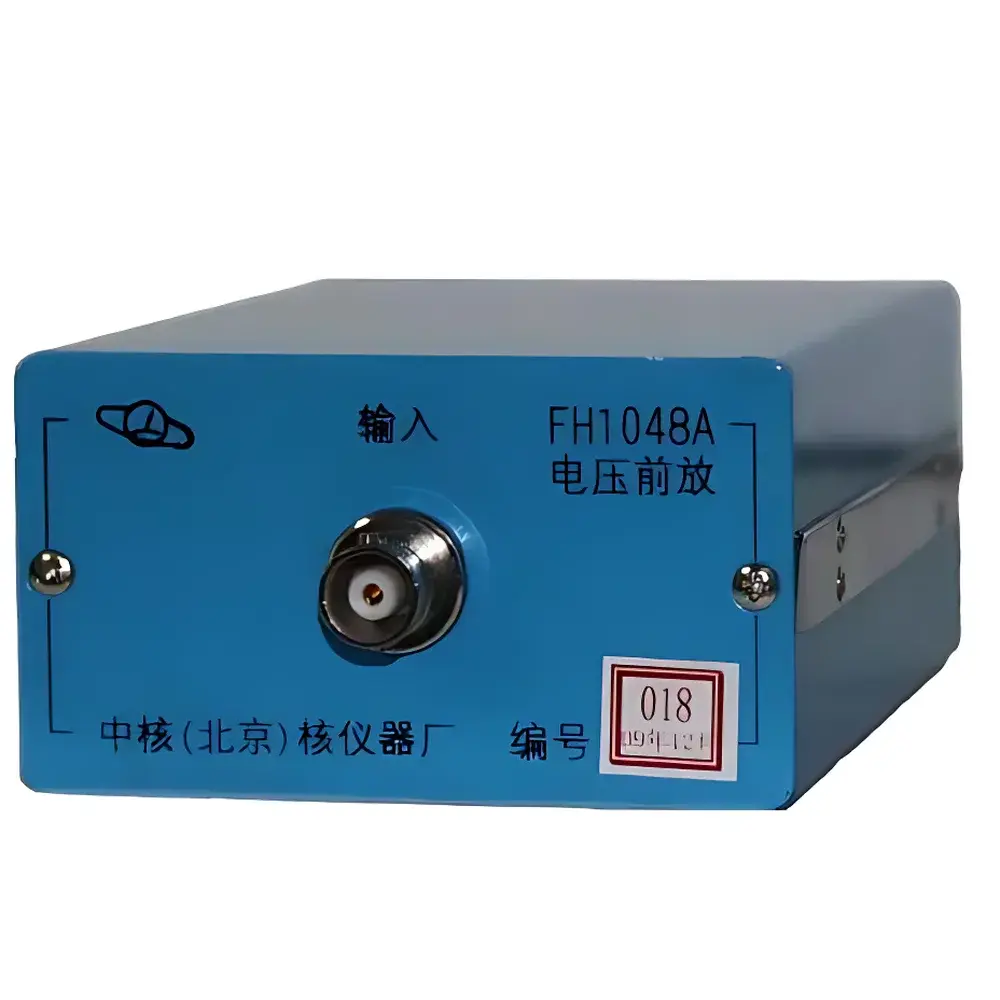
CNCS FH1048A Voltage Preamplifier
| Brand | CNCS |
|---|---|
| Origin | Beijing, China |
| Manufacturer Type | Authorized Distributor |
| Country of Origin | China |
| Model | FH1048A |
| Price | Upon Request |
| Gain | 5× |
| Gain Stability | ≤±0.03% over 8 h continuous operation |
| Integral Nonlinearity | ≤0.5% (with 1 kΩ load, 2 V output) |
| Input Impedance | ≥500 kΩ |
| Rise Time | ≤30 ns |
| Operating Temperature | 0–50 °C |
| Relative Humidity | ≤90% at 40 °C |
Overview
The CNCS FH1048A Voltage Preamplifier is a precision low-noise, wide-bandwidth analog signal conditioning module engineered for front-end amplification of weak voltage signals from radiation and optical detectors—including photomultiplier tubes (PMTs), proportional counters, and other high-impedance current-to-voltage transducers. Designed to operate in conjunction with standard NIM (Nuclear Instrumentation Module) or CAMAC-based nuclear instrumentation systems, the FH1048A provides stable, linear gain with minimal signal degradation—critical for quantitative photon counting, pulse-height analysis, and low-level light measurement applications in research laboratories, environmental monitoring stations, and nuclear safety facilities. Its core architecture employs discrete-component feedback networks and temperature-compensated biasing to ensure consistent performance across extended operational cycles, satisfying the stringent stability requirements of time-resolved spectroscopy and coincidence timing measurements.
Key Features
- Fixed voltage gain of 5× with calibrated output scaling for direct compatibility with ADCs, multichannel analyzers (MCAs), and oscilloscopes
- Exceptional long-term gain stability: ≤±0.03% drift over 8 hours of continuous operation—verified under thermal soak conditions at 40 °C
- Low integral nonlinearity (≤0.5%) measured at full-scale output (2 V into 1 kΩ), ensuring fidelity in amplitude-dependent analyses such as energy spectrum reconstruction
- High input impedance (≥500 kΩ) minimizes loading effects on high-output-impedance detectors, preserving signal integrity without requiring active impedance transformation stages
- Rapid transient response with ≤30 ns rise time, supporting pulse widths down to sub-100 ns—suitable for fast scintillation decay characterization and time-of-flight measurements
- Robust thermal design enabling reliable operation across 0–50 °C ambient range; humidity tolerance up to 90% RH at 40 °C meets IEC 60529 IP20 environmental classification for indoor instrumentation
Sample Compatibility & Compliance
The FH1048A interfaces directly with vacuum-tube-based and solid-state optical/radiation sensors operating in charge-integration or current-mode configurations. It supports PMTs with anode or dynode outputs, gas-filled proportional counters, and silicon photodiodes used in radioluminescence or Cherenkov detection setups. While not certified to specific ISO/IEC 17025 calibration standards out-of-box, the unit’s traceable gain specification and documented linearity enable integration into GLP- and GMP-compliant workflows when paired with NIST-traceable reference sources and documented calibration procedures. Its electrical noise floor and common-mode rejection ratio (CMRR > 80 dB typical) align with requirements outlined in ASTM E1023 for radiation detector signal processing modules.
Software & Data Management
As a hardware-only analog preamplifier, the FH1048A does not incorporate embedded firmware, digital control interfaces, or onboard data storage. It functions exclusively as a signal conditioning stage within larger acquisition chains. When integrated into PC-based systems via digitizers (e.g., CAEN DT57xx series or Struck SIS3316), its analog output is compatible with industry-standard acquisition software including ROOT, LabVIEW DAQmx, and ORTEC Maestro—supporting full audit trail logging, timestamped event capture, and histogram-based spectral analysis. For regulatory environments requiring electronic record integrity, system-level validation must include verification of end-to-end signal chain linearity, gain stability, and thermal drift per FDA 21 CFR Part 11 Annex 11 guidance.
Applications
- Scintillation spectrometry using NaI(Tl), LaBr₃(Ce), or plastic scintillators coupled to PMTs
- Alpha/beta particle counting in environmental air and water sampling systems
- Low-light bioluminescence and chemiluminescence assays in life science labs
- Neutron detection via 3He or BF₃ proportional counters in reactor instrumentation
- Calibration reference chains for illuminance meter verification against CIE photopic luminosity function
- Time-correlated single-photon counting (TCSPC) auxiliary amplification where fixed-gain, low-jitter staging is required
FAQ
Is the FH1048A compatible with NIM bin power supplies?
Yes—the FH1048A accepts standard ±12 V DC NIM power inputs and conforms to NIM mechanical dimensions (single-width module, 22.1 cm × 8.9 cm × 3.6 cm), enabling seamless integration into existing nuclear instrumentation racks.
Does it support differential input or only single-ended configuration?
The FH1048A features a single-ended, DC-coupled input with grounded shield reference—optimized for detector anode outputs referenced to chassis ground. Differential input capability requires external instrumentation amplifiers.
Can it be used with silicon photomultipliers (SiPMs)?
While primarily designed for vacuum-tube detectors, the FH1048A may condition SiPM outputs under low-gain, low-frequency conditions; however, its 30 ns rise time and 5× fixed gain are suboptimal for fast SiPM arrays—dedicated SiPM readout ASICs or transimpedance amplifiers are recommended for high-resolution timing applications.
Is calibration documentation provided with shipment?
Each unit ships with a factory test report listing measured gain, rise time, and linearity at 25 °C and 40 °C. Full metrological calibration certificates (ISO/IEC 17025 accredited) are available upon request through authorized CNCS service centers.
What is the recommended termination for the output signal?
The output is designed for 50 Ω coaxial termination; mismatched loads (>1 kΩ) may induce overshoot or ringing due to output stage impedance characteristics—always terminate into matched impedance for optimal pulse fidelity.





