
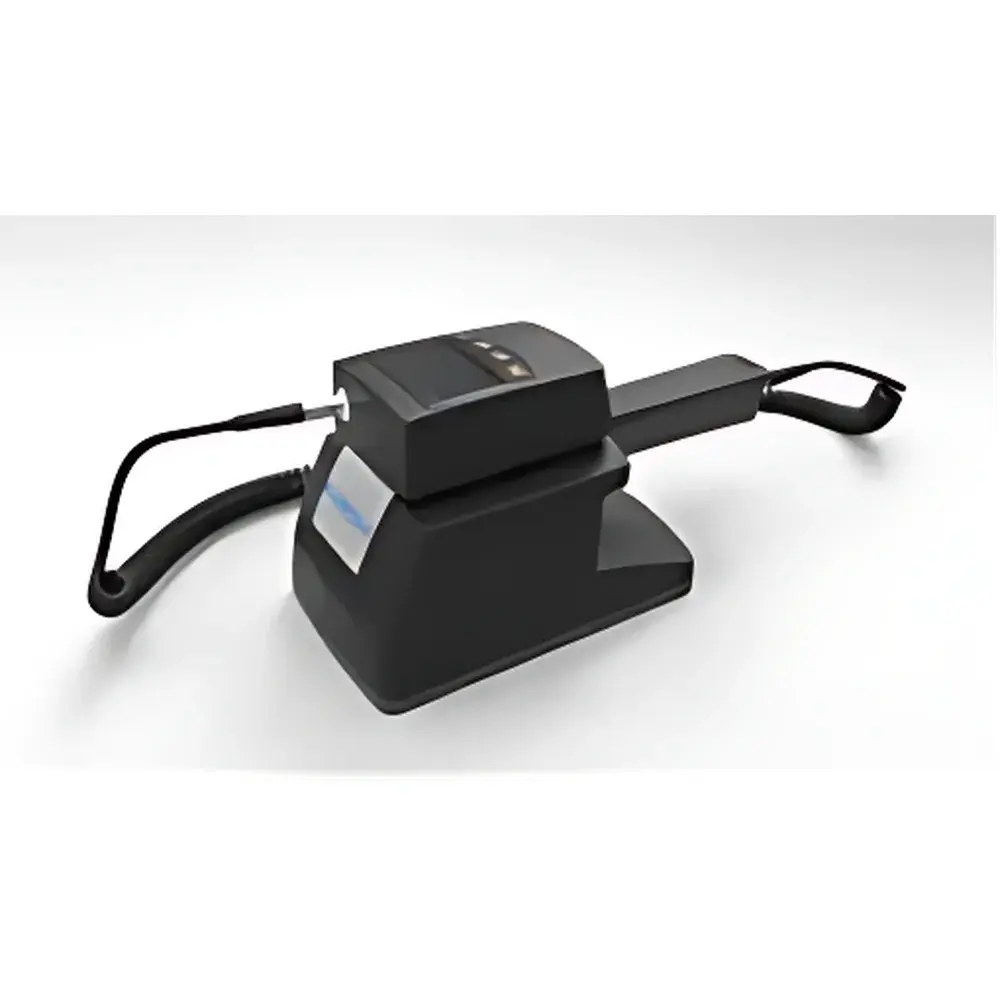
CNCS BH3206B Alpha/Beta Surface Contamination Monitor
| Brand | CNCS |
|---|---|
| Origin | Beijing, China |
| Model | BH3206B |
| Instrument Type | Portable Radiation Detector |
| Measurement Type | Alpha/Beta Counting |
| Detector | ZnS(Ag)-loaded plastic scintillator |
| Effective Detection Area | 170 cm² |
| Alpha Detection Efficiency | ≥35% (2π geometry, ²³⁹Pu source, φ50 mm aperture) |
| Beta Detection Efficiency | ≥40% (2π geometry, ⁹⁰Sr–⁹⁰Y source, φ50 mm aperture) |
| Background Count Rate | α ≤ 0.1 cps, β ≤ 15 cps |
| Counting Range | 1–10⁶ counts |
| Measurement Time | 1–16,000 s (user-selectable) |
| Stability | ±10% over 8 h (for counts >1000, using ²³⁹Pu and ⁹⁰Sr–⁹⁰Y standards) |
| Relative Error | <20% across full measurement range |
| Cross-Talk Ratio | α→β <15%, β→α <5% |
| Operating Temperature | 0–40 °C |
| Relative Humidity | ≤90% at 40 °C |
| Power Supply | Rechargeable battery pack with dedicated charger |
Overview
The CNCS BH3206B Alpha/Beta Surface Contamination Monitor is a portable, field-deployable radiation detection instrument engineered for quantitative assessment of alpha- and beta-emitting radionuclides on solid surfaces. It operates on the principle of dual-channel pulse discrimination using a ZnS(Ag)-loaded plastic scintillation detector — a configuration optimized for high-efficiency detection of low-penetrating alpha particles while maintaining robust sensitivity to medium-energy beta emissions (e.g., ⁹⁰Sr–⁹⁰Y). The 170 cm² effective detection area enables rapid surveying of large surface areas—such as laboratory benches, protective clothing, floor tiles, or equipment housings—without compromising spatial resolution or counting statistics. Designed in accordance with IEC 60846-1:2014 (Radiation protection instrumentation — Ambient and/or directional dose equivalent (rate) meters and/or monitors for beta, X and gamma radiation), the BH3206B delivers traceable, reproducible surface activity measurements expressed in counts per second (CPS), corrected for background and cross-talk. Its real-time net count calculation, combined with built-in uncertainty estimation, supports ALARA-compliant contamination control in nuclear facilities, radiopharmaceutical production labs, decommissioning sites, and hospital radiotherapy departments.
Key Features
- Simultaneous dual-channel alpha/beta counting with automatic background subtraction and statistical error propagation
- ZnS(Ag)-plastic composite scintillator offering high light yield for alpha detection and acceptable beta efficiency under 2π geometry
- Large-area (170 cm²) active detection surface enabling rapid scanning of flat or mildly contoured solid substrates
- User-configurable measurement duration from 1 second to 16,000 seconds (≈4.4 hours), supporting both quick screening and low-activity verification
- Onboard microcontroller-based data logging with internal memory storage; results exportable via serial interface to external PCs
- Integrated thermal printer for immediate hard-copy reporting of gross and net counts, measurement time, and estimated uncertainty
- Stable long-term performance: ±10% drift over 8 hours for counts >1000 (verified against ²³⁹Pu and ⁹⁰Sr–⁹⁰Y reference sources)
- Low cross-talk design: α-to-β channel leakage <15%; β-to-α leakage <5%, minimizing misclassification in mixed-contamination scenarios
Sample Compatibility & Compliance
The BH3206B is validated exclusively for planar, non-porous solid surfaces including stainless steel, concrete, vinyl flooring, cotton lab coats, and polyethylene shielding panels. It is not suitable for liquid, gaseous, or airborne particulate sampling. The instrument complies with national metrological verification regulations JJG 476–2019 (Surface Contamination Monitors for Alpha and Beta Emitters) and meets functional requirements aligned with ISO 7503-1:2019 (Evaluation of surface contamination — Part 1: Beta- and alpha-emitting radionuclides). While not certified to IEC 61526 for personal dosimetry, its counting methodology adheres to the same fundamental principles of geometric efficiency calibration and dead-time correction defined in that standard. Routine operation requires daily background verification and biweekly efficiency checks using traceable ²³⁹Pu and ⁹⁰Sr–⁹⁰Y disk sources.
Software & Data Management
Data acquisition and analysis are handled by embedded firmware without reliance on proprietary PC software. All raw and processed measurements—including gross counts, background-subtracted net CPS, relative standard deviation (%RSD), and acquisition timestamp—are stored in non-volatile memory. Export occurs via RS-232 serial protocol using ASCII text format compatible with spreadsheet applications (e.g., Microsoft Excel, LibreOffice Calc) or LIMS integration. No audit trail, electronic signature, or 21 CFR Part 11 compliance features are implemented; users requiring GLP/GMP traceability must implement external documentation protocols. Firmware updates are performed offline using manufacturer-provided utilities and require authorized service personnel.
Applications
- Routine contamination surveys in nuclear power plant auxiliary buildings and spent fuel handling areas
- Final clearance verification prior to release of decommissioned components or facility zones
- Quality control of radiopharmaceutical synthesis workstations and hot cells
- Personnel monitoring during entry/exit from controlled radiation areas (e.g., gloveboxes, fume hoods)
- Environmental remediation site characterization following accidental releases
- Educational use in university health physics laboratories for alpha/beta spectroscopy fundamentals
FAQ
What types of radioactive materials can the BH3206B detect?
It detects alpha emitters (e.g., ²³⁸U, ²³⁹Pu, ²⁴¹Am) and medium-to-high energy beta emitters (e.g., ⁹⁰Sr–⁹⁰Y, ¹⁴C, ³²P), but not low-energy beta emitters (e.g., ³H) or pure gamma emitters.
Is calibration traceable to national standards?
Yes—detector efficiency calibration is performed using NIM-certified ²³⁹Pu and ⁹⁰Sr–⁹⁰Y reference sources with certificate numbers traceable to the China Institute of Atomic Energy (CIAE).
Can it measure contamination on curved or irregular surfaces?
Only flat or gently curved solid surfaces within ±15° deviation from perpendicular incidence are recommended; significant curvature reduces geometric efficiency and increases angular dependence error.
Does the instrument support dose rate conversion?
No—it reports surface activity in CPS only; dose rate estimation requires separate conversion factors based on radionuclide identity, geometry, and regulatory guidance (e.g., IAEA Safety Reports Series No. 64).
What maintenance is required?
Annual recalibration is recommended; detector window cleaning with lint-free cloth and isopropyl alcohol every 3 months; battery capacity verification every 6 months.







