
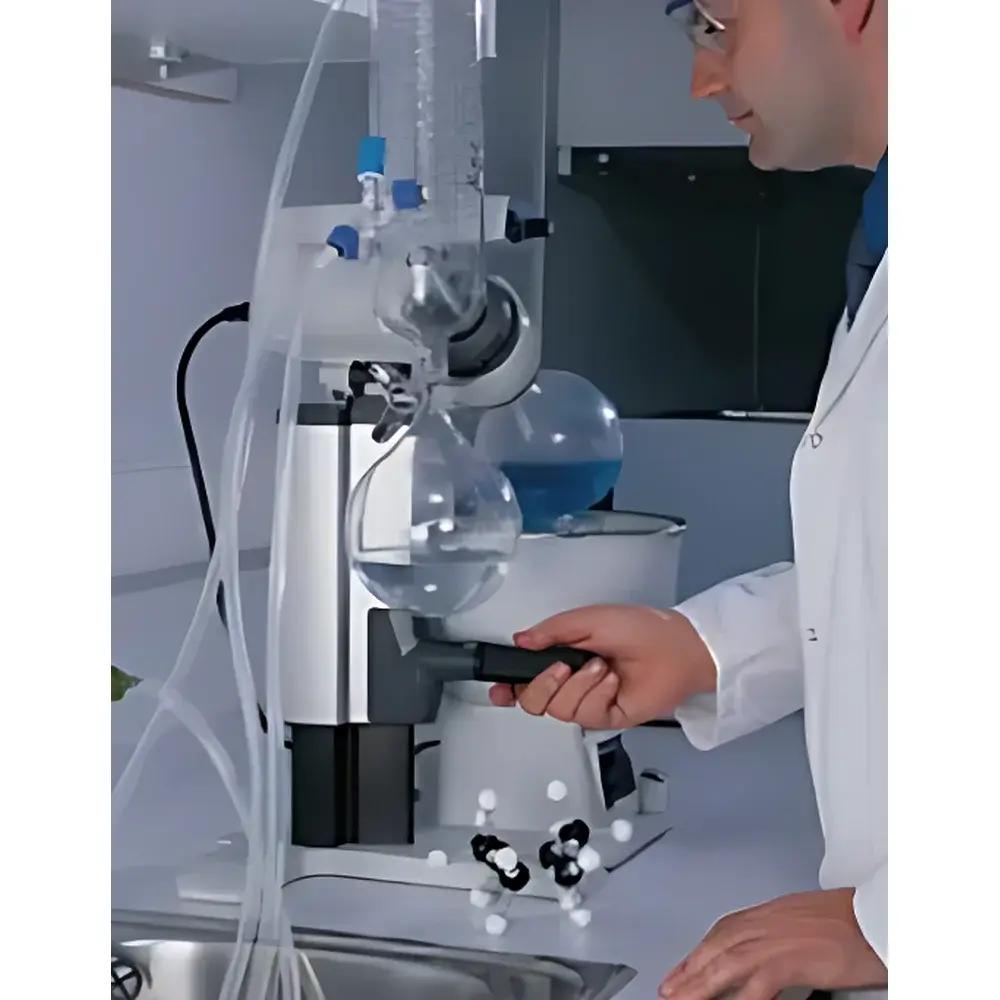
Stuart RE-300 Series Rotational Evaporator
| Origin | Germany |
|---|---|
| Manufacturer Type | Authorized Distributor |
| Origin Category | Imported |
| Pricing | Available Upon Request |
Overview
The Stuart RE-300 Series Rotational Evaporator is a precision-engineered benchtop distillation system designed for efficient solvent removal, concentration of heat-sensitive solutions, and gentle sample processing under reduced pressure. Operating on the principle of rotary evaporation—where a rotating flask generates a thin, uniform liquid film across its inner surface—the system maximizes heat transfer area while minimizing thermal degradation. Coupled with a thermostatically controlled water bath and an optimized condenser geometry, it enables rapid, reproducible evaporation at lowered boiling points dictated by vacuum level (typically 10–200 mbar). This architecture supports both atmospheric and sub-atmospheric operation, making it suitable for routine QC workflows, synthetic chemistry, natural product isolation, and pharmaceutical R&D where solvent recovery, yield preservation, and process repeatability are critical.
Key Features
- Three configurable models: RE-300 (inclined coil condenser), RE-301 (vertical coil condenser), and RE-302 (finger-type condenser)—each engineered for distinct condensation efficiency, footprint constraints, and vapor path optimization.
- Chemically inert fluid pathway constructed from borosilicate glass and PTFE components, ensuring compatibility with aggressive solvents including chlorinated hydrocarbons, strong acids, and bases.
- Brushless DC motor drive delivering smooth, low-vibration rotation (0–180 rpm) without sparking risk—essential for use in flammable solvent environments and compliant with ATEX/IECEx safety guidelines for non-hazardous zone laboratories.
- Durable graphite-PTFE vacuum sealing gasket with extended service life (>5,000 cycles), maintaining leak-tight integrity across repeated vacuum cycling and temperature gradients from ambient to 90 °C.
- Balanced counterweight lifting mechanism enabling effortless, ergonomic vertical adjustment of the evaporation assembly—even with full 1 L flasks mounted—reducing operator fatigue during multi-step protocols.
- Integrated continuous feed system with vacuum-rated valve and solvent addition tube, permitting real-time replenishment of reaction mixtures or extraction solvents without breaking vacuum or halting rotation.
- Optional polymer-coated glassware (RE-300P series): All major components—including 1 L receiving flasks, 1 L rotating flasks, and condensers—are coated with a transparent, thermochemically resistant polymer layer that absorbs mechanical shock, mitigates implosion risk under deep vacuum, and complies with ISO 17025 laboratory safety recommendations for glass containment.
Sample Compatibility & Compliance
The RE-300 Series accommodates standard ground-glass jointed glassware (ISO K 29/32 and K 45/50), supporting common flask sizes (50 mL to 2 L) and interchangeable condenser configurations. Its vacuum-tight design meets ISO 2768-1 general tolerances for laboratory apparatus and conforms to EN 61010-1:2019 safety requirements for electrical equipment in laboratory use. When operated with certified vacuum pumps and calibrated pressure controllers, the system supports GLP-compliant documentation of process parameters—including bath temperature, rotational speed, vacuum setpoint, and run duration—for audit readiness. While not intrinsically rated for Class I Division 1 hazardous locations, its brushless motor and sealed electronics enable safe deployment in fume hoods handling Class II and III flammable liquids per NFPA 30 and OSHA 1910.106.
Software & Data Management
The RE-300 Series operates as a standalone analog-digital hybrid instrument with intuitive manual controls (rotary speed dial, bath temperature knob, vacuum release lever) and optional digital interface modules for external monitoring. Though no proprietary software is bundled, all analog outputs—including bath temperature (Pt100 sensor), rotation speed (Hall-effect tachometer), and vacuum level (capacitance manometer signal)—are accessible via 0–10 V or 4–20 mA analog ports for integration into LabVIEW, SCADA, or LIMS platforms. Vacuum release timing and feed valve actuation can be externally triggered using TTL-level signals, facilitating synchronization with automated synthesis reactors or fraction collectors. Full audit trail capability requires external data logging; however, the system’s mechanical robustness and parameter stability support 21 CFR Part 11–compliant validation when paired with validated third-party acquisition hardware.
Applications
- Solvent concentration of organic extracts, polymer solutions, and natural product fractions under controlled vacuum (e.g., ethanol removal from plant extracts at ≤40 °C).
- Recovery and recycling of high-purity solvents (acetone, dichloromethane, ethyl acetate) in compliance with ISO 14001 waste minimization objectives.
- Vacuum drying of hygroscopic solids, crystalline intermediates, and lyophilized samples without thermal decomposition.
- Deaeration of viscous liquids (e.g., silicone oils, resins) prior to casting or coating processes.
- Parallel evaporation workflows using multiple RE-300 units connected to centralized vacuum and cooling systems—common in analytical method development labs adhering to USP dissolution testing standards.
FAQ
What vacuum level is recommended for optimal performance?
For most applications, a stable vacuum between 50–150 mbar provides optimal balance between evaporation rate and condensation efficiency. Lower pressures (<20 mbar) may be used for high-boiling solvents but require enhanced cold trap capacity.
Can the RE-300 be integrated with an automated vacuum controller?
Yes—via analog input/output ports, it accepts external PID vacuum control signals and provides real-time feedback for closed-loop regulation compatible with Edwards, Vacuubrand, or KNF controllers.
Is the polymer coating on RE-300P glassware autoclavable?
No—the coating is not rated for steam sterilization. It is intended for chemical resistance and mechanical protection only; cleaning must be performed with non-abrasive detergents and low-pressure rinse cycles.
What maintenance intervals are advised for the graphite-PTFE seal?
Inspect visually after every 200 operating hours; replace if cracking, compression set, or vacuum leakage exceeds 5 mbar/min decay rate under static test conditions.
Does Stuart provide IQ/OQ documentation packages?
Yes—validated installation and operational qualification templates aligned with ASTM E2500 and EU GMP Annex 15 are available upon request for regulated environments.
Related Products



