
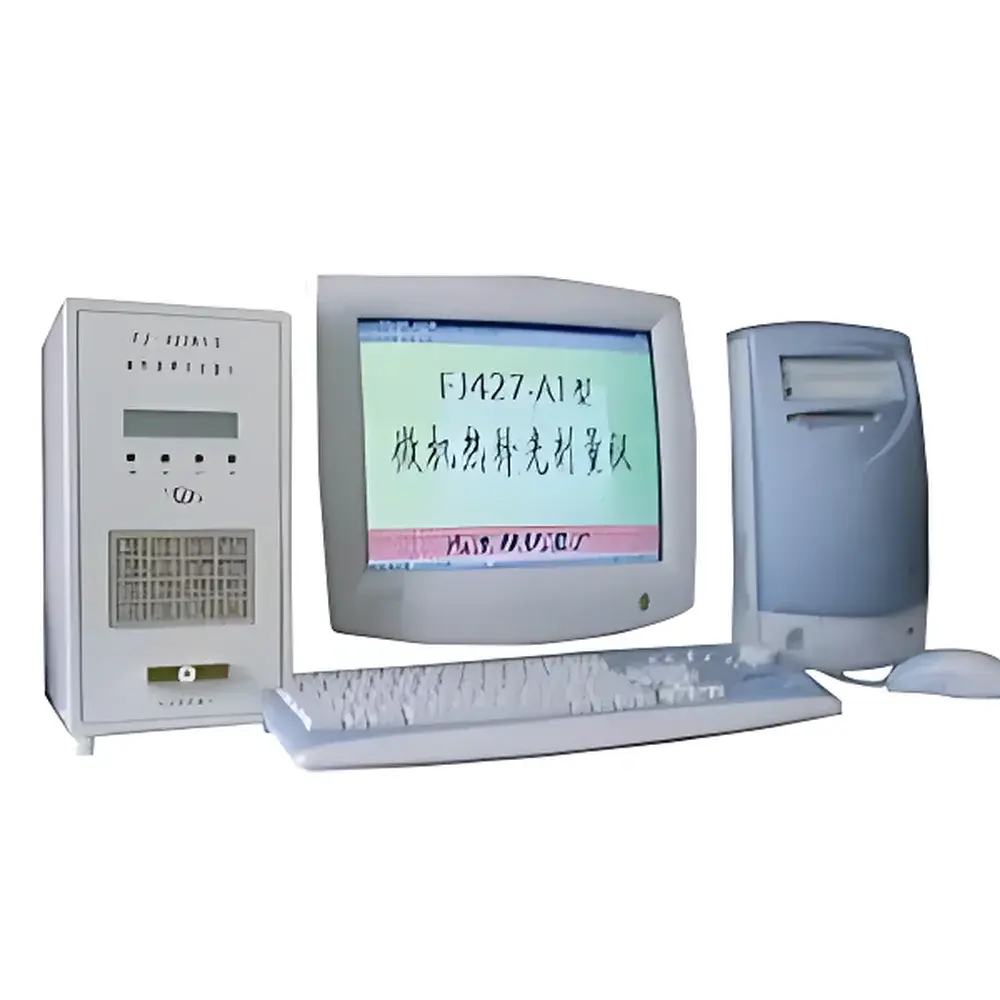
CNC-FJ427A1 Thermoluminescent Dosimeter Reader
| Brand | CNC (China Nuclear Control System) |
|---|---|
| Origin | Beijing, China |
| Model | FJ427A1 |
| Instrument Type | Laboratory TLD Reader |
| Measurement Principle | Thermoluminescence (TL) Readout |
| Radiation Types | β, γ, X-ray, and thermal neutron (via appropriate TLD phosphors) |
| Detector | Photomultiplier Tube (PMT), operating voltage range: −400 V to −1000 V |
| Sample Form Compatibility | Solid dosimeters (square chips, discs, rods, powder) |
| Dose Range | 0.000–9999 arbitrary units (calibrated in µGy–Gy via TL phosphor-specific calibration) |
| Linearity Range | 100 µGy – 4 Gy (for JR1152A LiF:Mg,Ti chips irradiated with ⁶⁰Co γ-rays) |
| Linearity Deviation | ≤ ±10% within specified range |
| Heating Program | Three-stage linear ramp (preheat, readout, anneal) |
| max total duration | 500 s |
| preheat | RT → 500 °C at max rate |
| readout | variable ramp 0–40 °C/s, temp range up to 500 °C |
| anneal | ramp to 500 °C at max rate |
| Programmable Parameters | 5 independent parameter sets (including ramp profile, PMT HV, background offset, reference light source count rate, calibration factor, real-time clock) |
| Background Subtraction | Automatic, performed every 30 min during operation |
| Sensitivity Stability | ≤ ±5% over 8-h continuous operation |
| Compliance | Designed per GB 10264–1988 (Chinese National Standard for Thermoluminescent Dosimetry Systems) |
| Physical Dimensions | 445 mm (W) × 205 mm (D) × 420 mm (H) |
| Net Weight | 22 kg |
| Power Supply | AC 220 V, 50 Hz |
Overview
The CNC-FJ427A1 Thermoluminescent Dosimeter Reader is a laboratory-grade, microprocessor-controlled TLD reader engineered for precise quantification of cumulative ionizing radiation dose absorbed by thermoluminescent phosphors. It operates on the fundamental principle of thermoluminescence: when previously irradiated crystalline materials (e.g., LiF:Mg,Ti, CaSO₄:Dy, or Al₂O₃:C) are heated under controlled conditions, trapped electrons recombine with lattice defects, emitting photons proportional to the absorbed dose. The emitted light is detected by a high-sensitivity photomultiplier tube (PMT), digitized, and converted into dose values using traceable calibration coefficients. Designed in accordance with GB 10264–1988—the Chinese national standard governing performance, calibration, and operational requirements for TLD systems—the FJ427A1 supports rigorous personal dosimetry programs, environmental monitoring, medical physics QA, and research applications where passive, integrating radiation detection is required.
Key Features
- Three-stage programmable linear heating system (preheat, readout, anneal), fully configurable via front-panel keypad; total ramp time ≤500 s, with individual stage durations and rates adjustable within defined limits.
- Five independent measurement parameter sets stored in non-volatile memory—each including PMT high voltage, background threshold, reference light source count rate, calibration factor, real-time clock, and full temperature ramp profile—enabling rapid switching between different TLD chip types or experimental protocols.
- Automatic background subtraction executed every 30 minutes, compensating for PMT dark current, amplifier drift, and ambient luminescence; integrated zero-drift correction applied in real time to all acquired glow curves.
- Onboard liquid crystal display (LCD) provides real-time visualization of dose value, ROI-integrated photon counts, temperature, heating curve, sample ID (0000–9999), date/time, and dynamic glow curve plotting with optional spectral deconvolution capability.
- Standard nitrogen purge port enables inert-atmosphere readout for low-dose measurements (<100 µGy), minimizing oxidative quenching effects and improving signal-to-noise ratio in sensitive applications.
- Robust mechanical architecture (22 kg net weight, steel chassis) ensures stability during extended operation and resistance to transport-induced misalignment; validated for continuous 8-hour operation with ≤±5% maximum relative error.
Sample Compatibility & Compliance
The FJ427A1 accommodates five standardized solid TLD geometries without mechanical modification: square chips (max 5×5×0.8 mm), circular discs (φ ≤10 mm), cylindrical rods (φ2×12 mm and φ1×6 mm), and loose powder samples placed in planchettes. Its PMT detector—operating at −400 V to −1000 V—is optimized for UV–visible emission spectra typical of common phosphors (e.g., 380–420 nm for LiF:Mg,Ti). All hardware and firmware functions comply with GB 10264–1988, which specifies linearity, reproducibility, energy response, and environmental tolerance requirements for accredited dosimetry services. While not pre-certified to ISO/IEC 17025 or ANSI N13.32, the instrument’s design facilitates integration into GLP-compliant workflows when paired with documented calibration procedures, traceable reference sources (e.g., ⁶⁰Co), and validated software protocols.
Software & Data Management
The FJ427A1 supports bidirectional RS-232 communication with Windows-based host computers. Its native acquisition and analysis software provides comprehensive database functionality—including sample ID indexing, chronological sorting, dose history tracking, and batch reporting. All raw glow curve data (temperature vs. photon count) and processed results (integrated ROI, corrected dose, background-subtracted net counts) are stored with metadata (date/time, operator ID, parameter set used, ambient conditions). Reports may be exported in CSV or printed directly, supporting audit-ready documentation. The software implements basic curve-fitting algorithms for peak identification and area integration but does not include automated kinetic modeling (e.g., general-order or mixed-order deconvolution). For regulatory environments requiring electronic record integrity, users must implement supplemental controls (e.g., file encryption, access logs, periodic backup verification) as part of their local SOPs.
Applications
- Personal dosimetry for nuclear facility staff, radiology technicians, and emergency responders using TLD badges compliant with ICRP and national regulatory frameworks.
- Environmental radiation surveillance—monitoring soil, sediment, or building materials for residual activity following decommissioning or accidental release.
- Medical physics quality assurance—verifying output consistency of radiotherapy beams (kVp, MV, brachytherapy sources) and validating phantom irradiation protocols.
- Research in radiation biology and material science—quantifying dose-response relationships in cell cultures or polymer degradation studies using calibrated TLD microprobes.
- Archival dose reconstruction—retrospective assessment of historical exposures using stored TLD elements from legacy monitoring programs.
FAQ
What TLD phosphors are compatible with the FJ427A1?
The reader is compatible with standard commercial TLD materials including LiF:Mg,Ti (TLD-100), LiF:Mg,Cu,P (TLD-100H), CaSO₄:Dy, and Al₂O₃:C—provided their emission spectra fall within the PMT’s spectral response range (300–650 nm) and physical dimensions conform to the supported geometries.
Does the instrument support automatic energy compensation for different radiation types?
No. Energy response correction must be applied externally using empirically determined correction factors derived from calibration irradiations with reference sources (e.g., ¹³⁷Cs, ⁶⁰Co, ²⁴¹Am/Be neutrons) and appropriate phantoms.
Can the FJ427A1 be used in field-deployable configurations?
It is designed strictly for laboratory use: it requires stable AC power (220 V, 50 Hz), controlled ambient temperature (5–40 °C), and non-condensing humidity (≤85% RH at 30 °C); no battery operation or ruggedized enclosure is provided.
Is firmware upgrade capability available?
Firmware updates are distributed by CNC upon request and require proprietary download tools and technical support engagement; no user-accessible bootloader or over-the-air update mechanism is implemented.
How is calibration traceability maintained?
Calibration is performed using nationally certified reference sources (e.g., CNIC-traceable ⁶⁰Co γ-ray fields) and documented against GB 10264–1988 test procedures; end-users are responsible for establishing and maintaining their own metrological chain to national standards.







