
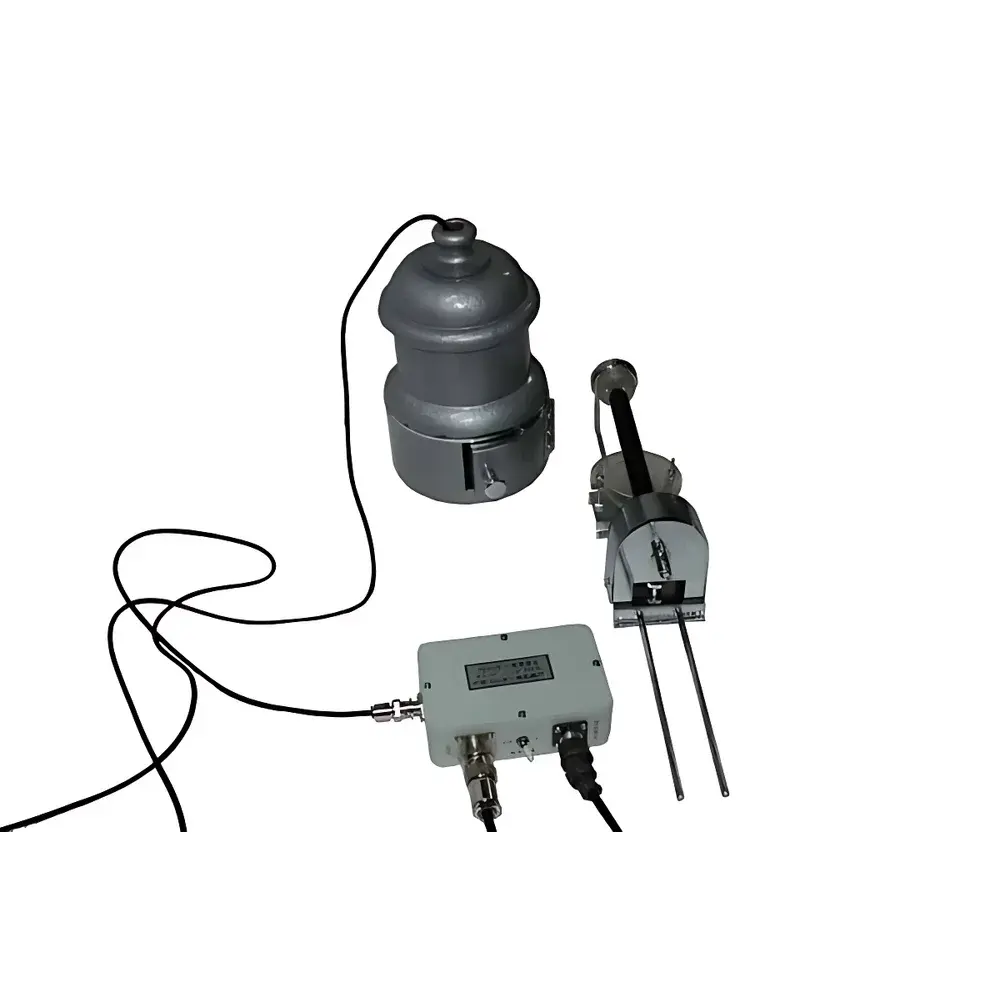
CNCs FJ365 Geiger-Müller Counter Probe
| Brand | CNCs (China Nuclear Control Systems) |
|---|---|
| Origin | Beijing, China |
| Manufacturer Type | Authorized Distributor |
| Product Origin | Domestic (PRC) |
| Model | FJ365 |
| Pricing | Available Upon Request |
Overview
The CNCs FJ365 Geiger-Müller Counter Probe is a radiation detection accessory engineered for precise pulse counting of ionizing radiation in laboratory, industrial, agricultural, and biomedical applications. Designed for integration with the FH463B scaler unit, the probe operates on the principle of gas-filled tube ionization—where incident α, β, or γ radiation triggers discrete electrical pulses proportional to particle energy deposition within the detector volume. Its dual-geometry sensor configuration enables optimized detection efficiency across radiation types: a cylindrical GM tube (≤365 mm length) for β and γ measurements, and a hemispherical (bell-shaped) GM tube for enhanced α and low-energy β detection due to its thin entrance window and large solid-angle acceptance. The probe does not provide energy spectroscopy but delivers high-reproducibility count-rate data suitable for dose rate estimation, contamination screening, and comparative activity assessment under controlled conditions.
Key Features
- Dual-sensor design: Interchangeable cylindrical and bell-shaped GM tubes tailored for distinct radiation modalities—cylindrical geometry optimized for medium-to-high-energy β and γ; bell-shaped geometry enabling efficient α detection through ultra-thin mica or polymer windows (typical thickness: 1.5–2.0 mg/cm²).
- Integrated preamplifier: Negative-polarity pulse output with input amplitude range of 0.2–20 V and pulse width compatibility from 5 µs to 400 µs—ensuring robust signal coupling to standard nuclear instrumentation modules (NIM) and scaler systems.
- Passive power architecture: Draws both high-voltage (typically 400–900 V DC) and low-voltage (±12 V or +24 V) supply directly from the host FH463B scaler—eliminating need for external power supplies and minimizing electromagnetic interference.
- Environmental resilience: Rated for operation at ambient temperatures from 0 °C to +40 °C and relative humidity ≤85% at +30 °C—validated per IEC 61000-4-2 (ESD immunity) and IEC 61000-4-3 (radiated RF immunity) for routine lab and field deployment.
- Mechanical interface: Standard BNC output connector with shielded coaxial cable (length: 2 m, optional extension up to 5 m); aluminum alloy housing with IP54-rated ingress protection against dust and splashing water.
Sample Compatibility & Compliance
The FJ365 probe is compatible with sealed and unsealed radioactive sources emitting α (e.g., 241Am, 239Pu), β (e.g., 90Sr/90Y, 3H, 14C), and γ (e.g., 137Cs, 60Co) radiation. It supports qualitative and semi-quantitative measurements in accordance with ISO 7503-1:2019 (Radiation protection — Monitoring of radioactivity in the environment — Part 1: General principles), ASTM D3648-16 (Standard Practice for Measurement of Radioactivity), and national standards GB/T 10257–2001 (Chinese standard for radiation monitoring instruments). While not certified for diagnostic medical use per IEC 62304 or FDA 21 CFR Part 11, it meets GLP-aligned documentation requirements when used with FH463B’s audit-trail-capable scaler firmware.
Software & Data Management
When paired with the FH463B scaler, the FJ365 probe supports real-time count accumulation, preset time/count triggering, and statistical uncertainty calculation (1σ confidence interval based on Poisson distribution). Data export is available via RS-232 or USB-C interface in CSV format, compatible with Microsoft Excel, OriginLab, and Python-based analysis workflows (e.g., NumPy/Pandas). Firmware versions ≥V3.2 support timestamped logging with UTC synchronization and user-defined calibration factor application (units: cps → Bq/cm² or µSv/h using empirical conversion coefficients). No proprietary software installation is required; basic configuration is performed via front-panel keypad or terminal command set (SCPI-like syntax).
Applications
- Surface contamination monitoring in nuclear medicine labs and radiopharmaceutical production facilities.
- Soil and crop radioactivity screening in post-incident environmental surveys (e.g., after reactor incidents or orphan source recovery).
- Educational demonstrations of decay statistics, half-life verification, and inverse-square law validation.
- Quality control of shielding materials (e.g., lead glass, borosilicate concrete) via transmission attenuation studies.
- Calibration verification of reference sources traceable to CNIM (China National Institute of Metrology) or secondary standards accredited by CNAS (China National Accreditation Service).
FAQ
Can the FJ365 probe be used independently without the FH463B scaler?
No—it requires external high-voltage bias and pulse conditioning provided exclusively by the FH463B or functionally equivalent NIM-compatible scalers with HV output capability.
What is the typical background count rate for the cylindrical GM tube?
Measured background ranges from 12–28 cpm (counts per minute) in low-radiation laboratories (<0.1 µSv/h ambient dose rate), consistent with tube volume and wall material (stainless steel or aluminized glass).
Is the probe suitable for neutron detection?
No—standard GM tubes are insensitive to neutrons; neutron measurement requires specialized 3He or BF3-filled proportional counters.
Does the probe include calibration certificate documentation?
Each unit ships with a factory test report listing plateau curve data, operating voltage, and dead-time correction factor; full ISO/IEC 17025 calibration is available as an optional service through authorized CNCs metrology centers.
What is the maximum recommended count rate before significant dead-time losses occur?
For reliable operation with <5% dead-time loss, sustained count rates should remain below 1,500 cps for the cylindrical tube and 800 cps for the bell-shaped tube—values derived from manufacturer-specified 180–220 µs intrinsic dead time.






