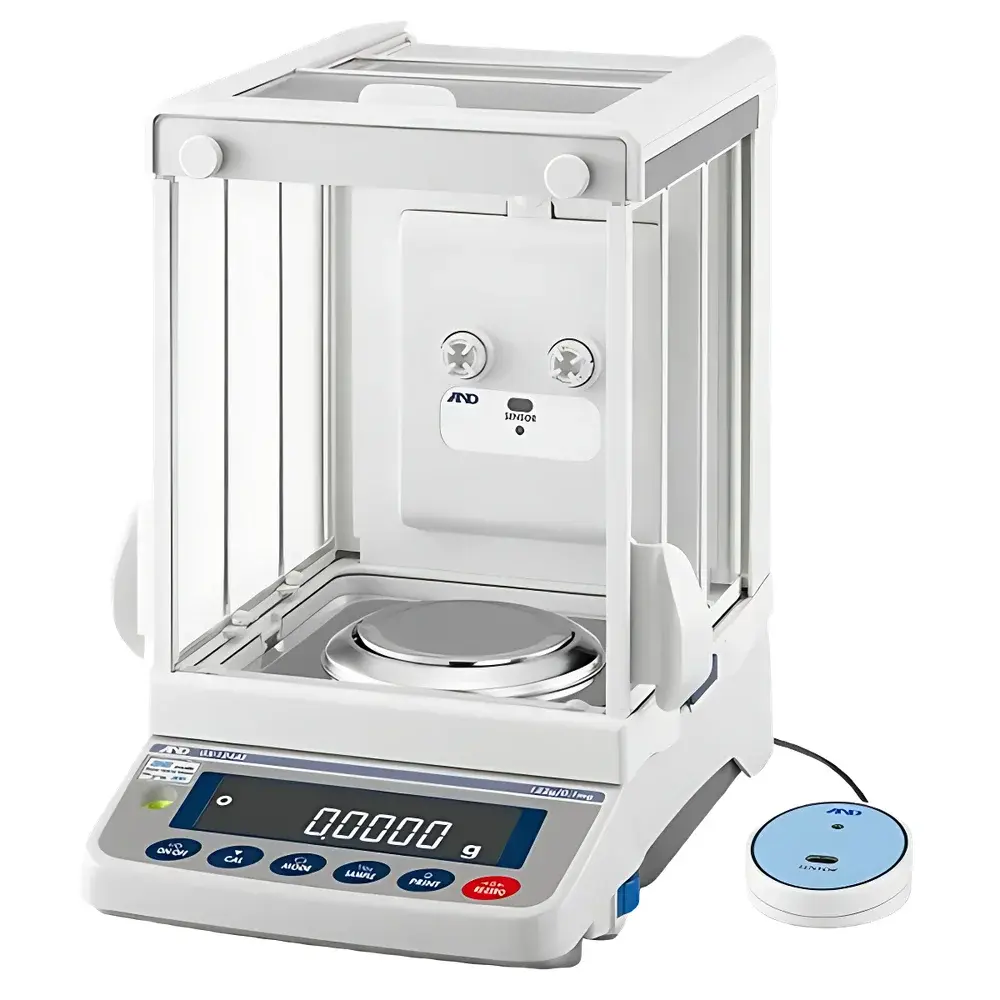
A&D GX124AE Advanced Analytical Balance with Integrated Electrostatic Discharger
| Brand | A&D |
|---|---|
| Origin | Japan |
| Manufacturer | A&D Company, Ltd. |
| Type | Internal Calibration Analytical Balance |
| Maximum Capacity | 320 g |
| Readability | 0.1 mg |
| Repeatability | 0.1 mg |
| Stabilization Time | ~1.5 s |
| Pan Size | Ø90 mm |
| Dimensions (W×D×H) | 259 × 358 × 332 mm |
| Interface | Dual RS-232C and USB |
| Compliance | GLP/GMP/GCP/ISO-compliant data output |
| Static Elimination | Built-in high-speed electrostatic discharger (2× faster than conventional units) |
| Environmental Compensation | Auto-self-calibration triggered by temperature drift |
| Software Features | ISD (Impact Sensing & Detection), APA (Automatic Minimum Weight Assessment), FRD (Flow Rate Display), User Permission Management (up to 11 accounts) |
Overview
The A&D GX124AE is a high-precision internal calibration analytical balance engineered for laboratories requiring traceable mass measurement under electrostatic-sensitive conditions. Designed and manufactured in Japan by A&D Company, Ltd.—a globally recognized leader in metrological instrumentation—the GX124AE employs electromagnetic force compensation (EMFC) technology to deliver stable, drift-resistant measurements at 0.1 mg readability across its 122 g nominal capacity (320 g maximum overload tolerance). Its integrated electrostatic discharger operates continuously during weighing, neutralizing surface charges on samples and containers—critical for accurate measurement of low-mass powders, polymers, pharmaceutical actives, and hygroscopic materials prone to electrostatic adhesion. Unlike external ionizers, the built-in discharger eliminates spatial dependency and ensures consistent discharge kinetics directly at the weighing pan, reducing measurement uncertainty associated with static-induced force artifacts.
Key Features
- Integrated High-Speed Electrostatic Discharger: Delivers charge neutralization at twice the speed of standard corona-based ionizers; automatically activates during tare and weighing cycles without user intervention.
- Intelligent Stability Detection (ISD): Monitors mechanical shock events (e.g., bench vibration, accidental contact) and triggers visual/audible alerts—enabling root-cause analysis and procedural refinement in QC environments.
- Automatic Minimum Weight Assessment (APA): Leverages A&D’s proprietary ECL (Enhanced Calibration Logic) algorithm to dynamically determine minimum weighable quantity (MWQ) based on real-time repeatability assessment—fully compliant with USP and ASTM E899 requirements.
- Flow Rate Display (FRD): Calculates volumetric or gravimetric flow rates for liquid dispensing or powder transfer applications using time-stamped mass change data—supports SOP-driven process validation.
- Environmental Self-Calibration: Detects ambient temperature fluctuations exceeding ±1.0 °C and initiates internal recalibration autonomously—ensuring long-term metrological integrity without manual intervention.
- Dual Communication Interface: Simultaneous RS-232C and USB connectivity enables concurrent connection to printers, LIMS, and peripheral controllers—supporting bidirectional command execution and real-time data streaming.
Sample Compatibility & Compliance
The GX124AE accommodates diverse sample forms—including fine powders, crystalline APIs, micro-tablets, and volatile solvents—via its Ø90 mm stainless-steel weighing pan and optional draft shield (sold separately). Its down-hanging hook (standard) supports density determination (with optional density kit) and suspended weighing per ISO 8655-6. All firmware and data handling comply with FDA 21 CFR Part 11 requirements for electronic records and signatures when paired with A&D’s AD-1687 software. Audit trails record operator ID, timestamp, calibration history, and all parameter modifications—meeting GLP, GMP, and ISO/IEC 17025 documentation mandates. Measurement uncertainty budgets are pre-configured per OIML R76 and EURAMET cg-18 guidelines.
Software & Data Management
Data output adheres to standardized GLP/GMP/GCP report templates, including instrument ID, operator credentials, environmental metadata (temperature/humidity), and full traceability of calibration events. Up to 200 measurement records, 50 calibration logs, and 50 unit-specific mass values are stored onboard with time/date stamping. Export formats include CSV, TXT, and XML—compatible with major LIMS platforms (e.g., LabWare, STARLIMS) and statistical process control (SPC) tools. User permission levels (11 total, including administrator, supervisor, and technician tiers) restrict access to calibration, configuration, and data deletion functions—enforcing role-based accountability.
Applications
- Pharmaceutical quality control: Active ingredient assay, blend uniformity testing, and reference standard preparation per USP .
- Materials science: Nanoparticle mass dosing, catalyst loading verification, and polymer additive quantification.
- Academic research: Gravimetric sorption studies, electrochemical electrode loading, and micro-reaction stoichiometry.
- Food & beverage QA: Nutrient fortification accuracy, allergen cross-contamination threshold verification.
- Environmental testing labs: Filter mass gain analysis for PM2.5/PM10 particulate matter monitoring (per EPA Method IO-3.2).
FAQ
Does the GX124AE meet ISO/IEC 17025 accreditation requirements for calibration laboratories?
Yes—the balance supports documented traceability to national standards (JCSS in Japan, NIST in the U.S.), includes full audit trail logging, and permits generation of calibration certificates with uncertainty statements aligned with GUM (JCGM 100:2008).
Can the electrostatic discharger be disabled for non-sensitive applications?
No—it operates automatically and continuously; however, its discharge field is confined to the immediate pan vicinity and does not interfere with adjacent instrumentation.
Is the internal calibration weight certified and replaceable?
The internal calibration mass is factory-sealed and non-user-serviceable; recalibration must be performed by an A&D-certified service center using traceable reference standards.
What is the recommended warm-up time before first use?
A minimum 30-minute stabilization period at constant ambient temperature (20–25 °C, ≤50% RH) is required to achieve thermal equilibrium of the EMFC sensor and ensure optimal repeatability.
Does the balance support direct integration with ERP systems like SAP QM?
Yes—via ASCII protocol over RS-232C or USB virtual COM port, enabling automated data capture into SAP QM modules using standard interface configurations.