
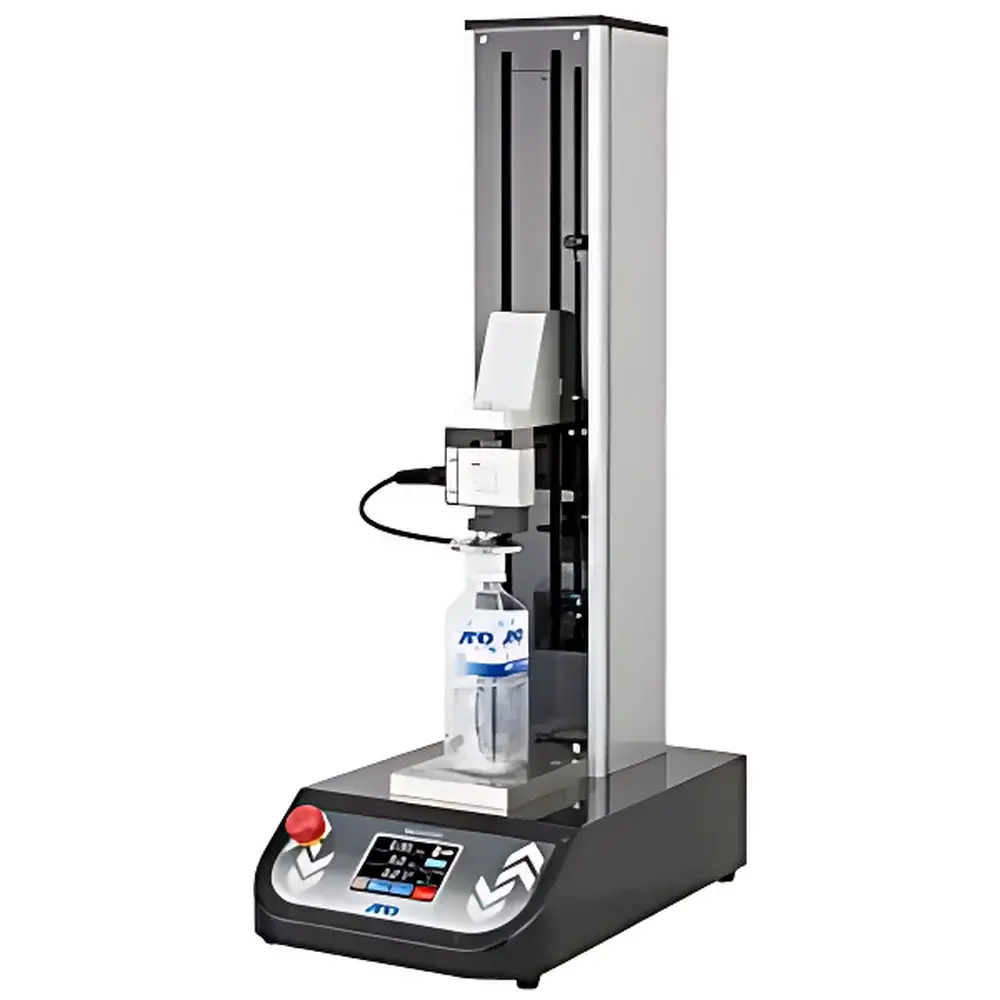
A&D MCT-1150 Desktop Universal Testing Machine
| Brand | A&D |
|---|---|
| Origin | Japan |
| Model | MCT-1150 |
| Type | Electromechanical Universal Testing Machine |
| Maximum Load Capacity | 2.5 kN |
| Effective Travel | 850 mm (STB-1225L) / 550 mm (STB-1225S) |
| Crosshead Speed Range | 0.05–1000 mm/min (adjustable in 0.01 mm/min increments) |
| Speed Accuracy | ±0.5% |
| Load Measurement Accuracy | ±1% of reading (within 1/1 to 1/500 of sensor rated capacity) |
| Automatic Load Range Switching | Up to 128× |
| Load Calibration | One-touch electronic calibration with integrated sensor diagnostics |
| Overload Protection | Yes |
| Travel Limiters | Dual-position (upper/lower) mechanical stops |
| Position Resolution | 0.001 mm (≤10 mm), 0.01 mm (>10 mm) |
| Dimensions (L×H×W) | 470 × 1450 × 335 mm (STB-1225L) / 470 × 1050 × 335 mm (STB-1225S) |
| Weight | 56 kg / 43 kg |
| Power Supply | AC 100 V, 1Φ, 50/60 Hz |
| Power Consumption | 350 VA |
| Operating Environment | 5–40 °C, 20–80 % RH |
| Data Acquisition Rate | 0.2 ms (with TACT interface) |
| Display | Optional full-color touchscreen interface |
| Control | PC-based test setup and execution |
Overview
The A&D MCT-1150 Desktop Universal Testing Machine is an electromechanical materials testing system engineered for precision tensile, compression, flexural, and peel testing in quality control laboratories, R&D facilities, and academic institutions. Built on A&D’s legacy of metrological rigor and Japanese manufacturing discipline, the MCT-1150 employs a servo-controlled crosshead drive with high-resolution encoder feedback and load cell signal conditioning compliant with ISO 7500-1 Class 1 accuracy requirements. Its core architecture supports static and quasi-static mechanical property evaluation—including ultimate tensile strength (UTS), yield point, elongation at break, modulus of elasticity, and fracture energy—across polymers, elastomers, thin metals, composites, adhesives, textiles, and biomedical specimens. The system integrates seamlessly into GLP- and GMP-aligned workflows through traceable calibration paths, audit-ready data logging, and hardware-level overload safeguards.
Key Features
- High-speed data acquisition at 0.2 ms sampling interval when used with the optional TACT digital interface—enabling accurate capture of transient mechanical responses such as brittle fracture initiation or viscoelastic relaxation peaks.
- Full-range automatic load scaling up to 128×, eliminating manual range switching and minimizing operator-induced measurement uncertainty across wide-force spans (e.g., from 20 N to 2.5 kN).
- Precision crosshead motion control with speed resolution of 0.01 mm/min across the full 0.05–1000 mm/min range, meeting ASTM E4 and ISO 527-1 repeatability criteria for displacement-controlled tests.
- Integrated one-touch electronic load calibration routine that leverages embedded sensor diagnostics to verify transducer linearity, hysteresis, and zero stability prior to test execution—reducing pre-test setup time while ensuring traceability to national standards.
- Energy-efficient standby mode reduces power draw by 30%, supporting sustainability goals without compromising system readiness or thermal stability of critical components.
- Modular human-machine interface options: standard alphanumeric keypad with intuitive command structure, or optional 7-inch full-color capacitive touchscreen with gesture navigation and real-time curve overlay.
Sample Compatibility & Compliance
The MCT-1150 accommodates specimens ranging from microfilaments (<0.1 mm diameter) to rigid plates (up to 850 mm effective travel). Standard grips include pneumatic vise, wedge-action, and shear-type configurations; custom fixtures are available per ISO 6892-1, ASTM D638, D790, and D903 specifications. All mechanical and electrical subsystems comply with IEC 61000-6-2 (EMC immunity) and IEC 61000-6-4 (EMC emissions), while structural safety meets ISO 12100 and EN 60204-1 requirements. Load cells are factory-calibrated to ISO/IEC 17025-accredited reference standards, with documentation supporting FDA 21 CFR Part 11-compliant electronic records when paired with validated software.
Software & Data Management
Control and analysis are performed via A&D’s proprietary WinTest Pro software (Windows 10/11 compatible), which provides full test method scripting, real-time stress–strain visualization, multi-curve comparison, and automated report generation in PDF/XLSX formats. Raw data files (.tdms) retain full metadata—including timestamp, environmental conditions, calibration history, and user ID—supporting ALCOA+ principles (Attributable, Legible, Contemporaneous, Original, Accurate, Complete, Consistent, Enduring, Available). Audit trails log all parameter modifications, test executions, and calibration events with immutable timestamps. Optional integration with LIMS via OPC UA or CSV export enables centralized QA/QC data governance.
Applications
- Quality assurance of medical device components (e.g., suture tensile strength per ISO 10993-12, catheter shaft stiffness per ISO 80369-7)
- Mechanical validation of packaging films and laminates (peel strength, seal integrity, puncture resistance per ASTM F88, F904)
- Rheomechanical characterization of thermoplastic elastomers and hydrogels under controlled humidity and temperature
- Adhesive bond strength evaluation for automotive interior trim assemblies (lap shear per ASTM D1002)
- Educational use in materials science curricula for hands-on instruction in Hooke’s law, Poisson’s ratio, and creep behavior
FAQ
What standards does the MCT-1150 support for compliance reporting?
The system is configured to generate test reports aligned with ASTM E4, ISO 7500-1, ISO 527, and JIS Z2241, with configurable pass/fail thresholds and statistical summaries (mean, SD, CV%) per batch.
Can the MCT-1150 be integrated into an existing laboratory network?
Yes—WinTest Pro supports TCP/IP communication, shared network drives, and Windows Active Directory authentication for role-based access control.
Is third-party calibration certification available?
A&D provides optional ISO/IEC 17025-certified calibration services with NIST-traceable certificates, including as-found/as-left data and measurement uncertainty budgets.
Does the system meet FDA 21 CFR Part 11 requirements?
When deployed with WinTest Pro in validated configuration (electronic signatures, audit trail enablement, and secure user management), it satisfies Part 11 technical controls for electronic records and signatures.
What maintenance intervals are recommended?
Preventive maintenance is advised every 12 months or after 5000 test cycles, including encoder verification, load cell zero drift assessment, and mechanical alignment checks per A&D Service Manual SM-MCT-1150 Rev. 3.2.



