
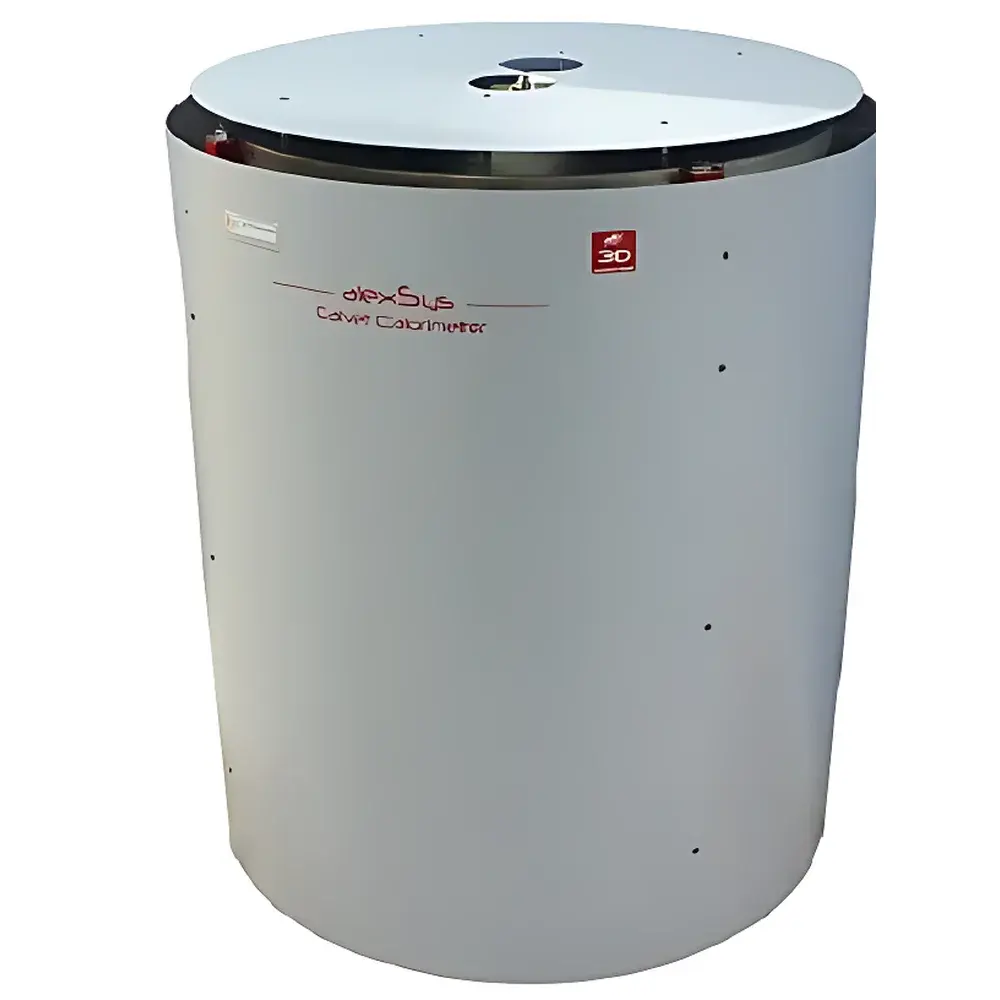
SETARAM Alexsys 800/1000 High-Temperature Calvet Calorimeter
| Brand | SETARAM |
|---|---|
| Origin | France |
| Model | Alexsys 800 / Alexsys 1000 |
| Calorimetry Principle | Isothermal Heat-Flow Calvet |
| Temperature Range | 500–800 °C (Alexsys 800) / 800–1000 °C (Alexsys 1000) |
| Sample Crucible Count | 2 |
| Crucible Volume | 28 mL / 20 mL (dual configuration) |
| Temperature Accuracy | ±0.1% of reading |
| Calorimetric Accuracy | ±1% |
| Heat Flow Resolution | 12.5 µW |
| Dimensions (W × H) | 800 mm × 880 mm |
Overview
The SETARAM Alexsys 800/1000 is a high-precision, high-temperature Calvet-type microcalorimeter engineered for quantitative thermodynamic characterization of materials under controlled isothermal conditions up to 1000 °C. Unlike conventional differential scanning calorimeters (DSC), the Alexsys employs a three-dimensional symmetric Calvet sensor architecture—comprising concentric cylindrical thermopile arrays surrounding both sample and reference crucibles—to achieve exceptional signal-to-noise ratio and near-zero thermal lag. This design enables true heat-flow measurement with minimal baseline drift, making it uniquely suited for long-duration isothermal studies of solid-state reactions, phase transformations, dissolution enthalpies, and catalytic heat effects in refractory systems. The instrument operates exclusively in isothermal mode across its specified temperature range, eliminating dynamic heating artifacts and supporting direct integration of heat flow over time to yield absolute enthalpy changes (ΔH) with metrological traceability.
Key Features
- Calvet geometry with dual 360° thermopile detection ensures uniform thermal coupling and minimizes radial heat-loss errors
- Dual-crucible configuration (28 mL main + 20 mL auxiliary) supports simultaneous sample/reference or comparative reaction studies
- High-stability furnace with multi-zone PID control maintains isothermal accuracy within ±0.1% of setpoint across full operating range
- Heat flow resolution of 12.5 µW enables detection of low-energy transitions (e.g., ordering phenomena in intermetallics or subtle redox steps in nuclear fuels)
- Refractory construction—including alumina fiber insulation and molybdenum/tungsten crucible options—ensures compatibility with aggressive atmospheres (inert, reducing, or CO₂-rich)
- Modular gas handling system with mass flow controllers supports programmable gas switching during isothermal holds
Sample Compatibility & Compliance
The Alexsys accommodates solid, powdered, and compacted samples—including ceramics, uranium oxides, silicon carbide composites, metallic alloys, and molten salt candidates—without requirement for encapsulation. Its high-temperature stability and inert crucible options comply with ASTM E1269 (standard test method for determining heat capacity by DSC) and ISO 11357-4 (plastics—DSC—part 4: determination of specific heat capacity), adapted for Calvet-based protocols. Data acquisition meets GLP and GMP documentation requirements through audit-trail-enabled software; raw heat flow and temperature logs are stored in vendor-neutral ASCII format for third-party analysis. Instrument validation aligns with ICH Q2(R2) guidelines for analytical procedure verification where calorimetric endpoints support regulatory filings in nuclear fuel qualification or advanced material certification.
Software & Data Management
Acquisition and analysis are performed via SETARAM’s CARYA software platform, which provides real-time visualization of heat flow, cumulative enthalpy, and temperature deviation. All experimental parameters—including gas composition, isothermal dwell time, and crucible identification—are timestamped and embedded in metadata. The software enforces electronic signatures per FDA 21 CFR Part 11 for regulated environments, and supports automated report generation compliant with ISO/IEC 17025 clause 7.8. Raw data exports include CSV and HDF5 formats, enabling integration with MATLAB, Python (SciPy), or Thermo-Calc for thermodynamic modeling. Calibration routines follow NIST-traceable standards using certified sapphire and nickel reference materials at multiple temperatures.
Applications
- Ceramic processing: Quantification of crystallization enthalpies in glass-ceramics and sintering exotherms in Si₃N₄ or Al₂O₃ compacts
- Nuclear materials: Enthalpy of formation for UO₂–PuO₂ solid solutions and oxidation enthalpies of Zr-alloys under steam exposure
- Thermoelectrics: Heat capacity mapping of half-Heusler compounds across α–β phase boundaries
- CO₂ capture media: Reaction enthalpies of CaO carbonation/decarbonation cycles under realistic flue-gas compositions
- Geological systems: Decomposition thermodynamics of carbonates and silicates at mantle-relevant pressures (when coupled with high-P accessories)
- Catalyst development: Isothermal reaction calorimetry of methane dry reforming on Ni–CeO₂ catalysts at 900 °C
FAQ
What distinguishes Calvet calorimetry from DSC for high-temperature work?
Calvet geometry measures absolute heat flow via spherical symmetry and multi-junction thermopiles, avoiding baseline curvature and calibration drift common in DSC at >600 °C.
Can the Alexsys operate under reactive atmospheres such as H₂ or CO₂?
Yes—optional Mo or W crucibles and sealed gas manifolds enable safe operation in reducing or carburizing environments up to 1000 °C.
Is it possible to perform heat capacity measurements on the Alexsys?
Yes—via the drop-calorimetry method: a pre-heated sample is dropped into the isothermal furnace, and the transient heat absorption yields Cp(T) with uncertainty <±2% above 500 °C.
How is instrument calibration verified across the temperature range?
Using NIST SRM 720 (sapphire) and SRM 750 (nickel) at ≥5 calibration points; certificates of calibration are issued annually per ISO/IEC 17025 requirements.
Does the system support automated sample loading?
Not natively—the Alexsys requires manual crucible insertion due to thermal mass constraints; however, custom robotic interfaces have been implemented by several national labs under collaborative agreements.



