
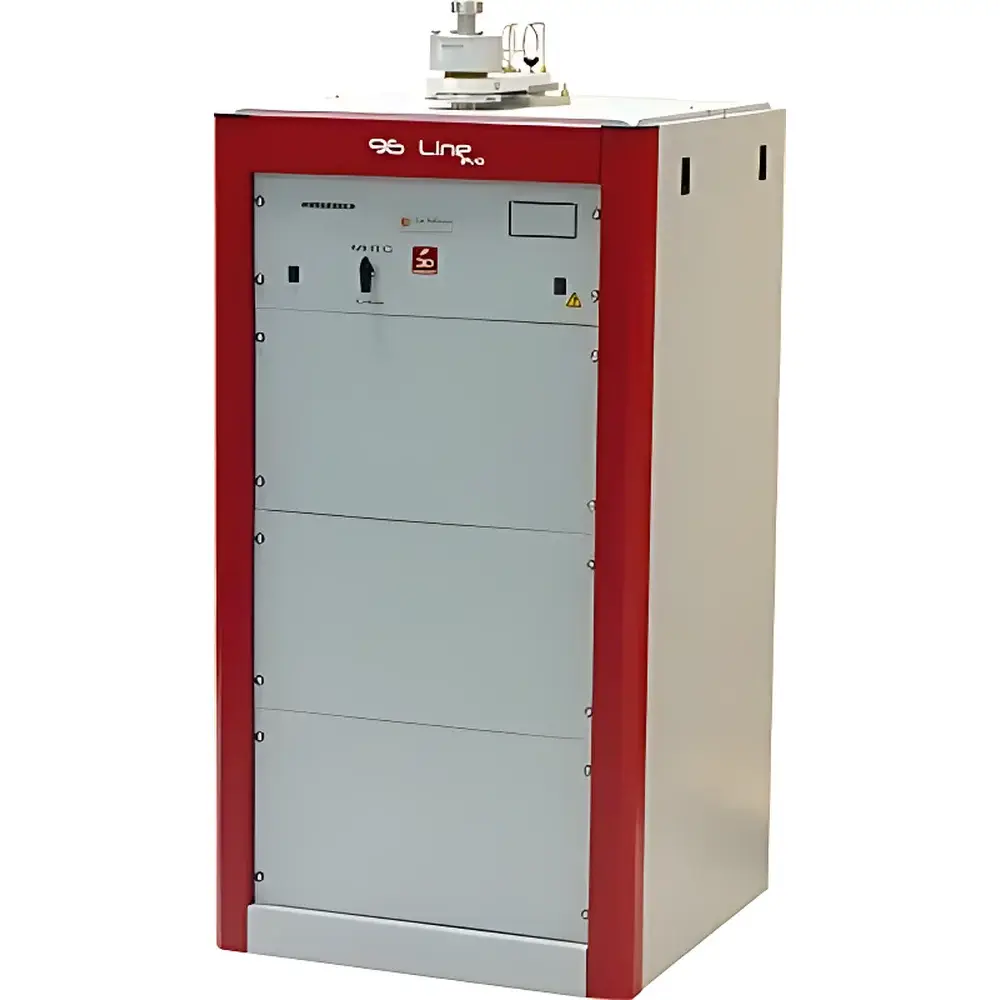
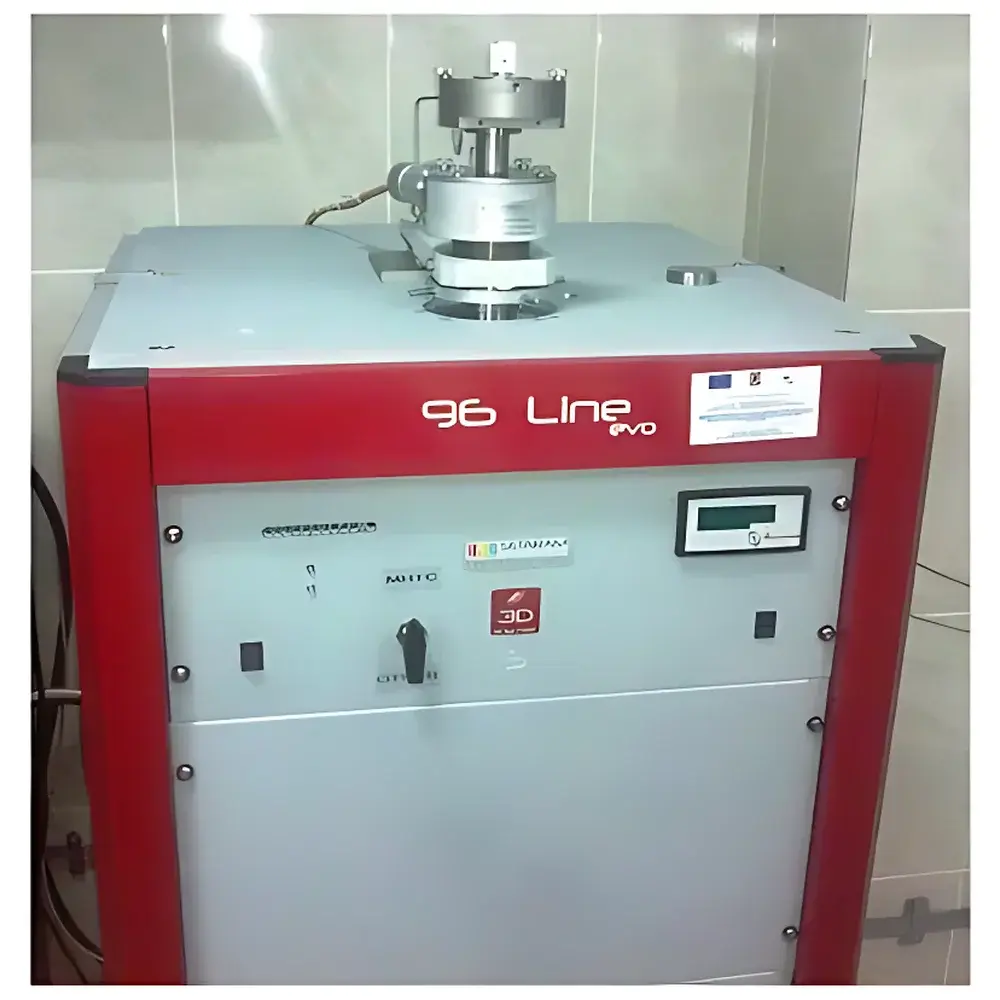
SETARAM 96line High-Temperature Specific Heat Analyzer
| Brand | SETARAM |
|---|---|
| Origin | France |
| Model | 96line High-Temperature Specific Heat Analyzer |
| Temperature Range | Ambient to 2000 °C |
| Temperature Accuracy | ±0.5 °C (typical for high-temperature DSC-grade calibration) |
| Heating/Cooling Rate | 0.001–99 K/min |
| Sample Capacity (Calorimetry) | 5.7 mL (Ø14.5 mm × H35 mm) |
| Specific Heat Measurement Uncertainty | ≤1% (per ASTM E1269 & ISO 11357-4) |
| TGA Max Load | 100 g |
| TGA Resolution | 0.3 µg |
| TMA Range | ±6 mm |
| TMA Resolution | 1.6 nm |
| Modular Configurations | Simultaneous TG-DSC, TG-DTA, TMA, 3D Heat-Flow Calorimetry |
Overview
The SETARAM 96line High-Temperature Specific Heat Analyzer is a modular, high-precision simultaneous thermal analysis platform engineered for rigorous thermophysical property characterization under extreme temperature conditions. Unlike conventional differential scanning calorimeters (DSC), the 96line implements a patented 3D heat-flow measurement architecture combined with a drop-calorimetry method—enabling direct, absolute specific heat (Cp) determination across ambient to 2000 °C. Its design adheres to the fundamental principles of heat balance calorimetry: by precisely measuring the thermal energy absorbed or released during controlled heating/cooling cycles in an inert or reactive atmosphere, it delivers traceable Cp values without reliance on reference material calibration curves. The system’s large-volume sample chamber (up to Ø20 mm × 80 mm for TGA; Ø14.5 mm × 35 mm for calorimetry) and suspended microbalance architecture accommodate heterogeneous, refractory, or geometrically irregular specimens—critical for aerospace superalloys, ceramic composites, nuclear fuel matrices, and metallurgical slags.
Key Features
- Drop-calorimetry mode with automated sample release into pre-equilibrated furnace zones—ensuring minimal thermal lag and high reproducibility in Cp measurement
- Triaxial heat-flow sensor array providing true 3D thermal flux resolution, essential for anisotropic materials and non-uniform heating profiles
- Suspended high-sensitivity microbalance (0.3 µg resolution) with corrosion-resistant ceramic suspension and optional gas-tight purge manifolds for SO2, NH3, or H2S environments
- Modular instrument architecture: field-reconfigurable between TG-only, TG-DSC, TG-DTA, TMA, and standalone 3D calorimetry modes without hardware disassembly
- Programmable heating/cooling rates from 0.001 to 99 K/min, with dual-zone furnace control enabling precise thermal gradient management
- Integrated high-temperature furnace rated to 2000 °C (with optional upgrades to 2100 °C), compliant with IEC 60584 and ASTM E2070 thermal stability requirements
Sample Compatibility & Compliance
The 96line accommodates bulk solids, powders, fibers, and cast ingots—including oxide ceramics, carbide-reinforced metals, graphite-matrix composites, and molten salt candidates for concentrated solar power applications. Its corrosion-resistant test kits (Al2O3/Y2O3-coated crucibles, SiC thermocouples, quartz gas lines) meet ISO 8502-9 and ASTM G151 for accelerated oxidation testing. Data acquisition and reporting comply with FDA 21 CFR Part 11 (electronic signatures, audit trails), GLP/GMP documentation templates, and ISO/IEC 17025 calibration traceability protocols. All thermal transitions are validated per ASTM E1269 (specific heat), ASTM E1131 (TG), and ISO 11357-4 (DSC).
Software & Data Management
SETARAM’s CALISTO software provides real-time multi-channel synchronization (heat flow, mass, displacement, gas evolution), baseline correction via dynamic reference subtraction, and Cp calculation using both drop-energy integration and step-heating methods. Raw data are stored in vendor-neutral HDF5 format with embedded metadata (operator ID, calibration certificate IDs, atmospheric composition logs). Batch processing supports ASTM-compliant uncertainty propagation per GUM (Guide to the Expression of Uncertainty in Measurement). Export modules generate CSV, Excel, and XML files compatible with MATLAB, Python (SciPy/Pandas), and LIMS platforms.
Applications
- Determination of enthalpy of formation for intermetallic phases and complex oxides in alloy development
- Phase diagram construction via heat capacity discontinuity mapping at solidus/liquidus boundaries
- Oxidation kinetics modeling through coupled TG-Cp analysis under controlled pO2
- Thermal stability assessment of refractory linings (MgO, Al2O3, ZrO2) used in steel ladles and glass furnaces
- Specific heat validation for nuclear fuel performance codes (e.g., BISON, TRANSURANUS)
- High-temperature thermo-mechanical behavior of CMCs (ceramic matrix composites) under thermal cycling
FAQ
What standards does the 96line follow for specific heat measurement?
ASTM E1269, ISO 11357-4, and DIN 51007 define the procedural framework; measurement uncertainty is reported per GUM (JCGM 100:2008).
Can the system operate under reducing or sulfidizing atmospheres?
Yes—optional corrosion-resistant gas handling kits support H2, CO, SO2, and H2S up to 1000 °C; full compatibility requires custom crucible selection and purge line certification.
Is the 3D calorimetry module interchangeable with standard DSC sensors?
Yes—the sensor bay uses standardized mechanical and electrical interfaces; module swaps require only software reconfiguration and factory calibration verification.
How is temperature accuracy verified across the full 2000 °C range?
Via multi-point ITS-90 fixed-point calibration (In, Sn, Zn, Al, Ag, Au, Cu) and in situ thermocouple drift monitoring with dual Pt/Rh thermocouples.
Does the system support automated long-term stability testing (e.g., 100+ hour isothermal holds)?
Yes—software-controlled thermal soak routines include automatic drift compensation, mass-loss rate trending, and alarm-triggered data archiving at user-defined intervals.



