
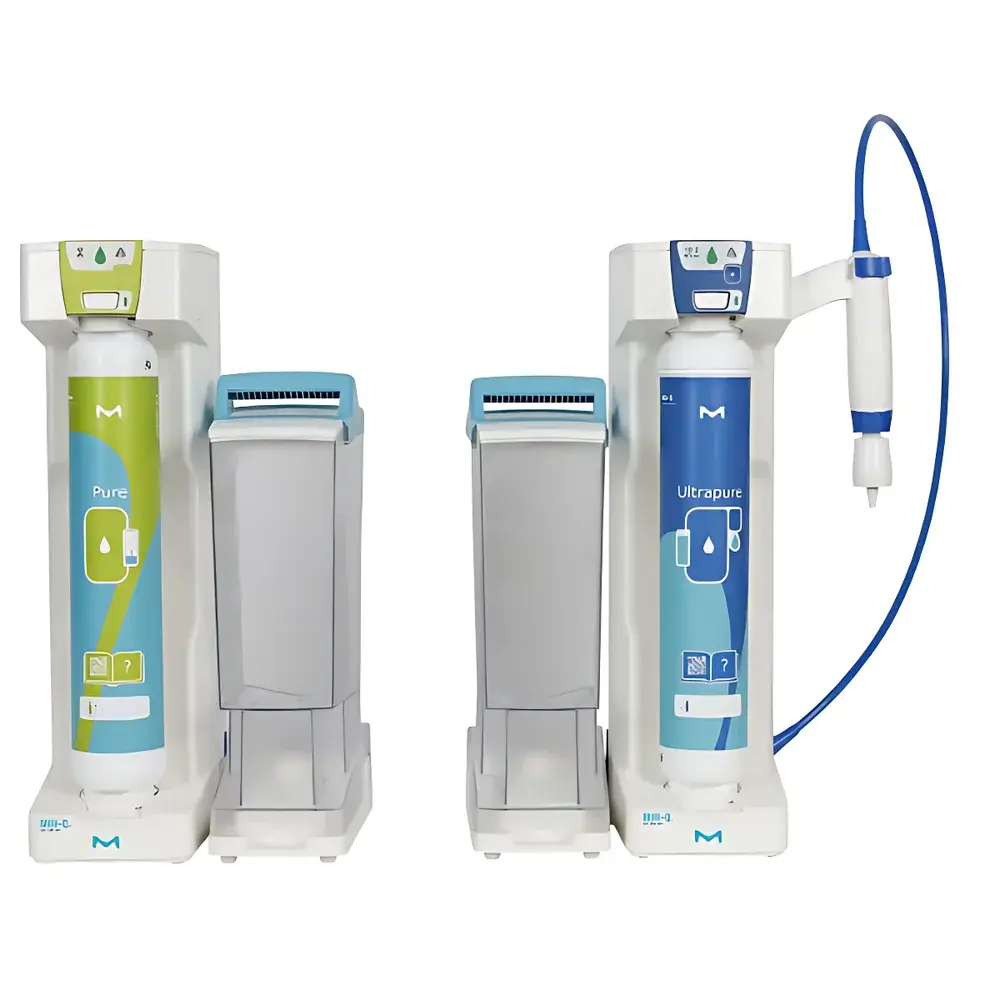
Milli-Q® SQ2 Series Ultra Pure Water System
| Brand | Milli-Q |
|---|---|
| Origin | France |
| Manufacturer | Producer |
| Product Type | Imported |
| Model | Milli-Q® SQ2 Series Ultra Pure Water System |
| Pure Water Grade | Type I (ASTM D1193-20) |
| Resistivity | 18.2 MΩ·cm @ 25 °C |
| Total Organic Carbon (TOC) | <5 ppb |
| Microbial Count | <0.001 CFU/mL |
| Endotoxin Level | <0.001 EU/mL |
Overview
The Milli-Q® SQ2 Series Ultra Pure Water System is a benchtop, self-contained water purification platform engineered for precision, reliability, and operational simplicity in modern life science, analytical chemistry, and pharmaceutical laboratories. It integrates reverse osmosis (RO), electrodeionization (EDI)-free ion exchange, ultraviolet photo-oxidation, and terminal ultrafiltration into a single compact unit—delivering Type I ultrapure water (per ASTM D1193-20, ISO 3696:1987, and CLSI EP22-A) directly from tap water or pre-treated feed sources. Unlike centralized or wall-mounted systems, the SQ2 operates independently on any lab bench without plumbing requirements—making it ideal for satellite labs, cleanrooms, QC/QA stations, and mobile research setups. Its core architecture eliminates dependence on external booster pumps or dedicated water lines, while maintaining continuous recirculation through UV-C (254 nm) and dual-stage Quanta™ purification cartridges to ensure stable resistivity ≥18.2 MΩ·cm and TOC ≤5 ppb at point-of-use.
Key Features
- Compact footprint (22 × 27 cm)—occupies less space than an A4 sheet, enabling deployment on crowded benches or biosafety cabinets.
- High-capacity RO module delivering up to 42 L/h of purified water; refills the integrated Switch™ reservoir in under 6 minutes.
- Automatic RO membrane flush cycles before tank filling and during idle periods—minimizing biofilm formation and preserving long-term membrane integrity.
- SQPAK™ Quanta purification cartridges featuring IQo™ ion-exchange resin for sub-ppt ionic removal and SQPAK™ TOC Quanta cartridges with catalytic activated carbon for trace organic adsorption.
- Integrated UV photo-oxidation (185/254 nm dual-lamp configuration) combined with continuous recirculation loop ensures consistent TOC reduction and microbial control.
- Modular “Twist & Lock” cartridge system enables tool-free replacement of all consumables—including pre-filters, RO membranes, and terminal filters—in under 60 seconds.
- Color-coded components (cartridges, tubing, UI icons) support intuitive installation, maintenance, and operator training—reducing procedural errors and downtime.
- Robust mechanical design validated via robotic endurance testing simulating 7 years of daily use—including 100,000+ reservoir insertions and handheld dispensing actuations.
Sample Compatibility & Compliance
The Milli-Q® SQ2 meets stringent regulatory and methodological requirements for critical applications across regulated environments. Its ultrapure water output complies with USP , EP 2.2.44, JP 17, and ISO 14644-1 Class 5 cleanroom standards when used with appropriate terminal filtration (e.g., SQPAK™ Bio filter). The system supports GLP/GMP workflows through optional audit-trail-enabled software modules compliant with FDA 21 CFR Part 11. All wetted materials—including fluid paths, tanks, and filters—are USP Class VI-certified and leachate-tested per ISO 10993-12. Pre-treatment performance achieves >96% ion rejection and >99% removal of colloids, particulates, and organic precursors—ensuring stable feed quality for downstream purification stages.
Software & Data Management
While the base SQ2 model operates via tactile interface and LED status indicators, optional connectivity kits enable integration with LabManager™ cloud-based monitoring platforms. These modules log real-time parameters—including resistivity, TOC, UV intensity, flow rate, and cartridge lifetime—and generate exportable CSV reports for internal QA audits. Firmware updates are delivered over-the-air (OTA), ensuring ongoing compliance with evolving data integrity standards. For fully paperless labs, the system supports electronic signature capture and user-level access controls aligned with ALCOA+ principles.
Applications
- HPLC, UHPLC, and LC-MS mobile phase preparation requiring low-TOC, low-metal eluents.
- Cell culture media formulation where endotoxin and nuclease contamination must remain below detection limits.
- Atomic absorption spectroscopy (AAS), ICP-OES, and ICP-MS calibration standard dilution.
- Molecular biology workflows including PCR, qRT-PCR, NGS library prep, and CRISPR reagent preparation.
- Pharmaceutical stability testing and dissolution media preparation per USP .
- Educational labs needing robust, low-maintenance ultrapure water access without infrastructure modifications.
FAQ
Does the SQ2 require connection to municipal water supply?
No—it accepts feed water from pressurized sources (e.g., building mains) or non-pressurized containers via optional gravity-feed kit. An integrated booster pump ensures consistent RO performance regardless of inlet pressure fluctuations.
Can multiple dispensing points be added to one SQ2 unit?
Yes—via modular expansion kits supporting up to three independent dispensing arms connected to a single purification core, eliminating need for duplicate systems.
What is the expected service life of the UV lamp?
The dual-wavelength UV assembly is rated for ≥12,000 hours of continuous operation and does not require routine replacement under normal usage conditions.
Is the system compatible with environmental sustainability goals?
Yes—the SQ2 reduces tap water consumption by 60% via optimized RO recovery circuitry, uses 100% recycled cardboard packaging with PE cushioning containing 50% post-consumer content, and features modular design enabling component-level repair and extended lifecycle beyond 10 years.
How is microbial contamination controlled in the distribution loop?
Continuous recirculation passes water through a 254 nm UV chamber and terminal ultrafilter (0.22 µm pore size), achieving ≥6-log reduction of viable microorganisms; optional SQPAK™ Bio filter adds 0.1 µm ultrafiltration plus endotoxin/nuclease retention.
Related Products



