
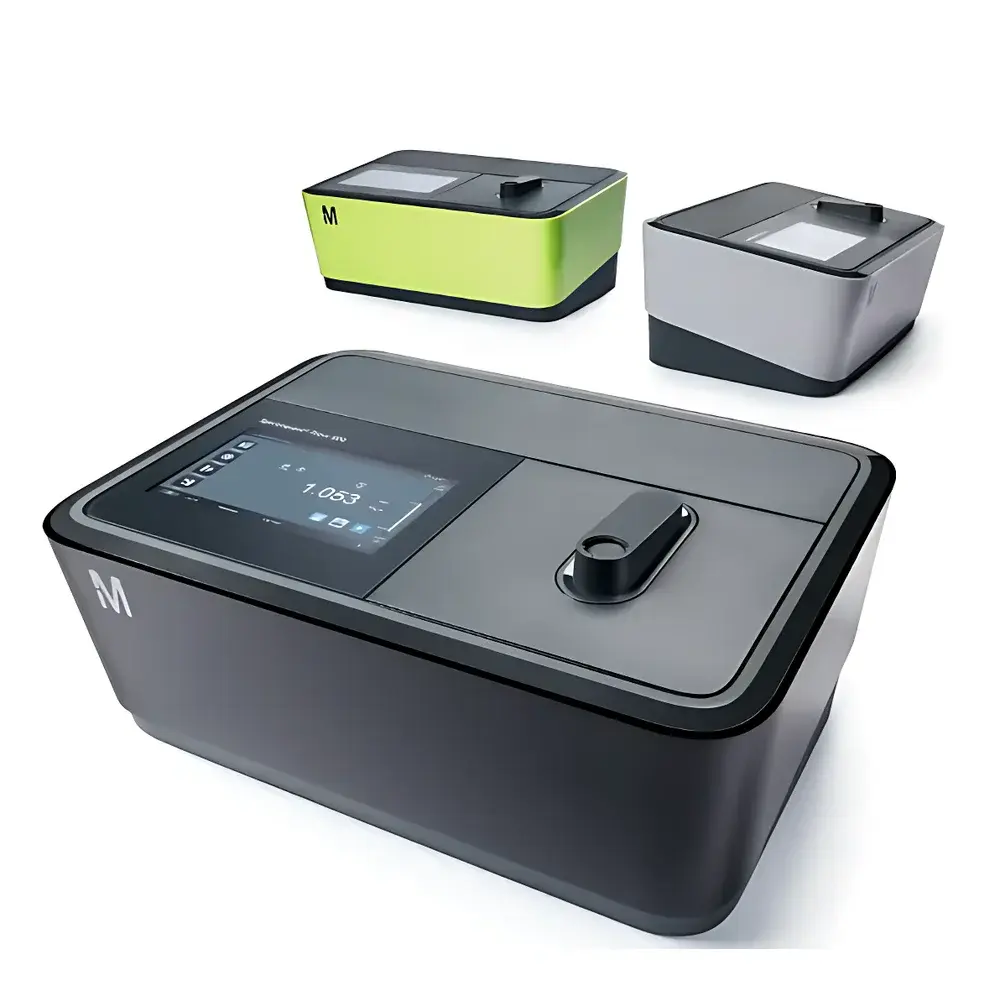
Merck Spectroquant® Prove100/300/600 Laboratory Multi-Parameter Water Quality Analyzer
| Brand | Supelco |
|---|---|
| Origin | Germany |
| Model | Prove100 / Prove300 / Prove600 |
| Instrument Type | Laboratory Water Quality Analyzer |
| Detection Parameters | COD, Ammonia-N, Total Phosphorus, Total Nitrogen |
| Wavelength Range | Prove100: 320–1100 nm |
| Prove300 & Prove600 | 190–1100 nm |
| Light Source | Prove100: Tungsten Halogen Lamp |
| Prove300 & Prove600 | Xenon Flash Lamp |
| Spectral Bandwidth | Prove100 & Prove300: 4 nm |
| Prove600 | 1.8 nm |
| Absorbance Range | ±3.0 Abs |
| Absorbance Resolution | 0.001 Abs |
| Wavelength Accuracy | ±1 nm |
| Stray Light | ≤0.1% T at 340 nm (all models) |
| Sample Holders | 16-mm round cuvettes |
| Built-in Methods | Pre-programmed Spectroquant® test protocols + 99 user-defined methods + 20 wavelength-scan/dynamic methods |
| Compliance | EN 61010-1, IEC 61010-1, EN IEC 61326-1, 2004/108/EC |
| IP Rating | IP31 |
| Operating Temperature | 10–35 °C |
| Dimensions | 416 × 276 × 237 mm |
| Weight | 6.8 kg |
Overview
The Merck Spectroquant® Prove100/300/600 Laboratory Multi-Parameter Water Quality Analyzer is a modular family of double-beam spectrophotometers engineered for precision, traceability, and regulatory compliance in environmental and process water laboratories. Based on UV-Vis absorption spectroscopy—specifically dual-beam reference-compensated photometry—the Prove series quantifies analytes via colorimetric reactions using certified Spectroquant® reagent kits. Each model supports standardized EPA, ISO, DIN, and APHA methods for critical parameters including chemical oxygen demand (COD), ammonia nitrogen (NH₃-N), total phosphorus (TP), and total nitrogen (TN). The Prove100 operates in the visible range (320–1100 nm) with a tungsten halogen source, ideal for routine wastewater and drinking water screening. The Prove300 extends into the deep UV (190–1100 nm) using a pulsed xenon lamp, enabling detection of nitrate, nitrite, and low-concentration organics per USP and ISO 15705. The Prove600 integrates a high-resolution Czerny-Turner monochromator with 1.8 nm spectral bandwidth and 100-mm pathlength capability, delivering sub-ppb sensitivity for silica in boiler feedwater or bromate in bottled water—applications requiring adherence to WHO guidelines and EU Directive 2020/2184.
Key Features
- Dual-beam optical architecture with real-time reference compensation ensures high reproducibility across variable ambient lighting conditions—enabled by patented open-lid measurement technology (IP31-rated optical chamber).
- Live QR-code recognition system automatically imports lot-specific calibration data, expiry dates, and traceable CRM metadata from every Spectroquant® pre-filled vial or bulk reagent pack.
- Automated cuvette recognition detects pathlength (10, 20, 50, or 100 mm) and geometry (round or square), eliminating manual input errors and supporting GLP-compliant audit trails.
- Three-tiered platform scalability: Prove100 (visible-only, cost-optimized), Prove300 (UV-Vis, field-deployable robustness), Prove600 (high-resolution, trace-level quantification).
- AQA (Analytical Quality Assurance) framework supports two-tier verification: AQA1 validates instrument photometric stability using PhotoCheck standards; AQA2 validates full method performance with CombiCheck or NIST-traceable CRMs.
- Comprehensive interference monitoring: built-in algorithmic assessment of spectral overlap, turbidity correction, and matrix effects—documented per sample in raw data logs.
Sample Compatibility & Compliance
The Prove series accommodates standard 16-mm round vials and rectangular cuvettes (10–100 mm pathlength), compatible with all Spectroquant® test kits—including those validated under ISO 6060 (COD), ISO 7150-1 (ammonia), ISO 6878 (phosphate), and ISO 11905-1 (total nitrogen). All models meet EN 61010-1 safety requirements for laboratory equipment and comply with electromagnetic compatibility standards EN IEC 61326-1. Data integrity aligns with FDA 21 CFR Part 11 principles through secure user authentication, electronic signatures, and immutable audit logs for concentration, absorbance, transmittance, kinetic, and full-spectrum scan results. Firmware and method updates are distributed via Merck’s validated download portal, maintaining version-controlled traceability for ISO/IEC 17025-accredited labs.
Software & Data Management
Embedded firmware supports 28 interface languages and provides native implementation of ASTM D1253 (residual chlorine), APHA Standard Methods 4500-NO₂⁻-B (nitrite), and ICUMSA GS5/8-13 (sugar colorimetry). The system stores up to 2,000 quantitative results plus 20 full-spectrum or kinetic datasets locally, with export options to CSV, PDF, or LIMS via USB-A, USB-B, or Ethernet. Ad hoc testing modes permit immediate absorbance/transmittance acquisition without method selection—critical during method development or troubleshooting. All spectral scans (0.1/1/5 nm step resolution) complete in under 7 minutes across 190–1100 nm, with wavelength accuracy maintained at ±1 nm and repeatability within ±0.2 nm.
Applications
The Prove platform serves municipal wastewater treatment plants (COD/TN compliance per EU Urban Wastewater Directive 91/271/EEC), pharmaceutical manufacturing (PW/DI water QC per USP ), beverage production (bromate monitoring per FDA 21 CFR 165.110), and power generation (silica in boiler feedwater per ASTM D4581). Its trace-level detection capability enables verification of advanced oxidation process (AOP) efficiency and disinfection by-product formation—supporting research-grade investigations under ISO 5667-3 and EN ISO 5667-16.
FAQ
Does the Prove600 support 100-mm pathlength cuvettes for ultra-low-concentration analysis?
Yes—its optomechanical design accommodates 100-mm square cuvettes, enabling detection limits down to 0.5 µg/L for silica and 0.1 µg/L for bromate when paired with corresponding Spectroquant® kits.
Can users import custom calibration curves not included in the factory library?
Yes—up to 99 user-defined methods can be created, validated, and password-protected, with full documentation of slope, intercept, R², and uncertainty propagation.
Is remote software update functionality validated for GxP environments?
Firmware and method updates are digitally signed and version-logged; release notes include change control documentation compliant with Annex 11 and ALCOA+ data integrity principles.
How does the open-lid measurement feature maintain photometric accuracy?
Patented optical shielding and dynamic background subtraction compensate for ambient light intrusion in real time—verified per ISO 17025 clause 5.9.1 for measurement uncertainty estimation.
What regulatory frameworks does the AQA workflow satisfy?
AQA1 and AQA2 procedures fulfill ISO/IEC 17025:2017 requirements for equipment verification (clause 6.4.10) and method validation (clause 7.2.2), as well as EPA Method 300.1 QA/QC criteria.
Related Products







