
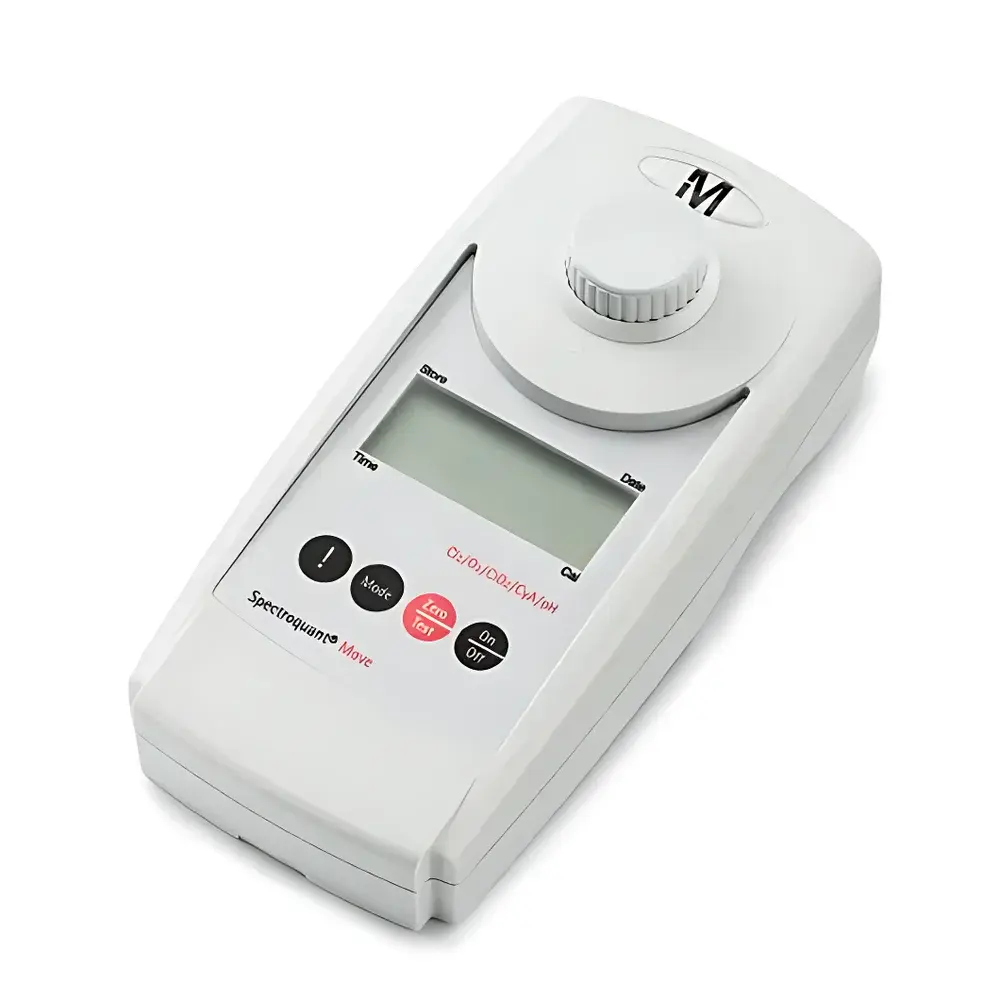
Supelco® Move DC Portable Multi-Parameter Water Quality Analyzer for Free Chlorine, Total Chlorine, Chlorine Dioxide, Ozone, Cyanuric Acid, and pH
| Brand | Supelco |
|---|---|
| Origin | Germany |
| Model | Move DC |
| Instrument Type | Portable |
| Measurement Principle | DPD-based Spectrophotometry |
| Measured Parameters | Free Chlorine, Total Chlorine, Chlorine Dioxide, Ozone, Cyanuric Acid, pH |
| Range | 0.02–4.5 mg/L (for chlorine species and ozone) |
| Accuracy | ±3% of reading |
| Repeatability | ±0.02 mg/L |
| Absorbance Resolution | 0.01 A |
| LOD | 0.02 mg/L |
| Optical System | LED light source, interference filter, photodiode detector, transparent cuvette chamber |
| Wavelength | 530 nm |
| Display | LCD |
| Power | 4 × AAA batteries (up to 17 h operation or ~5,000 measurements) |
| Weight | 260 g |
| Dimensions (instrument) | 155 × 75 × 35 mm |
| Enclosure Rating | IP68 |
| Memory Capacity | 16 measurement records |
| Data Transfer | Optional Spectroquant® IRiM infrared interface |
Overview
The Supelco® Move DC Portable Multi-Parameter Water Quality Analyzer is an engineered solution for on-site quantification of critical disinfectant residuals and supporting water quality parameters in drinking water, swimming pools, cooling towers, wastewater effluents, and distribution systems. It employs the standardized N,N-diethyl-p-phenylenediamine (DPD) spectrophotometric method—recognized by ISO 7393-2, ASTM D1253, and EPA Method 334.0—for reliable determination of free chlorine, total chlorine, chlorine dioxide, and ozone. Simultaneous pH and cyanuric acid measurements further support comprehensive disinfection process control, particularly in chlorinated pool and spa management where stabilizer concentration directly impacts chlorine efficacy and dosing strategy.
Key Features
- True multi-parameter capability: single-device analysis of six regulated parameters without hardware reconfiguration or sensor swapping
- IP68-rated enclosure ensures full dust ingress protection and submersion resistance up to 1.5 m for 30 minutes—validated for field use in rain, splashing, or emergency response scenarios
- Dedicated optical path optimized at 530 nm with high-stability LED illumination and precision interference filtering, minimizing interferences from turbidity or colored organics
- Integrated absorbance measurement range of 0.00–3.00 A with 0.01 A resolution, calibrated against traceable NIST-traceable DPD standards
- Onboard AQA (Analytical Quality Assurance) functionality: preloaded verification routines using certified DPD standard solutions to confirm instrument performance prior to each analytical session
- Low-power architecture enabling >5,000 measurements per battery set (4 × AAA), eliminating dependency on external power sources during extended field campaigns
Sample Compatibility & Compliance
The Move DC accepts standard 10-mm square glass or plastic cuvettes compatible with DPD reagent kits (e.g., Supelco® Spectroquant® test kits 1.14542, 1.14543, 1.14544). Sample volume requirement is 10 mL per test. All assays comply with international regulatory frameworks including ISO 7393-2 (chlorine), ISO 10957 (chlorine dioxide), ISO 15490 (ozone), and APHA Standard Methods 4500-Cl G and 4500-O3 G. The device supports GLP-compliant documentation through optional IRiM data transfer, generating time-stamped, operator-identified records suitable for audit trails under FDA 21 CFR Part 11 when paired with validated software workflows.
Software & Data Management
Data storage is local to the instrument (16 measurement sets with parameter ID, date/time stamp, and absorbance value). For expanded traceability, the optional Spectroquant® IRiM infrared interface enables wireless transmission to Windows-based PCs running Spectroquant® Evaluation Software. This platform supports automated calibration curve generation, batch reporting, PDF export, and integration into LIMS environments via CSV or XML output. Audit trail features include user login tracking, method version logging, and immutable record timestamps—essential for laboratories operating under ISO/IEC 17025 or drinking water utility QA/QC programs.
Applications
- Routine monitoring of residual disinfectants across municipal water treatment plants and distribution networks
- Swimming pool and recreational water facility compliance testing per CDC Model Aquatic Health Code (MAHC) and EN 15288-1
- Emergency response teams verifying disinfectant levels post-natural disaster or infrastructure failure
- Industrial cooling water system operators managing biocide dosing and corrosion control
- Environmental consultants conducting third-party validation of point-of-use treatment devices
- Educational laboratories teaching standard methods for oxidant analysis in environmental chemistry curricula
FAQ
Is the Move DC compliant with US EPA drinking water regulations?
Yes—the DPD methodology implemented aligns with EPA Methods 334.0 (free/total chlorine) and 375.4 (chlorine dioxide), and supports compliance with the Surface Water Treatment Rule (SWTR) and Long Term 2 Enhanced Surface Water Treatment Rule (LT2ESWTR) monitoring requirements.
Can the instrument be recalibrated in the field?
No field recalibration is required; however, daily verification using supplied AQA standards is mandatory per ISO 8466-1 and internal QA protocols. Full factory recalibration is performed by authorized Supelco service centers.
Does it support measurement of combined chlorine independently?
Combined chlorine is derived mathematically as the difference between total chlorine and free chlorine values—both measured sequentially within the same sample using standardized DPD reagent addition sequences.
What reagents are required for cyanuric acid analysis?
The cyanuric acid assay uses a separate melamine-based colorimetric method (Spectroquant® test kit 1.14546); no DPD reagents are involved, and the instrument automatically switches wavelength and calibration curves upon parameter selection.
Is Bluetooth connectivity available?
No—data transfer is exclusively via the proprietary Spectroquant® IRiM infrared interface to ensure electromagnetic compatibility in industrial environments and prevent unauthorized remote access to measurement data.







