
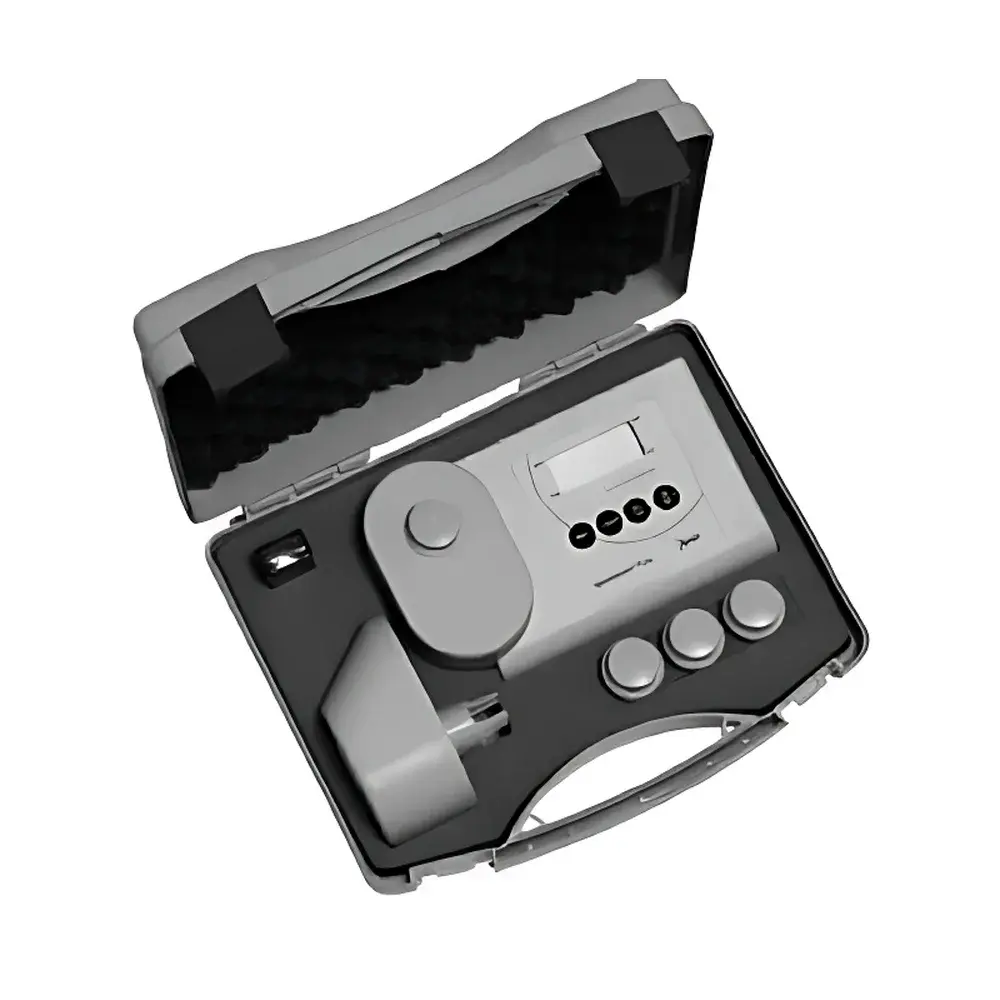
Merck Spectroquant® Picco Cl₂/O₃/pH/ClO₂/CyA Portable Photometer
| Brand | Merck |
|---|---|
| Origin | Germany |
| Manufacturer Type | Original Equipment Manufacturer (OEM) |
| Product Category | Imported Instrument |
| Model | Picco Cl₂/O₃/pH/ClO₂/CyA |
| Instrument Type | Laboratory & Field-Portable Water Quality Analyzer |
| Optical System | Wavelength-Specific LED Light Source with Interference Filter |
| Measurement Wavelength | 528 nm |
| Measurement Time | 3–4 seconds per test |
| Power Supply | 9-V Alkaline Battery (≈600 measurements per battery) |
| Auto Power-Off | Activated after ≈5 minutes of inactivity |
| Operating Temperature | 5–40 °C |
| Operating Humidity | 30–90 % RH (non-condensing) |
| Compliance | CE-marked per DIN EN 55022, EN 61000-4-2, EN 61000-4-8, EN 50082-2, EN 50081-1, DIN V ENV 50140, EN 50204 |
Overview
The Merck Spectroquant® Picco Cl₂/O₃/pH/ClO₂/CyA is a compact, single-parameter photometer engineered for rapid, reliable quantification of critical disinfectant and stabilizer parameters in water matrices. Based on fixed-wavelength absorbance photometry at 528 nm, the instrument implements pre-calibrated, reagent-based colorimetric chemistry—fully aligned with Merck’s validated Spectroquant® test kits. Unlike multi-parameter platforms requiring complex calibration or software configuration, the Picco series operates on a dedicated, parameter-specific optical path optimized for each analyte: free chlorine (Cl₂), total chlorine, ozone (O₃), pH (via indicator-based color shift), chlorine dioxide (ClO₂), and cyanuric acid (CyA). Its design follows the principle of method standardization—each measurement is traceable to Merck’s certified reference materials and conforms to internationally recognized procedures including ISO 7393-2 (chlorine), ISO 15490 (ozone), and ASTM D1253 (chlorine residual). The device functions as a standalone field-deployable photometer, eliminating dependency on external PCs or network infrastructure while maintaining analytical integrity across laboratory, municipal, and recreational water settings.
Key Features
- Pre-programmed, single-analyte firmware—no user calibration required; each unit is factory-configured for one specific parameter (e.g., Picco Cl₂, Picco O₃)
- Dedicated 528 nm LED light source paired with precision interference filter ensures high spectral selectivity and minimizes interferences from turbidity or colored background
- Integrated 16 mm or 24 mm round cell adapter (model-dependent) supports standardized Spectroquant® cuvettes; all accessories—including battery, cuvettes, and protective carry case—are included in one portable kit
- Battery-powered operation (9 V alkaline) enables >600 consecutive measurements without recharging; auto-shutdown after 5 min idle conserves power and extends battery life
- Robust housing rated for ambient conditions between 5–40 °C and 30–90 % RH (non-condensing); CE-compliant per electromagnetic compatibility (EMC) and safety directives applicable to laboratory instrumentation
Sample Compatibility & Compliance
The Picco photometer is validated for use with Merck’s proprietary Spectroquant® test kits, which provide lyophilized or stabilized reagents in sealed vials. These kits are formulated for defined sample volumes (typically 10 mL), matrix tolerances (e.g., up to 500 mg/L chloride for chlorine assays), and reaction kinetics compatible with the instrument’s fixed incubation timing. Applications span potable water distribution systems, swimming pool and spa management, cooling tower monitoring, food processing rinse water verification, and wastewater disinfection control. All test methods meet regulatory expectations under national drinking water guidelines (e.g., U.S. EPA Method 334.0 equivalents, German TrinkwV Annex 3), and support GLP-aligned documentation when paired with Merck’s optional LIMS-integrated reporting tools. While the Picco itself does not generate electronic audit trails, its deterministic measurement logic and fixed calibration curves ensure repeatability required for routine QC/QA workflows.
Software & Data Management
The Picco operates without embedded software or connectivity interfaces—its firmware is read-only and parameter-specific, ensuring immunity to version drift or configuration errors. Results are displayed numerically on a high-contrast LCD screen with unit-specific scaling (e.g., mg/L Cl₂, pH units, ppm O₃). No data logging, USB export, or Bluetooth capability is included; users record results manually or transcribe them into external LIMS or spreadsheet environments. This architecture aligns with ISO/IEC 17025 Clause 5.9.1 requirements for equipment that “does not require software validation” due to absence of programmable logic affecting result generation. For laboratories requiring 21 CFR Part 11 compliance, Merck recommends pairing Picco-generated data with controlled procedural documentation rather than attempting digital integration.
Applications
- Swimming pool and spa operators verifying daily residual disinfectant levels (free/total chlorine, O₃, ClO₂) and cyanuric acid stabilization thresholds (30–50 ppm range)
- Municipal water utilities performing rapid field checks during distribution system maintenance or emergency response
- Food & beverage facilities validating sanitizer concentrations in CIP rinse cycles per FDA Food Code Appendix D
- Environmental laboratories conducting routine screening prior to confirmatory analysis by HPLC or amperometric titration
- Educational institutions teaching fundamental principles of colorimetric analysis and water treatment chemistry
FAQ
Is the Picco Cl₂/O₃/pH/ClO₂/CyA capable of measuring multiple parameters simultaneously?
No. Each Picco unit is configured for one specific parameter only. Users must select the appropriate model (e.g., Picco Cl₂ or Picco CyA) based on their primary analytical need.
Can third-party reagents be used with this photometer?
Merck does not validate or guarantee performance with non-Spectroquant® reagents. Deviations in reagent composition, reaction stoichiometry, or cuvette geometry may compromise accuracy and traceability.
Does the instrument require annual recalibration?
No. As a fixed-curve photometer, it relies on factory-established calibration stored in firmware. Verification via Merck-certified control standards (e.g., Art. No. 114546) is recommended before each analytical session.
What is the typical detection range for cyanuric acid using the Picco CyA model?
The validated linear range is 2–200 mg/L CyA, per Merck Spectroquant® Test Kit 114545 instructions, using the 10 mL sample volume protocol.
Is the Picco suitable for ISO 17025-accredited testing?
Yes—as a Class II photometer under ISO/IEC 17025:2017 Clause 6.4.10, provided method validation, uncertainty estimation, and operator competence are documented per accredited scope requirements.
Related Products







