
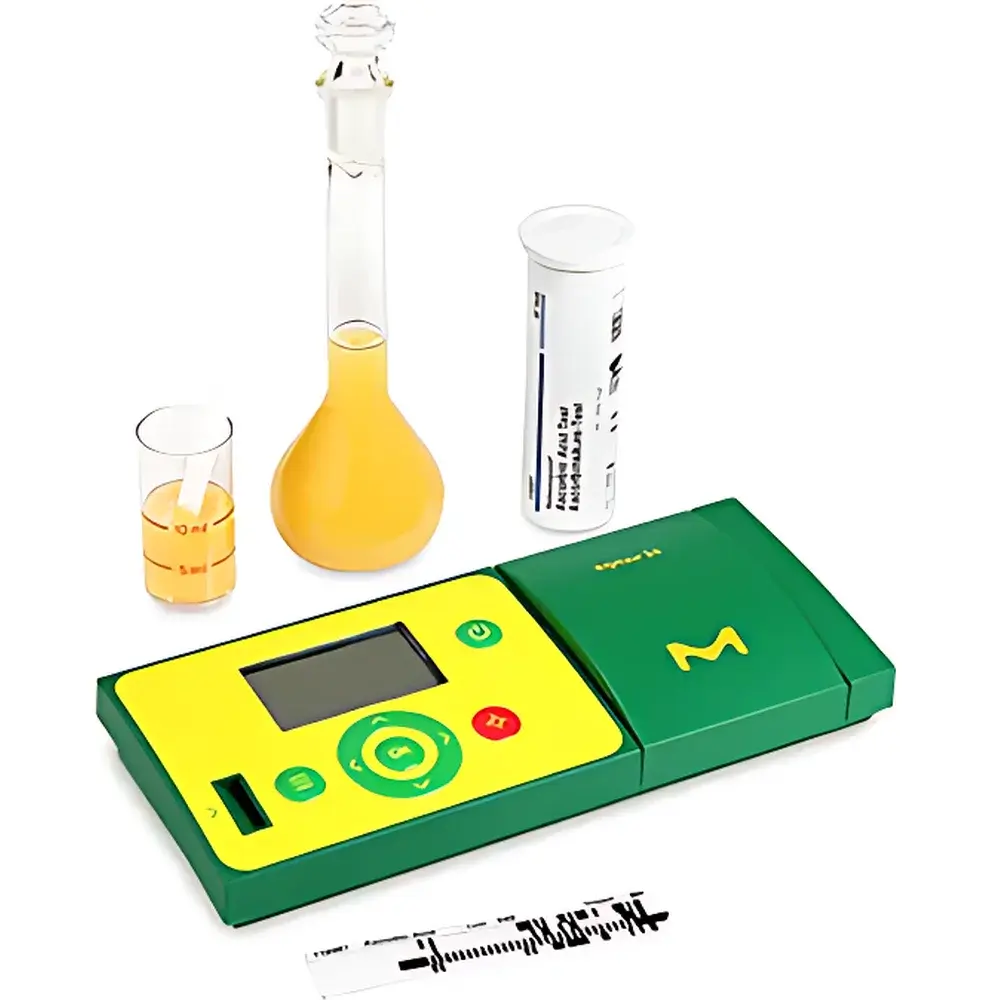
Merck Reflectoquant® RQflex® 20 Reflectometer with Barcoded Test Strips
| Origin | Germany |
|---|---|
| Supplier Type | Authorized Distributor |
| Origin Category | Imported Instrument |
| Model | RQflex® 20 |
| Price | Upon Request |
Overview
The Merck Reflectoquant® RQflex® 20 Reflectometer is a portable, microprocessor-controlled photometric instrument engineered for rapid, quantitative analysis of liquid samples using standardized, barcoded test strips. It operates on the principle of reflectance photometry: incident light from dual-wavelength LEDs (green and red) is directed onto the reagent-impregnated zone of a test strip; the intensity of reflected light—modulated by the chromogenic reaction—is measured and converted into concentration values via pre-programmed, batch-specific calibration curves stored in the strip’s embedded barcode. This eliminates manual calibration and ensures traceable, reproducible results across user sites and time. Designed for field-deployable use in resource-constrained or non-laboratory environments, the RQflex® 20 delivers laboratory-grade reliability without requiring optical benches, temperature-controlled rooms, or trained analysts—making it ideal for real-time process monitoring in agriculture, food & beverage production, environmental water testing, and disinfectant residue verification.
Key Features
- Intuitive, multilingual graphical interface with step-by-step visual guidance—supports Simplified Chinese, English, German, French, Spanish, Portuguese, and Japanese
- Barcode-driven calibration: each RQ test strip package includes a unique batch-specific barcode enabling automatic loading of calibration data, slope/intercept parameters, and expiry information
- High-precision dual-beam LED optics (4 × LEDs, green/red) with 0.1% relative remission resolution over 4–90% remission range
- Onboard analytical quality assurance (AQA): integrated RQcheck verification strips and Total System Monitoring (TSM) protocols validate instrument performance prior to critical measurements
- Configurable countdown timer with audible alert—synchronizes with strip incubation periods (e.g., 30 s, 60 s, 120 s) to minimize timing-related variability
- Robust, handheld form factor (184 × 79 × 30 mm; 253 g with batteries); operates on four AAA alkaline cells with >1,000 measurements per set
- Internal memory stores up to 50 test methods, 200 measurement records, and 50 RQcheck validation logs—with no external PC required for routine operation
Sample Compatibility & Compliance
The RQflex® 20 is validated for use with over 20 Merck Reflectoquant® test strip assays—including ammonia nitrogen, free chlorine, nitrate, nitrite, pH, total hardness, glucose, HMF (hydroxymethylfurfural), total sugar, peracetic acid, hydrogen peroxide, ascorbic acid, iron, calcium, magnesium, potassium, sulfite, formaldehyde, lactic acid, malic acid, and phosphate. Each assay complies with relevant international standard methods where applicable (e.g., ISO 7890-3 for nitrate/nitrite, ASTM D1253 for residual chlorine, EN ISO 15512 for peracetic acid). The system supports GLP/GMP-aligned workflows through audit-trail-capable AQA functions, including timestamped RQcheck results and instrument baseline verification logs. While not FDA 21 CFR Part 11-compliant out-of-the-box, raw data export (via optional IR interface or manual transcription) enables integration into validated LIMS environments under client-defined SOPs.
Software & Data Management
The RQflex® 20 operates autonomously without proprietary software installation. All method parameters, calibration coefficients, and result calculations are embedded in firmware and strip barcodes. Measurement data—including sample ID, date/time stamp, operator ID (manually entered), method name, and numeric result with unit—are stored locally and viewable on the 256 × 160 dot reflective LCD. Results can be exported manually or via optional infrared (IR) data transfer to PCs running Merck’s free RQ Manager software (Windows-compatible), which enables report generation, trend charting, and CSV export for statistical process control (SPC). Firmware updates are delivered via SD card or IR link, ensuring long-term method consistency and regulatory adaptability.
Applications
- Agriculture & Fertilizer Management: Field quantification of soil extract nitrate/nitrite and phosphate to prevent over-fertilization and mitigate eutrophication risks—aligned with EU Nitrates Directive monitoring requirements.
- Food & Beverage Quality Control: Rapid HMF testing in honey and fruit juices (EN 12142); total sugar screening for low-/zero-sugar beverage verification; peracetic acid residue checks post-rinse in PET bottle sterilization lines.
- Water & Wastewater Monitoring: On-site assessment of drinking water residual chlorine, ammonia nitrogen in wastewater influent, and total hardness in boiler feedwater—supporting ISO 9001 and ISO 14001 operational controls.
- Disinfection Process Validation: Dual-range peracetic acid testing (0.1–1500 mg/L) for cold sterilization of packaging materials, meeting EMA and USP environmental monitoring expectations.
FAQ
How does the barcode calibration ensure accuracy across different test strip batches?
Each RQ test strip batch undergoes factory calibration against reference standards traceable to NIST and BAM. The barcode encodes unique slope, intercept, and tolerance limits—automatically loaded at measurement initiation to correct for inter-batch reagent variability.
Can the RQflex® 20 be used for regulatory submissions?
While the instrument itself is not certified for regulated GxP submission, its AQA functionality, traceable calibration, and data integrity features support compliance with ISO/IEC 17025 and internal QA protocols when deployed within documented SOPs.
What is the typical measurement uncertainty for key parameters like free chlorine or nitrate?
At mid-range concentrations, typical repeatability is ±10% relative standard deviation (RSD), consistent with ISO 8466-1 guidelines for semi-quantitative field methods—validated per Merck’s published technical notes for each assay.
Is preventive maintenance required?
No scheduled maintenance is needed. Users perform daily visual inspection of optical path and periodic RQcheck verification (recommended before each shift or after 20 measurements); lens cleaning with lint-free tissue is sufficient.



