
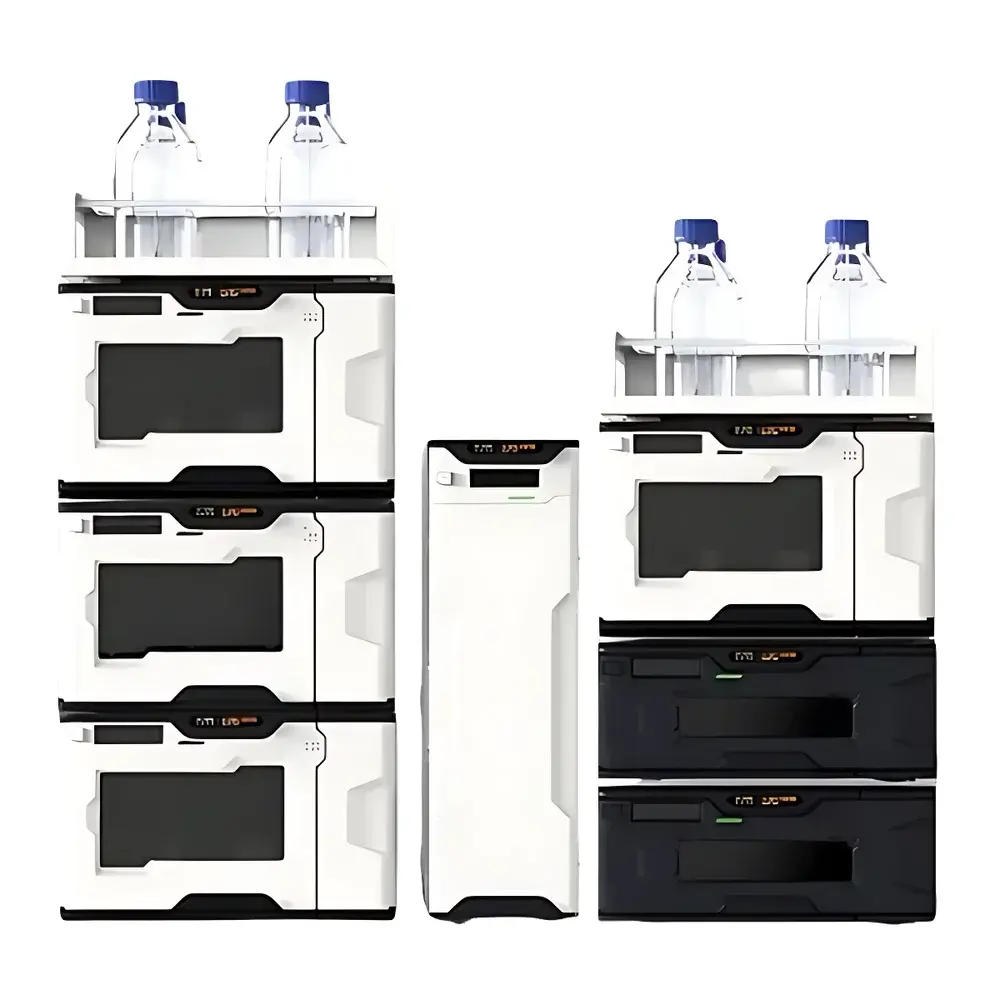
Two-Dimensional High-Performance Liquid Chromatograph (2D-HPLC) System by Wooking
| Brand | Wooking |
|---|---|
| Model | 2D-HPLC |
| Type | Multidimensional Liquid Chromatograph |
| Origin | Shandong, China |
| Supplier Type | Authorized Distributor |
| Regional Classification | Domestically Manufactured Instrument |
| Pricing | Available Upon Request |
Overview
The Wooking 2D-HPLC system is a multidimensional liquid chromatography platform engineered for enhanced selectivity, peak capacity, and matrix tolerance in complex sample analysis. Unlike conventional one-dimensional HPLC, this system employs two independent chromatographic separation dimensions—typically coupling a strong-cation-exchange (SCX) or trap column in the first dimension with a reversed-phase (C18) analytical column in the second—connected via a high-pressure switching valve and integrated loop-based transfer mechanism. This architecture enables comprehensive orthogonality between separation mechanisms, significantly improving resolution of co-eluting analytes in highly heterogeneous matrices such as infant formula, biological fluids, food extracts, and environmental samples. The system operates under gradient elution control in both dimensions, with precise synchronization of flow rates (0.1–5.0 mL/min), injection volumes (1–100 µL), and column temperature (ambient to 80 °C), ensuring reproducible retention time alignment and robust method transfer.
Key Features
- Modular dual-pump configuration: Two independently programmable quaternary solvent delivery systems support gradient formation in both dimensions with pressure ratings up to 600 bar.
- Integrated online solid-phase extraction (SPE): A dedicated SPE cartridge interface allows automated sample cleanup, analyte enrichment, and matrix removal prior to second-dimension injection—critical for trace-level vitamin quantification in fortified dairy products.
- High-speed column switching: Electromechanical six-port, two-position valves enable sub-second transfer of heart-cut or comprehensive fractions from Dimension 1 to Dimension 2 with minimal band broadening.
- Low-dispersion flow path design: All fluidic pathways—including transfer lines, loops, and detector cells—are optimized for internal diameters ≤ 0.12 mm and minimized dwell volume (< 120 µL), preserving chromatographic integrity during multidimensional transfer.
- Universal detection compatibility: Designed for seamless integration with UV-Vis (190–800 nm), fluorescence (excitation/emission programmable), and mass spectrometry interfaces (ESI/APCI sources) without hardware modification.
- Robust architecture with GLP-compliant operation: Includes hardware-based event logging, audit trail-enabled software, and password-protected method locking for regulated environments.
Sample Compatibility & Compliance
The Wooking 2D-HPLC system demonstrates validated performance for quantitative analysis of fat-soluble vitamins (A, D₃, E) in infant formula—a matrix characterized by high lipid content, emulsifier interference, and low analyte concentrations (ng/g range). Sample preparation follows AOAC 2012.01 and ISO 11292 protocols, incorporating saponification, hexane extraction, and silica gel cleanup prior to online SPE–2D-HPLC injection. The system meets instrumental requirements outlined in USP , EP 2.2.46, and FDA Guidance for Industry on Analytical Procedures and Methods Validation for Drugs and Biologics. Data integrity conforms to 21 CFR Part 11 through electronic signatures, audit trails, and immutable raw data storage. All firmware and control logic are designed to support GMP/GLP laboratory workflows, including instrument qualification (IQ/OQ/PQ) documentation templates and calibration traceability to NIST-traceable standards.
Software & Data Management
Control and data processing are managed via Wooking ChromoLink™ v3.2, a Windows-based chromatography data system (CDS) compliant with ASTM E1947-22 and ISO/IEC 17025:2017 requirements. The software provides synchronized method programming across both dimensions, real-time contour plot generation for comprehensive 2D chromatograms, and automated peak tracking using retention time windows and spectral correlation algorithms. Raw data files (.wcd) are stored in vendor-neutral format with embedded metadata (instrument ID, operator, timestamp, sequence ID), supporting long-term archival and third-party reprocessing. Integrated report modules generate PDF/CSV outputs compliant with LIMS ingestion standards, including uncertainty estimation per EURACHEM/CITAC Guide, and automatic flagging of out-of-specification (OOS) results based on user-defined acceptance criteria.
Applications
- Quantitative determination of vitamins A, D₃, and E in infant formula and dietary supplements per AOAC Official Method 2012.01.
- Comprehensive profiling of polar and non-polar metabolites in serum and urine for clinical biomarker discovery.
- Residue analysis of multi-class pesticides in fruits and vegetables using orthogonal SCX–C18 separation.
- Characterization of monoclonal antibody charge variants and glycoforms in biopharmaceutical development.
- Impurity profiling of synthetic pharmaceutical intermediates with overlapping retention behavior in 1D-HPLC.
FAQ
What is the primary advantage of 2D-HPLC over conventional 1D-HPLC for infant formula analysis?
It resolves co-eluting interferences from milk fat globule membrane proteins and phospholipids that otherwise mask vitamin peaks in single-dimension runs—enabling accurate quantification without offline fractionation.
Does the system support method transfer to other HPLC platforms?
Yes; all methods are defined using platform-agnostic parameters (gradient time, flow rate, column dimensions, temperature), and ChromoLink™ exports method files in ANDI/NetCDF format for cross-vendor compatibility.
Is online SPE mandatory for vitamin analysis, or can it be bypassed?
Online SPE is optional but strongly recommended for infant formula due to its ability to remove >95% of triglycerides and cholesterol esters prior to second-dimension separation—reducing column fouling and extending C18 lifetime.
How is system suitability verified in regulated environments?
ChromoLink™ includes automated system suitability testing (SST) routines aligned with USP , calculating resolution, tailing factor, and %RSD for replicate injections—results are logged with digital signature and timestamp.
Can the system be integrated into an existing LIMS infrastructure?
Yes; it supports ASTM E1467-compliant HL7 and ASTM E1947-compliant XML data exchange protocols, enabling bidirectional communication with major LIMS vendors including LabVantage, Thermo Fisher SampleManager, and STARLIMS.





