
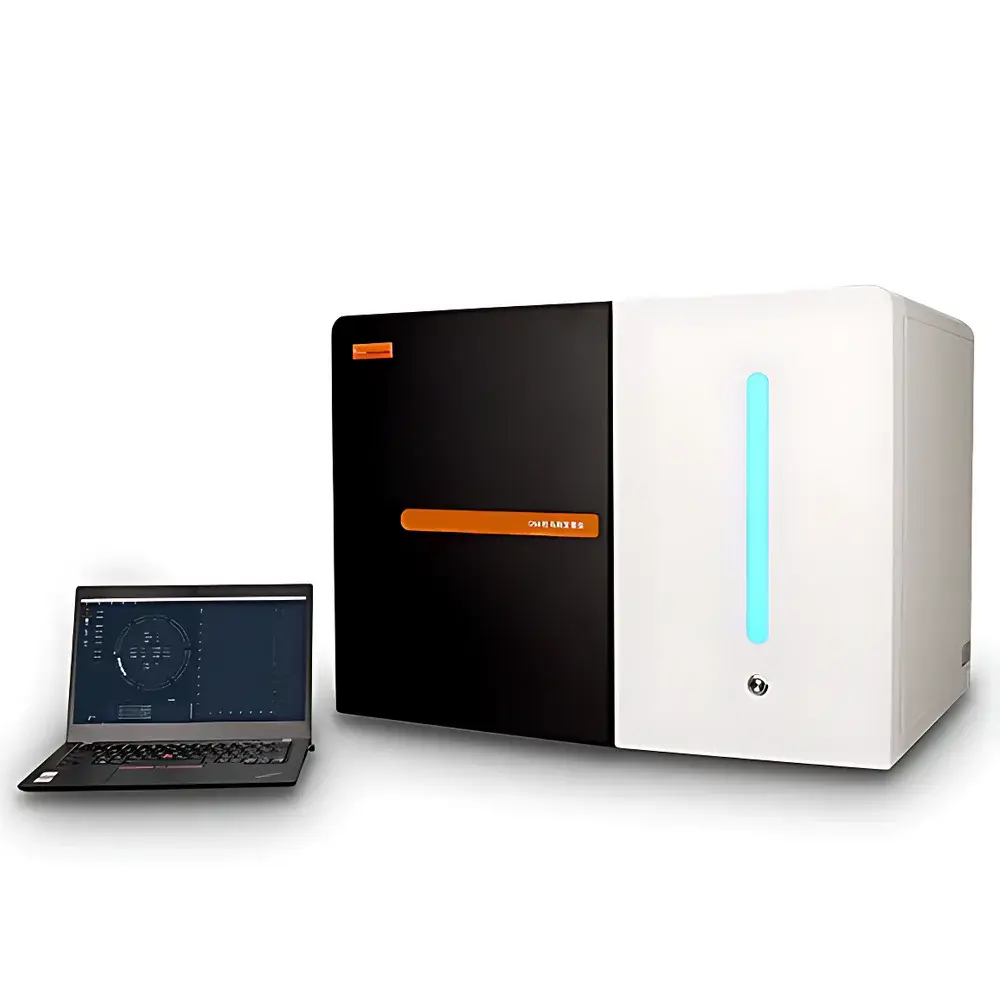
Hanon D50 Dumas Nitrogen Determinator
| Brand | Hanon |
|---|---|
| Origin | Shandong, China |
| Model | D50 |
| Principle | Dumas Combustion Method |
| Nitrogen Range | 0.1–500 mg |
| Analysis Time | 3–4 min per sample |
| Repeatability | ≤0.5% RSD (using 150 mg of 10% N standard) |
| Sample Mass | ≤1 g (solid) or ≤1 mL (liquid) |
| Recovery Rate | >99.5% |
| Power Consumption | 2000 W |
| Dimensions (L×W×H) | 735 mm × 560 mm × 560 mm |
| Detector | Thermal Conductivity Detector (TCD) |
| Combustion Temperature | Up to 1200 °C |
| Carrier Gas | CO₂ (99.999% purity) |
| Oxygen Supply | High-purity O₂ (99.999%) |
| Autosampler Capacity | 1 × 60 positions |
| Calibration | Linear or user-defined non-linear curve |
| Communication Interface | RS485 (internal), RS232/USB (external) |
| Operating Environment | 15–30 °C, ≤85% RH |
| Weight | 80 kg |
Overview
The Hanon D50 Dumas Nitrogen Determinator is a fully automated, high-throughput elemental analyzer engineered for precise and reliable quantification of total nitrogen in organic matrices using the standardized Dumas combustion method. Based on controlled high-temperature oxidative pyrolysis in pure oxygen, followed by catalytic reduction and thermal conductivity detection (TCD), the D50 delivers rapid, reagent-free nitrogen analysis without acid digestion or hazardous chemicals. Its dual-stage combustion system operates at up to 1200 °C, ensuring complete oxidation of refractory nitrogen compounds across diverse sample types—from cereals and feedstuffs to fertilizers and dairy products. The instrument complies with internationally recognized protocols including AOAC 992.15, ISO 14891, and ASTM D5133, and is validated against multiple Chinese national standards (e.g., GB 5009.5-2016, GB/T 31578-2015, NY/T 2007-2011), making it suitable for routine QC/QA in food, agricultural, environmental, and regulatory laboratories operating under GLP or GMP frameworks.
Key Features
- Dual-stage combustion architecture with independent primary and secondary oxidation zones, enabling complete mineralization of complex organic nitrogen species—even in high-fat or high-fiber samples.
- Triple-stage water removal system: integrated metal condenser (primary), followed by two sequential chemical desiccant traps—ensuring baseline stability and long-term TCD detector integrity.
- Two-stage gas pressure regulation within the pneumatic manifold, maintaining consistent carrier (CO₂) and oxidant (O₂) flow profiles across variable ambient conditions and extended run times.
- Advanced TCD detector with active temperature stabilization (±0.01 °C), minimizing thermal drift and supporting sub-milligram nitrogen detection sensitivity.
- High-efficiency copper-based reduction column for quantitative conversion of NOx to N2, with extended service life and minimal oxygen scavenger consumption.
- Intelligent oxygen dosing algorithm that dynamically adjusts O₂ pulse volume based on sample mass, matrix type, and historical combustion data—reducing consumable usage by up to 30%.
Sample Compatibility & Compliance
The D50 accommodates solid samples up to 1 g and liquid samples up to 1 mL, with no derivatization or pre-digestion required. It supports heterogeneous matrices including whole grains, ground feed, meat homogenates, milk powder, compost, urea-based fertilizers, and AUS 32 (diesel exhaust fluid). All analytical methods are traceable to certified reference materials (CRMs) such as NIST SRM 1547 (Peach Leaves) and LGC CRM 7111 (Wheat Gluten). Instrument performance meets ISO/IEC 17025 requirements for method validation, and software functionality includes full audit trail capability compliant with FDA 21 CFR Part 11 for electronic records and signatures. Routine operation adheres to GB/T 27404–2008 (Laboratory Quality Control Guidelines) and supports internal calibration verification per ISO 8466-1.
Software & Data Management
The embedded Windows-based control software provides intuitive workflow management with preloaded expert method libraries covering over 20 application-specific protocols—including cereal protein, animal feed crude protein, fertilizer total N, and biomass nitrogen. Users may define custom calibration curves (linear or polynomial), configure report templates with institutional logos and unit preferences, and export raw chromatograms, peak integrations, and statistical summaries (RSD, mean, SD) in CSV, PDF, or XML formats. Real-time monitoring displays combustion furnace temperature, TCD signal response, carrier gas pressure, and oxygen flow rate. Leak detection routines (automated and manual), fault diagnostics (23 distinct error codes), and predictive maintenance alerts—based on cumulative oxygen consumption and cycle count—are logged with timestamps for compliance review. Data archiving supports networked storage and role-based access control.
Applications
The D50 serves as a core nitrogen analysis platform in accredited testing laboratories performing routine determinations for nutritional labeling, regulatory compliance, and product release. Key applications include: determination of crude protein in animal feed and aquafeed formulations (per GB/T 6432); total nitrogen in compound fertilizers (GB/T 15063-2020) and BB fertilizers (GB/T 21633-2020); protein content in wheat flour and rice (GB/T 31578-2015); nitrogen recovery validation in wastewater biosolids; and quality control of urea solutions used in selective catalytic reduction (SCR) systems (GB 29518-2013). Its robustness and low operational cost make it particularly suited for high-volume screening in grain elevators, feed mills, and contract testing facilities.
FAQ
What standards does the D50 comply with for food and feed analysis?
The D50 is validated against GB 5009.5-2016 (Food), GB/T 31578-2015 (Grains), NY/T 2007-2011 (Legumes), and AOAC Official Method 992.15 (Animal Feed), among others.
Is CO₂ the only acceptable carrier gas?
Yes—CO₂ is specified for optimal TCD sensitivity and baseline stability; helium or argon are not supported due to detector calibration constraints.
Can the D50 be integrated into a LIMS environment?
Yes—via RS232 or USB serial emulation, with configurable ASCII output format compatible with major LIMS platforms.
What is the expected lifetime of the reduction column under normal use?
With intelligent O₂ dosing and typical throughput (≤200 samples/week), the copper-based reduction column maintains performance for ≥12 months before scheduled replacement.
Does the software support multi-user authentication and electronic signature capture?
Yes—role-based login, password policies, and 21 CFR Part 11-compliant audit trails with immutable event logging are enabled by default.






