
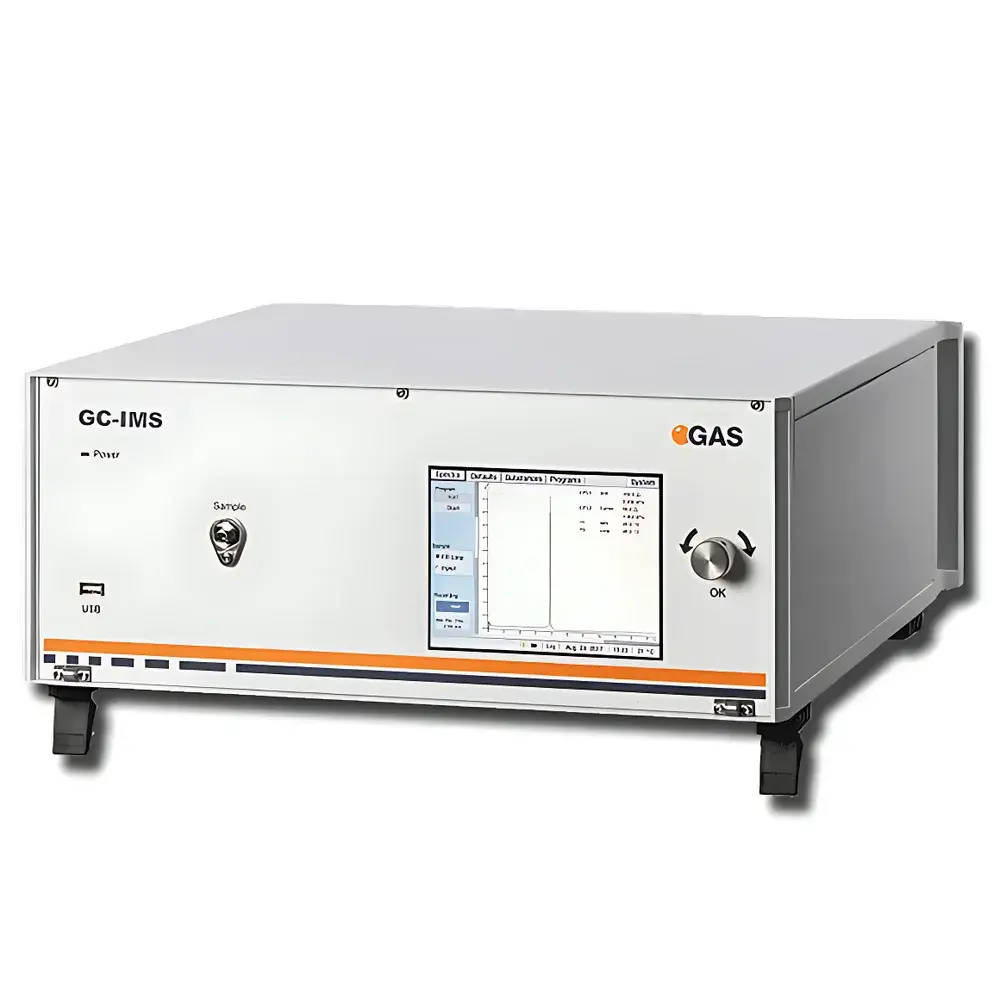
G.A.S. GC-IMS Environmental Gas Analyzer
| Brand | G.A.S. |
|---|---|
| Origin | Germany |
| Model | GC-IMS |
| Detection Limit | <1 ppb (v/v) |
| Sample Introduction | 6-port valve direct injection |
| Library | VOC-specific ion mobility spectral library |
| Operating Mode | Switchable positive/negative ion mode |
| Portability | Field-deployable, battery- and vehicle-power compatible |
| Compliance | Designed for ISO 16000-6, ASTM D5197, US EPA Method TO-15/TO-17 context |
Overview
The G.A.S. GC-IMS Environmental Gas Analyzer is a compact, field-deployable hyphenated analytical platform integrating gas chromatography (GC) with high-resolution ion mobility spectrometry (IMS). It operates on the principle of differential mobility separation—where gaseous analytes are ionized (typically via tritium or UV source), separated in a drift tube under controlled electric field and buffer gas flow, and detected based on their collision cross-section (CCS)-dependent drift time. Coupled with capillary GC pre-separation, the system achieves orthogonal resolution of volatile organic compounds (VOCs) at trace concentrations without cryogenic trapping or thermal desorption preconcentration. This architecture enables real-time, on-site analysis of complex air matrices—including ambient air, industrial emissions, indoor environments, and process streams—with detection limits consistently below 1 ppb (v/v) for key target VOCs such as benzene, formaldehyde, siloxanes, and sulfur-containing odorants.
Key Features
- No vacuum system required: Operates at ambient pressure, eliminating need for pumps, oil maintenance, or vacuum leaks—reducing downtime and total cost of ownership.
- Rapid thermal stabilization: Achieves operational readiness within ≤5 minutes after power-on, suitable for intermittent or emergency deployment.
- Direct gas-phase injection: Supports both manual and automated sampling via 6-port valve; compatible with optional CGFU (Closed Gas Flow Unit) for carrier-gas-free continuous monitoring.
- Dual-polarity operation: Switchable between positive- and negative-ion modes to maximize coverage across compound classes (e.g., aldehydes, amines, nitroaromatics, organophosphates).
- Integrated auto-sampling module: Programmable sampling intervals (1–60 min), synchronized with LAV software-triggered analysis sequences.
- Real-time quantification: Pre-loaded calibration curves enable on-device concentration calculation and immediate display post-run; user-definable alarm thresholds trigger visual/audible alerts upon exceedance.
- Robust mechanical design: IP54-rated enclosure, shock-absorbing chassis, and low-mass components ensure reliable performance during transport and field use—including vehicle-mounted operation.
Sample Compatibility & Compliance
The GC-IMS analyzer accepts undiluted ambient air, headspace vapors, and process gas streams directly—no derivatization, preconcentration, or solvent extraction required. It is validated for use in compliance-critical workflows aligned with ISO 16000-6 (indoor air VOC measurement), ASTM D5197 (ambient air formaldehyde), and US EPA Method TO-15 (summarized VOC screening). While not certified as a Class I Division 2 device, its non-vacuum architecture and low-power electronics meet intrinsic safety prerequisites for many industrial perimeter and wastewater treatment facility applications. Data integrity adheres to ALCOA+ principles; audit trails, electronic signatures, and user-access controls are configurable in LAV software to support GLP/GMP-aligned reporting requirements.
Software & Data Management
The instrument is operated via two core software modules: Laboratory Analytical Viewer (LAV) and GC×IMS Library Search Suite. LAV serves as the primary data acquisition, visualization, and quantitative engine—supporting .mea file import, CSV export, and integration with third-party statistical tools (e.g., R, Python pandas). Its “Reporter” plugin enables pairwise comparison of IMS peak intensities across reference and unknown samples, generating difference heatmaps ideal for source attribution. The “Gallery-Plot” plugin renders multi-sample IMS chromatograms as stacked contour plots, facilitating rapid visual discrimination of VOC profile similarity or divergence—critical for odor source tracing and authenticity verification. Quantitative analysis employs classical external standard calibration; curves are stored onboard and applied automatically during analysis. GC×IMS Library Search combines NIST retention index data with G.A.S.-curated drift time libraries, enabling compound identification with dual-parameter matching (GC retention time + IMS drift time). Users may extend the library via GC×IMS Library Edit, building industry-specific spectral references for long-term method development.
Applications
This platform is engineered for dynamic, unattended VOC monitoring in diverse environmental and industrial contexts: real-time cabin air quality assessment in automotive manufacturing and testing; continuous indoor air surveillance in offices, hospitals, and schools; online detection of silicones (e.g., D4, D5) in biogas upgrading facilities; odorant monitoring (e.g., THT, mercaptans) in natural gas distribution; and fingerprint-based tracking of treatment efficiency in wastewater off-gas streams. It supports regulatory compliance verification (e.g., EU VOC Solvents Directive, China GB/T 18883), product safety validation (e.g., appliance outgassing, food packaging migration), and forensic odor investigations—such as pinpointing emission sources across factory perimeters using spatially resolved IMS profiles.
FAQ
Does the GC-IMS require carrier gas cylinders?
No—when configured with the optional CGFU (Closed Gas Flow Unit), the system recirculates purified drift gas, eliminating dependence on external helium or nitrogen supplies.
Can it quantify VOCs without laboratory calibration standards?
Quantitative accuracy requires initial calibration with certified standards; however, once established, curves are embedded in the instrument firmware and applied autonomously during field operation.
Is the system compliant with FDA 21 CFR Part 11 for electronic records?
LAV software supports configurable audit trails, role-based access control, and electronic signature workflows—enabling Part 11 compliance when deployed within validated IT infrastructure.
What is the typical analysis time for a full VOC screening?
Standard automotive cabin screening (7 regulated compounds) completes in ≤15 minutes; broader profiling (up to 100+ features) may require 20–30 minutes depending on GC temperature ramp and IMS gating frequency.
How is data exported for regulatory reporting?
Raw .mea files and processed .csv exports include full metadata (timestamp, instrument ID, operator, method parameters); LAV-generated reports comply with ISO/IEC 17025 documentation requirements for accredited laboratories.




