
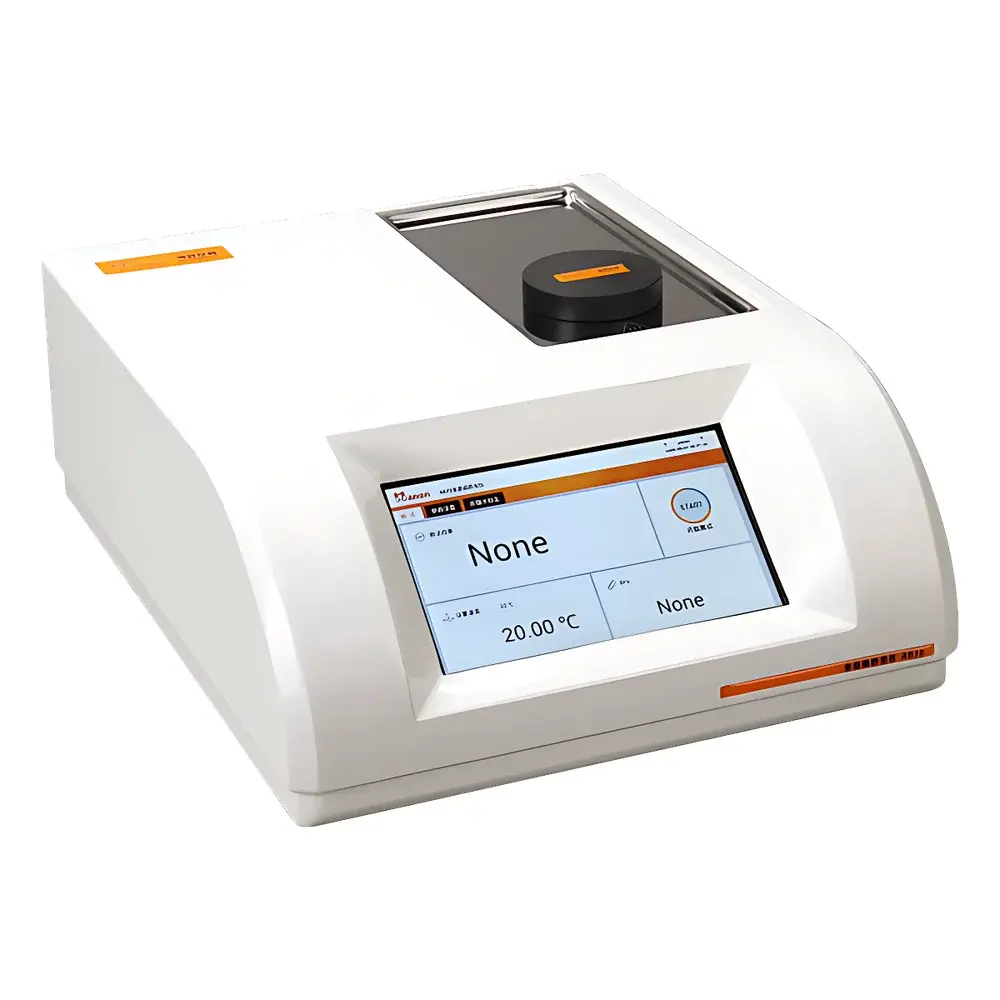
Hanon A670 Automated Digital Refractometer
| Brand | Hanon |
|---|---|
| Model | A670 |
| Type | Benchtop Refractometer |
| Temperature Control | Peltier-based, 5–80 °C (±0.02 °C) |
| Display | 7-inch capacitive touchscreen (Android OS) |
| Measurement Range | 1.30000–1.70000 (nD) |
| Accuracy | ±0.0001 (nD) |
| Resolution | 0.0001 / 0.00001 (nD) selectable |
| Brix Range | 0–100.0% (±0.1%) |
| Light Source | >100,000 hr LED |
| Prism Material | Sapphire-grade optical glass |
| Data Storage | 4 GB internal + USB backup |
| Connectivity | 2× USB, RS232, Ethernet, Wi-Fi (A670 only) |
| Compliance | FDA 21 CFR Part 11 (user roles, audit trail, electronic signature, data integrity) |
Overview
The Hanon A670 Automated Digital Refractometer is a precision benchtop instrument engineered for high-accuracy refractive index (nD) and Brix measurements in regulated and research-intensive laboratory environments. It operates on the principle of total internal reflection at the sample-prism interface, with automated critical angle detection enabled by a high-resolution CCD sensor array and stabilized monochromatic LED illumination (589.3 nm equivalent). Unlike manual or analog refractometers, the A670 eliminates operator-dependent variability through fully automated optical alignment, temperature equilibration, and signal processing—ensuring traceable, repeatable results across diverse liquid matrices. Its integrated Peltier thermoelectric system maintains sample temperature within ±0.02 °C over a controlled range of 5–80 °C, satisfying stringent thermal stability requirements for ISO 21744, ASTM D1218, and USP refractometry protocols.
Key Features
- High-stability sapphire-grade prism: Chemically inert, scratch-resistant, and compatible with aggressive solvents, acids, and viscous samples—designed for >100,000 cleaning cycles without performance degradation.
- Precision Peltier temperature control: Delivers rapid thermal equilibration (<90 s from 20 °C to 40 °C), uniform heat distribution across the measurement cell, and real-time temperature monitoring with 0.01 °C display resolution.
- Advanced optical architecture: 5-megapixel CCD detector coupled with collimated LED light source (lifetime >100,000 hours) enables robust signal-to-noise ratio even for deeply colored, turbid, or high-viscosity liquids (e.g., crude oils, syrups, polymer solutions).
- Regulatory-compliant embedded software: Fully compliant with FDA 21 CFR Part 11—featuring four-tier user role management (Administrator, Supervisor, Operator, IT), mandatory password complexity policies, session timeout with screen lock, and immutable audit trail logging all instrument interactions including timestamp, user ID, parameter changes, and result exports.
- Flexible data handling: 4 GB onboard storage supports ≥500,000 measurement records; dual USB ports enable direct U-disk backup/restore; Ethernet and Wi-Fi (A670 only) allow secure network integration with LIMS or ELN systems.
- Customizable calculation engine: Built-in formula editor supports multi-segment piecewise functions for non-linear Brix-to-concentration conversion, density correction, or proprietary quality indices per ASTM D4052 or ISO 12185 workflows.
Sample Compatibility & Compliance
The A670 accommodates transparent, translucent, opaque, and highly viscous liquid samples—including hydrocarbons, glycerol-based formulations, pharmaceutical suspensions, fruit concentrates, and edible oils—without dilution or filtration. Its wide nD range (1.30000–1.70000) and Brix capability (0–100.0%) meet method requirements across multiple international standards: ASTM D1218 (petroleum products), ISO 21744 (food and beverage), USP (pharmaceutical excipients), and AOAC 932.12 (sugar analysis). Temperature calibration against distilled water at 20 °C, 25 °C, and 40 °C ensures metrological traceability to NIST-traceable reference materials. All firmware and calibration logs are digitally signed and cryptographically hashed to prevent post-acquisition modification—fulfilling ALCOA+ (Attributable, Legible, Contemporaneous, Original, Accurate, Complete, Consistent, Enduring, Available) data integrity criteria.
Software & Data Management
Running on a certified Android-based embedded OS, the A670’s interface supports tri-language operation (English, Chinese, Russian) and features intuitive gesture navigation, context-sensitive help, and one-touch measurement initiation. Raw and processed data—including nD, Brix, temperature, operator ID, and audit metadata—are stored in encrypted SQLite databases. Export formats include CSV (for Excel/SPC analysis), PDF reports (with digital signature and timestamp), and XML (for LIMS ingestion). Audit trails record every action: login/logout events, calibration executions, method modifications, and result deletions—retained indefinitely unless archived externally. Data export requires supervisor-level approval when configured under GxP mode, enforcing separation of duties per ICH GCP and EU Annex 11.
Applications
- Pharmaceutical QC: Excipient concentration verification (e.g., propylene glycol, glycerin), syrup formulation consistency, and solvent purity checks per USP monographs.
- Food & Beverage: Brix standardization in juice, honey, and dairy processing; sugar recovery optimization in beet/cane refining; alcohol content estimation via refractive index correlation.
- Petrochemical QA: Hydrocarbon blend verification, lubricant base oil classification, and biodiesel (FAME) content assessment per EN 14214.
- Chemical R&D: Polymer solution concentration monitoring, surfactant micelle formation studies, and reaction endpoint detection in condensation syntheses.
- Academic Research: Teaching optical property fundamentals, developing custom calibration models, and validating AI-driven predictive analytics for compositional analysis.
FAQ
Does the A670 support GLP/GMP-compliant data archiving?
Yes—the instrument generates immutable audit trails, enforces user authentication with role-based permissions, and stores all raw data with cryptographic hashing to ensure data integrity and regulatory readiness for FDA, EMA, or PMDA inspections.
Can the sapphire prism be cleaned with acetone or chloroform?
Yes—sapphire-grade optical glass is chemically resistant to common organic solvents, strong acids (e.g., HNO3, H2SO4), and caustic bases, enabling rigorous decontamination between high-risk samples.
Is temperature calibration traceable to national standards?
Calibration uses NIST-traceable distilled water reference points at 20 °C, 25 °C, and 40 °C; certificate of calibration includes uncertainty budget per ISO/IEC 17025 requirements.
How is data security maintained during network transmission?
Wi-Fi and Ethernet connections support WPA2-Enterprise authentication and TLS 1.2 encryption; all remote data transfers require authenticated API keys or client-certificate validation.
What is the service life expectancy of the LED light source?
Rated minimum operational lifetime is 100,000 hours under continuous use at nominal current—equivalent to >11 years of 24/7 operation—with luminance decay <5% over that period.




