
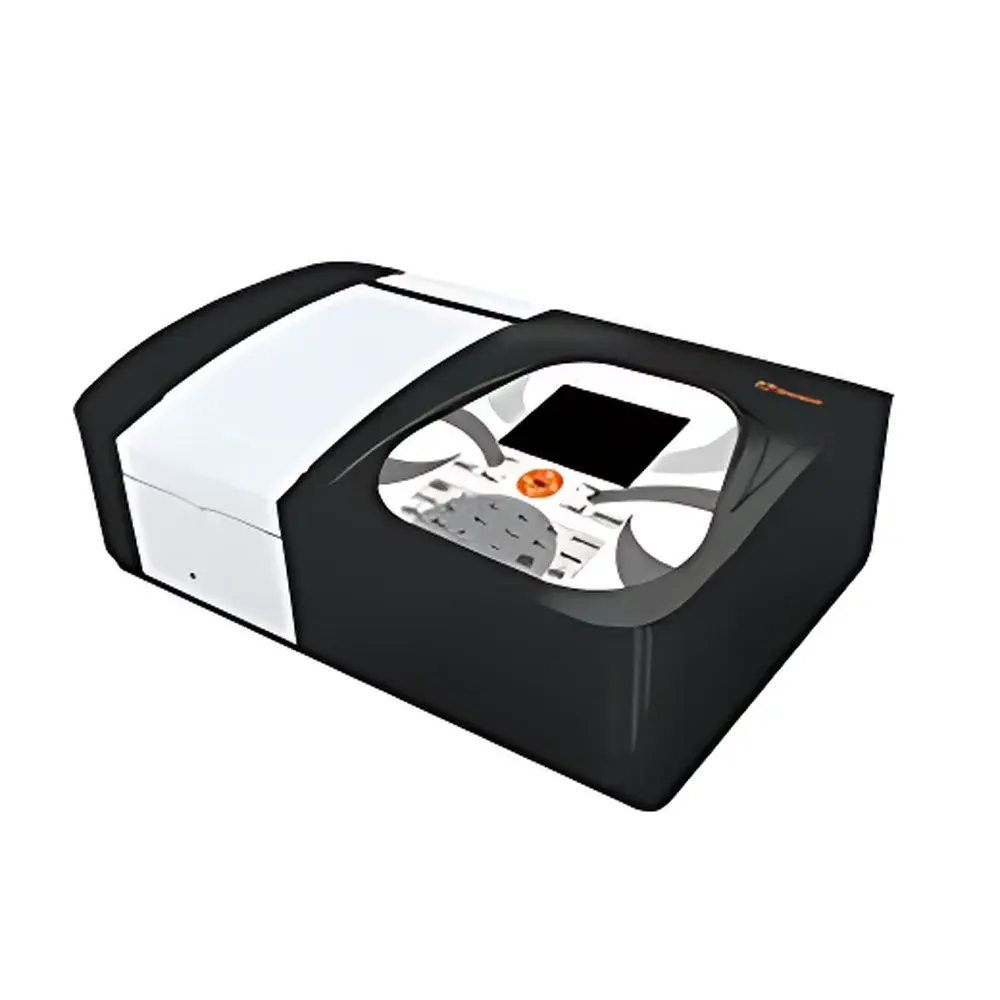
Hanon i6 Ultraviolet-Visible Spectrophotometer
| Brand | Hanon |
|---|---|
| Origin | Shandong, China |
| Model | i6 |
| Optical Design | Double-beam |
| Detector Type | Photodiode Array (PDA) |
| Wavelength Range | 190–1100 nm |
| Wavelength Accuracy | ±0.1 nm at D₂ line (656.1 nm), ±0.3 nm across full range |
| Wavelength Repeatability | ≤0.1 nm |
| Spectral Bandwidth | 0.5 / 1 / 2 / 4 / 5.0 nm (selectable) |
| Stray Light | ≤0.03% T |
| Photometric Accuracy | ±0.2% T |
| Photometric Repeatability | ±0.15% T |
| Baseline Flatness | ±0.001 A |
| Drift | ≤0.001 A/h at 500 nm |
| Noise Level | ≤0.0005 A |
| Photometric Range | 0–200% T, –4.0 to +4.0 A, 0–9999 C |
| Wavelength Setting | Automatic |
| Scan Speed | High/Medium/Low (3-step selectable) |
| A/D Resolution | 24-bit |
| Display | 320 × 240 LCD |
| Light Sources | Imported deuterium lamp & tungsten-halogen lamp |
| Power Supply | AC 220 V/50 Hz or 110 V/60 Hz |
| Dimensions | 470 × 370 × 180 mm |
| Weight | 20 kg |
Overview
The Hanon i6 Ultraviolet-Visible Spectrophotometer is a double-beam, microprocessor-controlled analytical instrument engineered for precision absorbance, transmittance, and concentration measurements across the ultraviolet, visible, and near-infrared spectral regions (190–1100 nm). Its optical architecture employs a high-stability dual-beam configuration with real-time reference beam compensation, minimizing drift and enhancing measurement reproducibility in routine QC, academic research, and method development environments. The system utilizes a photodiode array (PDA) detector for rapid spectral acquisition without mechanical scanning, enabling high-speed full-spectrum capture and improved signal-to-noise ratio. Core optical components—including the deuterium and tungsten-halogen light sources—are sourced from internationally certified suppliers, ensuring long-term spectral stability and radiometric consistency. The i6 adheres to fundamental photometric principles defined in ISO 6223, ASTM E275, and USP , supporting traceable calibration and regulatory-compliant operation.
Key Features
- Double-beam optical path with real-time background correction for enhanced baseline stability and reduced environmental sensitivity
- Suspended optical assembly mounted on reinforced baseplate—mechanically isolates the spectrometer core from external vibration and thermal deformation
- 24-bit high-resolution analog-to-digital conversion for extended dynamic range and improved low-absorbance detection capability
- Selectably adjustable spectral bandwidth (0.5, 1, 2, 4, or 5.0 nm) to optimize resolution vs. signal intensity trade-offs per application
- Automatic wavelength calibration using built-in deuterium and tungsten reference lines; supports user-initiated validation per ISO 17025 internal verification protocols
- Integrated large-format LCD (320 × 240 pixels) with intuitive menu navigation—enables standalone operation without PC connection
- Three-step scan speed selection (high/medium/low) for balancing acquisition time, spectral fidelity, and noise performance
- Comprehensive onboard functionality: photometric mode, quantitative analysis (single/multi-point calibration), kinetic assay, spectral scanning, multi-wavelength analysis, and nucleic acid/protein quantification (A₂₆₀/A₂₈₀)
Sample Compatibility & Compliance
The i6 accommodates standard 10-mm rectangular cuvettes (glass, quartz, or plastic), as well as optional micro-volume adapters and flow cells for specialized applications. Its optical design supports both transmission and reflectance measurements (with optional accessories). The instrument meets essential performance criteria outlined in ISO 9001 quality management systems and is suitable for laboratories operating under GLP or GMP frameworks. While not pre-certified for FDA 21 CFR Part 11, its data integrity features—including timestamped audit trails, password-protected method storage, and non-editable raw data export via USB—facilitate alignment with electronic record requirements during internal validation. All photometric accuracy and stray light specifications comply with ICH Q2(R2) guidelines for analytical instrument qualification.
Software & Data Management
The i6 is compatible with Hanon’s proprietary PC-based software suite, which provides advanced spectral processing, derivative analysis, peak identification, and customizable report generation. Raw data are stored in ASCII-compatible formats (.txt, .csv) for seamless integration into LIMS or third-party statistical platforms (e.g., JMP, OriginLab). The software supports method templates compliant with SOP-driven workflows and includes built-in tools for Beer-Lambert law validation, linearity assessment (r² ≥ 0.999), and limit-of-detection estimation. USB 2.0 interface ensures reliable firmware updates and secure data transfer without reliance on legacy parallel ports. All measurement logs include metadata (operator ID, date/time stamp, lamp hours, wavelength settings, slit width), fulfilling traceability requirements for ISO/IEC 17025 accreditation.
Applications
- Quantitative determination of active pharmaceutical ingredients (APIs) and excipients per USP/EP monographs
- Enzyme kinetics and ligand-binding assays requiring high-temporal-resolution absorbance monitoring
- Quality control of dyes, pigments, and colorants in chemical manufacturing
- DNA/RNA purity assessment (A₂₆₀/A₂₈₀ and A₂₆₀/A₂₃₀ ratios) and protein concentration calculation using Bradford/Lowry/Biuret methods
- Water and wastewater analysis—including nitrate, phosphate, and heavy metal speciation via colorimetric derivatization
- Educational laboratory instruction for foundational spectroscopic theory and experimental validation
FAQ
What wavelength calibration standards are supported by the i6?
The i6 performs automatic wavelength verification using the intrinsic emission peaks of the deuterium lamp (656.1 nm) and tungsten lamp (multiple visible lines); users may also employ NIST-traceable holmium oxide or didymium filters for external validation.
Can the i6 be integrated into an automated lab workflow?
Yes—the instrument supports RS-232 and USB virtual COM port communication protocols, enabling remote command execution (e.g., START SCAN, READ ABS) via LabVIEW, Python, or custom SCADA interfaces.
Is the photodiode array detector cooled?
No—the PDA operates at ambient temperature; however, its low dark-current design and 24-bit digitization mitigate thermal noise sufficiently for routine analytical workloads.
How often should the deuterium and tungsten lamps be replaced?
Typical lamp lifetimes are 2,000 hours for deuterium and 5,000 hours for tungsten; the software tracks cumulative lamp-on time and issues configurable alerts prior to end-of-life.
Does the i6 support compliance with pharmacopeial methods?
Yes—it meets the instrumental performance requirements specified in USP , EP 2.2.25, and JP 2.05 for UV-Vis spectrophotometers used in compendial testing.




