
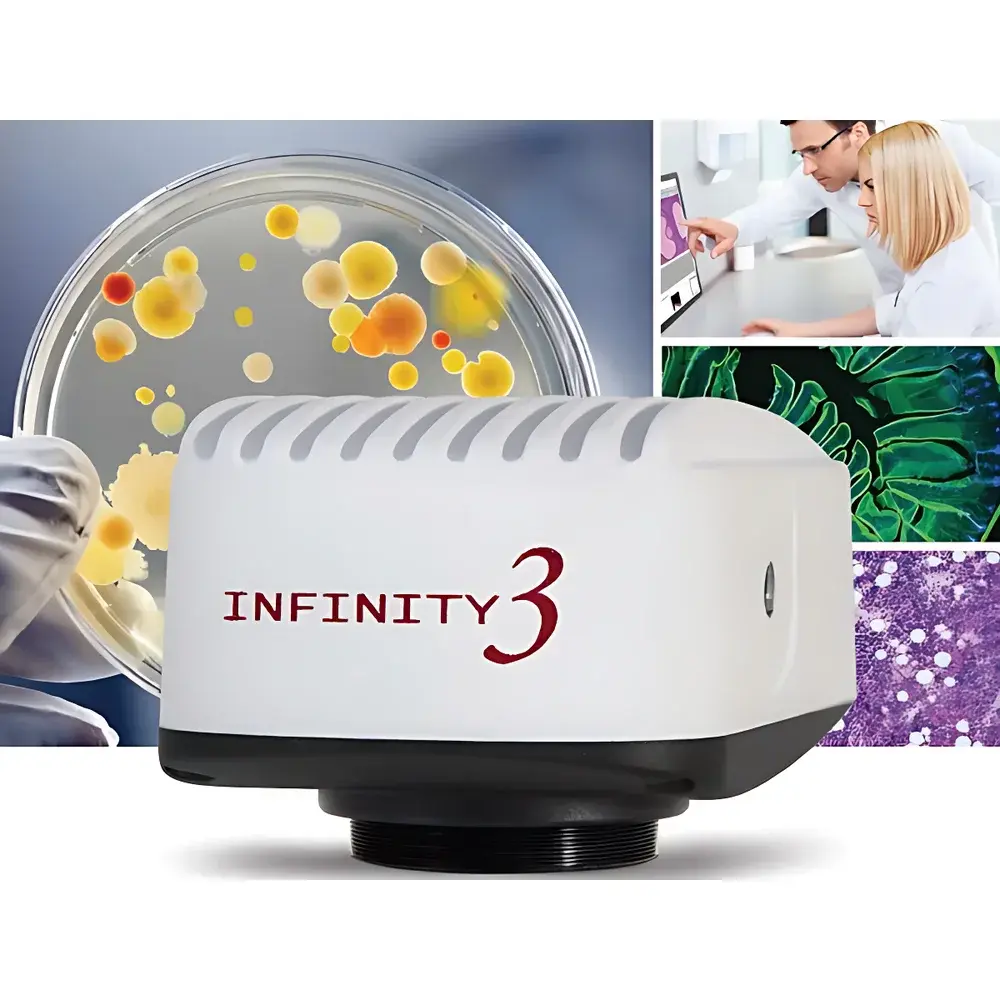
Teledyne Lumenera INFINITY Series Microscopy Cameras
| Brand | Teledyne Lumenera |
|---|---|
| Origin | Canada |
| Model | INFINITY |
| Image Resolution | 2752 × 2192 |
| Pixel Size | 6.5 µm |
| Sensor Format | 1″ |
| Frame Rate | 27 fps |
| Dynamic Range | 16-bit |
| Quantum Efficiency | 95% |
| Interface | USB 3.1 |
| Monochrome/Color | Selectable |
Overview
The Teledyne Lumenera INFINITY Series represents a family of high-performance digital microscopy cameras engineered for precision life science, materials research, and industrial inspection applications. Built on advanced CMOS and high-sensitivity CCD sensor architectures, the INFINITY platform delivers exceptional image fidelity, low-noise performance, and real-time acquisition capabilities essential for quantitative microscopy workflows. These cameras operate on the principle of digital photon capture—converting incident light from microscope optical paths into calibrated, spatially resolved digital signals—with particular emphasis on preserving signal-to-noise ratio (SNR) across varying illumination conditions. Designed for integration with upright, inverted, and stereo microscopes via standard C-mount interfaces, the INFINITY series supports both transmitted and reflected light modalities—including brightfield, phase contrast, DIC, fluorescence, and darkfield imaging. Its modular architecture enables seamless compatibility with major microscope brands and third-party automation platforms, making it suitable for routine quality control, academic research, and regulated production environments.
Key Features
- High quantum efficiency (up to 95%) ensures superior photon capture efficiency—critical for low-light fluorescence and time-lapse imaging.
- 16-bit dynamic range enables precise quantification of intensity gradients without saturation or shadow clipping.
- Large-format 1″ CMOS sensors (e.g., INFINITY3-6UR and INFINITY5-5) provide extended field-of-view coverage while maintaining pixel-level resolution integrity.
- USB 3.1 interface guarantees sustained high-bandwidth data transfer, supporting full-resolution streaming at up to 27 fps (INFINITY3-6UR) or 75 fps (INFINITY5-5) without frame dropping.
- Hardware-based binning, region-of-interest (ROI) selection, and programmable exposure control allow optimization for speed, sensitivity, or resolution based on application requirements.
- Thermally stable sensor design minimizes dark current drift during extended acquisitions—essential for long-duration timelapse or multi-channel fluorescence experiments.
- Onboard FPGA processing enables real-time image enhancement, including flat-field correction, background subtraction, and gamma adjustment—reducing post-acquisition computational load.
Sample Compatibility & Compliance
The INFINITY Series is compatible with a broad spectrum of sample types—from live-cell cultures and tissue sections to metallurgical specimens and semiconductor wafers. Its adjustable gain, exposure time, and white balance settings accommodate diverse optical configurations and staining protocols. All models comply with CE, FCC, and RoHS directives. When deployed in regulated environments (e.g., ISO 13485-certified medical device manufacturing or GLP-compliant preclinical labs), the cameras support audit-ready metadata embedding—including timestamp, exposure parameters, lens ID, and user-defined annotations—ensuring traceability per FDA 21 CFR Part 11 requirements when used with compliant software platforms.
Software & Data Management
Teledyne Lumenera provides the INFINITY ANALYZE and INFINITY CAPTURE software suites, offering intuitive acquisition control, measurement tools (area, intensity profiling, particle counting), and batch export functionality. Both applications support TIFF, PNG, JPEG, and raw 16-bit formats, with optional HDF5 output for large-scale dataset interoperability. SDKs (C/C++, Python, MATLAB, .NET) enable custom integration into LabVIEW, Micro-Manager, or proprietary analysis pipelines. Metadata adheres to EMBO Digital Imaging Guidelines and is embeddable in OME-TIFF containers for FAIR (Findable, Accessible, Interoperable, Reusable) data management practices.
Applications
- Live-cell imaging and calcium flux monitoring requiring high temporal fidelity and low phototoxicity.
- Automated pathology slide scanning and digital cytology where color accuracy and spatial linearity are critical.
- Materials characterization—including grain boundary analysis, coating uniformity assessment, and defect detection in additive manufacturing.
- Educational microscopy labs needing robust, maintenance-free imaging solutions with consistent calibration across instrument fleets.
- Regulatory documentation workflows in pharmaceutical QC, where image provenance and repeatability must meet ISO/IEC 17025 or USP standards.
FAQ
What sensor technology does the INFINITY3-6UR use?
It employs a global-shutter, back-illuminated CMOS sensor with 1″ optical format and 6.5 µm pixels.
Is the camera compatible with Windows, macOS, and Linux?
Yes—native drivers and SDKs are provided for all three operating systems.
Can I synchronize multiple INFINITY cameras for stereo or multi-angle imaging?
Hardware triggering via TTL input/output ports supports precise inter-camera synchronization with sub-millisecond jitter.
Does the camera support hardware binning?
Yes—2×2 and 4×4 hardware binning modes are available to enhance SNR at the expense of spatial resolution.
How is calibration maintained across different microscope objectives?
Pixel calibration (µm/pixel) is stored per objective in the software profile and automatically applied during measurement mode.




