
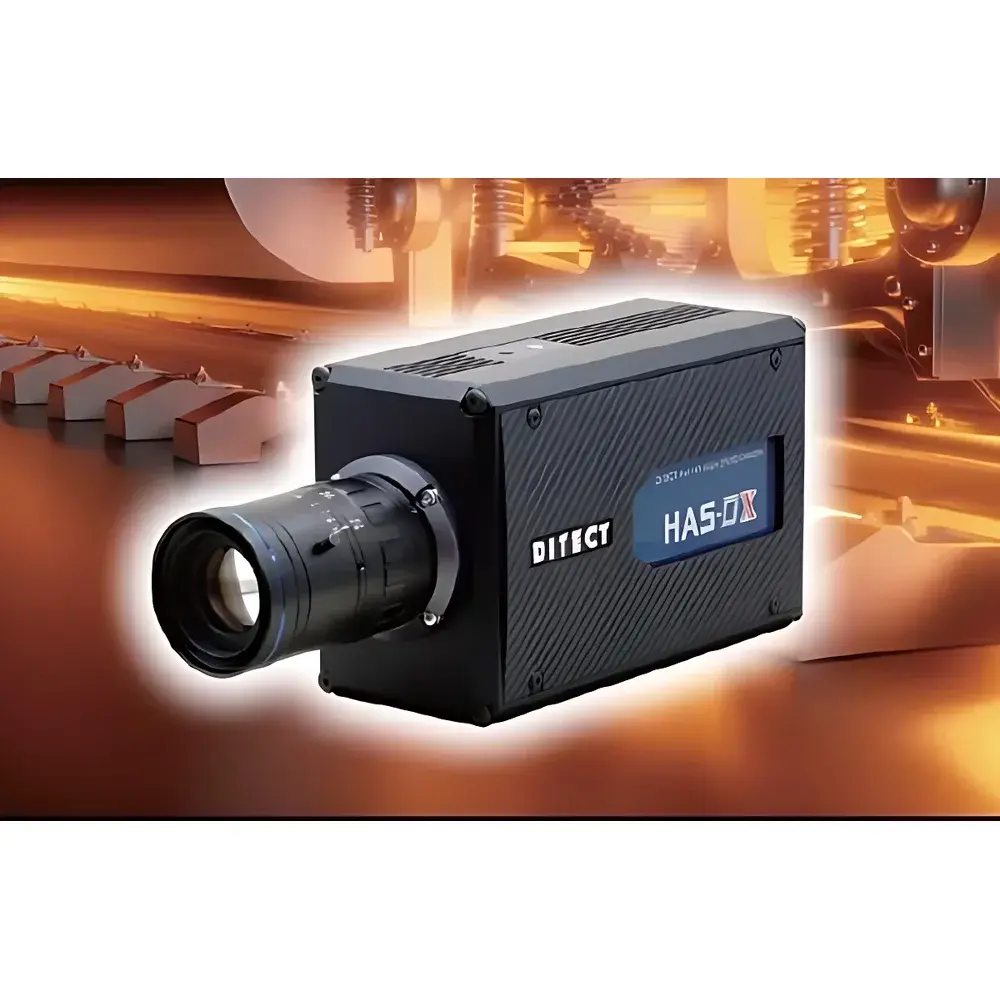
DITECT HAS-DX High-Speed High-Resolution CMOS Camera
| Brand | DITECT |
|---|---|
| Origin | Japan |
| Model | HAS-DX |
| Resolution | 1920 × 1080 (Full HD, 2 MP) |
| Maximum Frame Rate | 100,000 fps (at reduced ROI) |
| Standard Frame Rate | 2,000 fps (at full resolution) |
| Interface | USB 3.0 |
| Pixel Size | 5.86 µm |
| Sensor Type | Global Shutter CMOS |
| Compliance | CE, RoHS |
| Operating System Support | Windows 10/11 (64-bit), Linux (SDK available) |
Overview
The DITECT HAS-DX is a high-performance, global-shutter CMOS-based high-speed imaging system engineered for quantitative dynamic optical measurement in research and industrial environments. Built upon a scientific-grade monochrome or color CMOS sensor with native Full HD (1920 × 1080) resolution, the HAS-DX delivers exceptional temporal fidelity and spatial clarity for time-resolved visualization of rapid physical phenomena. Its core architecture leverages a high-bandwidth USB 3.0 interface to sustain sustained data throughput—enabling real-time acquisition at up to 2,000 frames per second (fps) at full resolution, and up to 100,000 fps at region-of-interest (ROI)-based subsampling. This performance envelope positions the HAS-DX as a validated tool for applications requiring precise synchronization, minimal motion blur, and high signal-to-noise ratio under pulsed or continuous illumination—particularly where frame-accurate timing and pixel-level radiometric consistency are critical.
Key Features
- Global shutter CMOS sensor with 5.86 µm pixel pitch ensures zero rolling-shutter distortion, essential for accurate velocity vector mapping and synchronized multi-camera setups.
- Native Full HD resolution (1920 × 1080) at 2,000 fps enables high-fidelity capture of transient events without interpolation artifacts or spatial downscaling compromises.
- Flexible ROI cropping allows frame rate scaling up to 100,000 fps while preserving sub-microsecond exposure control and deterministic trigger latency (< 1 µs jitter).
- USB 3.0 Vision-compliant interface eliminates the need for proprietary frame grabbers; supports plug-and-play integration with standard industrial PCs and laptops.
- Onboard memory buffer (up to 16 GB DDR4) enables extended burst acquisition—critical for capturing unpredictable transient events such as shockwave propagation or droplet impact dynamics.
- Hardware-triggered external sync (TTL-compatible) and programmable GPIO support enable seamless integration into multi-sensor test benches, including laser sheet synchronization for PIV and stereo-DIC configurations.
Sample Compatibility & Compliance
The HAS-DX is optimized for use with standard C-mount and CS-mount lenses, supporting focal lengths from 6 mm to 100 mm depending on working distance and field-of-view requirements. It operates effectively under both continuous broadband illumination and pulsed laser illumination (e.g., Nd:YAG, diode-pumped solid-state lasers), with adjustable exposure times ranging from 100 ns to 10 s. The camera complies with CE marking directives for electromagnetic compatibility (EMC Directive 2014/30/EU) and low-voltage safety (LVD Directive 2014/35/EU), and conforms to RoHS 2011/65/EU restrictions on hazardous substances. While not certified for medical or aerospace-specific standards, its design aligns with general laboratory instrumentation requirements under ISO/IEC 17025-accredited testing environments when used with traceable calibration sources.
Software & Data Management
The HAS-DX is supported by DITECT’s proprietary acquisition software suite—HAS Capture Studio—which provides real-time preview, histogram-based exposure optimization, non-uniformity correction (NUC), and lossless 12-bit TIFF/RAW export. An open-source SDK (C/C++, Python bindings) enables custom integration with MATLAB, LabVIEW, or Python-based analysis pipelines—including OpenCV, scikit-image, and PyPIV for particle image velocimetry workflows. All acquired datasets include embedded metadata (timestamp, exposure, gain, trigger status, lens ID), facilitating audit-ready documentation. While the system does not natively implement FDA 21 CFR Part 11 electronic signature or audit trail features, raw data export formats are fully compatible with third-party LIMS and ELN platforms that enforce GLP/GMP-compliant data governance policies.
Applications
- Stereo particle image velocimetry (stereo-PIV) for 3D velocity vector field reconstruction in wind tunnels, combustion chambers, and microfluidic devices.
- Digital image correlation (DIC) for full-field strain and displacement mapping during high-strain-rate mechanical testing (e.g., Hopkinson bar experiments).
- Ballistics and impact dynamics analysis—including projectile deformation, fragmentation, and shock front propagation.
- Fluid-structure interaction (FSI) studies involving flexible membranes, flapping wings, or vortex-induced vibrations.
- Industrial process monitoring—such as high-speed printing, wire bonding, or automated solder-joint inspection—where sub-millisecond event resolution is required.
- Biomechanics research, including insect flight kinematics, muscle contraction dynamics, and vocal fold vibration analysis.
FAQ
What is the maximum sustained frame rate at full resolution?
The HAS-DX achieves 2,000 fps at native 1920 × 1080 resolution with full 12-bit depth and no pixel binning.
Does the camera support external hardware triggering?
Yes—TTL-compatible trigger input/output ports provide sub-microsecond timing accuracy for synchronization with lasers, motion stages, or other high-speed sensors.
Is SDK support available for custom software development?
Yes—DITECT provides documented C/C++ and Python APIs, including source examples for real-time streaming, ROI configuration, and metadata parsing.
Can the HAS-DX be used in vacuum or extreme temperature environments?
No—the device is rated for operation within 0–40 °C ambient temperature and standard atmospheric pressure; environmental enclosures must be externally provided.
What lens mount options are supported?
The HAS-DX features a standard C-mount interface; CS-mount lenses may be used with a 5 mm adapter ring.






